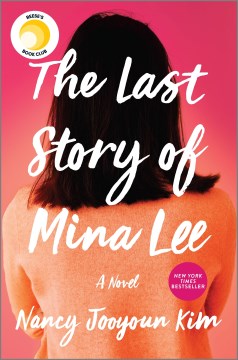
This last month I have had a lot more enquiries about the Book Club. Not drawn by the book, The Last Story of Mina Lee by Nancy Jooyoun Kim, but interested in participating. We had sixteen people present at our meeting, two brand new participants, in addition to a couple of members who responded by email. Everyone spoke and in our brief hour we had an amazing discussion. The connections that we make are what I appreciate most about our book club – connections with books, with each other, with the past and the future, with people we may never know but whose lives we may impact through our heightened understanding of the world and informed action throughout our lives. Talk about the circle of life!
Our first responder immigrated from Mexico to the Los Angeles area when he was eight years old and has been excited by the many books we have read this year taking place in locations familiar to him—from The Library Book (September), Clark and Division (November), All In (June), and now The Last Story of Mina Lee. One of us remarked that just the mention of so many Korean comfort foods would be moving to readers who recognized them. I had been inspired to visit an Asian market and put out sand pears, Asian apples, Korean melons, kimchi-flavored ramen packages, kimchi-flavored seaweed snacks, and cans of rice punch for people to take home. I also found a Seoul Food Korean Cookbook in the library that helped me understand the ingredients and effort involved in making kimchi. Another member had enjoyed looking up the various foods mentioned, particularly noting the unusual double J in jjigae (a popular Korean stew).
We wondered that Mina was more interested in learning Spanish than English. We recognized that it is harder for adults to learn a foreign language and easier to connect with other immigrants—less threatening or embarrassing to struggle with language in front of them. One of us had a dear friend who immigrated from Syria, without knowing any English. Her friend struggled terribly and watching American soap operas on television helped. Another of us likes to watch Spanish telenovelas because it is easier to understand what is going on, even if you don’t understand all of the words. Then another member said that we were dating ourselves; now we have technology and Google Translate! Which brought on a discussion of the reliability of technology: GPS that leads you to a dead end or bad translations that at best make no sense.
We were incredulous that a child could be raised by a mother who spoke no English and yet not speak the mother’s native language. I watched an interview in which the author, Nancy Jooyoun Kim, said that her own mother could not speak English and she used Google Translate to have more complex conversations than toddler speak. The author believes that, like Margot and Mina, because her mother worked so much and they had no other family around also speaking Korean, once she reached school age, she became focused on perfecting English, which for her meant NOT learning Korean.[1]
One of us hadn’t yet finished the book, but she particularly appreciated the dynamic of the mother-daughter relationship. Her mother is also an immigrant and she has such a close relationship with her that she could not imagine how Margot could be so disparaging of Mina. This led to a brief discussion about how the children of immigrants want to distance themselves from their parents in order to assimilate. Some of us felt that allteenagers are like that! But Margot was no longer a teenager. An email responder considered Margot a “spoiled brat,” and several members agreed.
A new member found a lot of problems with the story. She considered Margot an unlikeable plastic character. She didn’t think the crime mystery was necessary and she wanted more detailed descriptions. She felt the timeframe was unrealistic, three months from arrival to Mina’s pregnancy, and then Mr. Park shot on Christmas Eve, eaten by animals, and found on Christmas Day. Many of us did like the mystery and we discussed the likelihood that Margot would have forgiven Mrs. Baek. Margot understood that there was no malice, it really was an accident. One member liked the book up until the end; so again, the story didn’t work for everyone. Still another of us shook her head and said that the whole book was a tragedy. Mina’s life, the struggles of immigrants, the Los Angeles riots that ruined many more businesses than just Mina’s.
And then one of us said that the real tragedy was the lack of communication. How could Mina and Margot sit at dinner together as described and not talk? Which brings us back to a previous comment that there is a difference between loneliness and being alone. I did not mention it at the meeting, but I particularly like Mina’s question: “Would Margot ever realize that when Mina said she was bored, she was trying to say that she was lonely?” Was Mina afraid to show and accept love because she believed she lost everything she loved? One of us read a quote from Mina’s visit to the Grand Canyon: “Beauty was safety. Beauty kept us from harm.” This reminded him of Keats’ poem, Ode on a Grecian Urn: “Beauty is truth, truth beauty,—that is all Ye know on earth, and all ye need to know.”[2]
We ended the discussion wondering why Mina did not tell Mr. Kim he had a daughter. We all wanted to know and the majority of us felt that, particularly because he was dying, he should have been told. This seems crucial. In the interview I watched, the author acknowledged shame as a powerful motivator. Mr. Kim was married. Mina had wondered about being faithful to her deceased husband. Even though we believe that we are more open-minded now, one member stressed that silent judgement against single mothers still exists. One of us shared that when her father died, the secrets that came to light were shocking. People are so much more complex than what they present to their families, or to the world.
And we are both the individual and the community, a little more connected because we’ve experienced the same book. Thanks for reading and discussing with us.
- Other Works Discussed:
- All In: an autobiography (2021) by Billie Jean King
- Clark and Division (2021) by Naomi Hirahara
- Clock Dance (2018) by Anne Tyler
- I Am the Subway (2021) by Kim, Hyo-ŭn – a bestselling Korean picture book translated by Deborah Smith
- Kimchi, Kimchi Every Day (2022) Korean-American author-illustrator Erica Kim shares her pride in her delicious cultural food through her cut paper art technique.
- The Library Book (2018) by Susan Orlean
- Pachinko (2017) by Min Jin Lee
- Seoul Food Korean Cookbook: Korean Cooking From Kimchi and Bibimbap to Fried Chicken and Bingsoo (2015) by Imatome-Yun, Naomi
- Speak, Okinawa: a memoir (2021) by Elizabeth Miki Brina
- The Wangs vs. The World (2016) by Jade Chang
[1] The Gloss Book Club. June 30, 2022. Web accessed 7/10/2023. https://www.youtube.com/watch?v=LCenkA5YkAY
[2] https://www.poetryfoundation.org/poems/44477/ode-on-a-grecian-urn
 WhitneyBookBistro
From MR: Not exactly a page turner but I did learn about the trials of Asian immigrants. Very timely topic.
The alternating between present and past was annoying and ended up making the story longer than necessary.
We didn’t find out until the very end how Mina died and who killed her.
Margot was a spoiled brat. Mina was devoted to her and the love was not returned.
Mr Kim gave Mina the love and attention she craved. He was kind and soft spoken. I thought his marital arrangement was strange. I think they both loved each other. Mr. Kim had to leave or Mr. Park would have made his life miserable. The immigrants had no legal recourse if they didn’t have papers and Mr. Park knew it. Right vs. wrong is not always black & white. That’s why Margot didn’t press charges against Mrs. Baek.
Mina didn’t tell Margot about her relationship with Mr. Kim and vice versa. I think that was sad. They deserved to know each other.
Even in Koreatown we see privileged people abusing their own.
Food was a very important element in the story but listening to the audio version I could not understand what they were eating.