Little Fires Everywhere by Celeste Ng was easy to read but challenged us all in different ways. The novel starts provocatively, with a house burning down, a disheveled and stunned parent, and oddly placid children. Would we have kept reading without this teaser?
We got off to a slowish start. Our first responder made us chuckle because she found it 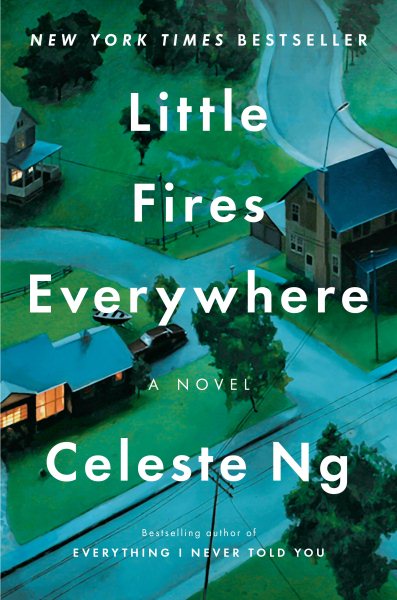 easy to read and it seemed familiar – then she realized she had seen the television series! Although she remembered some of the major plot points, she had forgotten enough to stay interested. Our next responder found it twisty, like Big Little Lies by Liane Moriarty, and she wanted to read the book before watching the series. This led to a discussion of race because the actors for Mia and Pearl in the series are black. The author was vague about the race of Mia and Pearl, which leaves it open for discussion. One of us had thought Mia was Asian, which would lend more authority to the characters because the author’s parents are Chinese immigrants and she grew up in Shaker Heights.
As we continued sharing back and forth across and around the table, we were a little more critical about the story development. Easy to read but a bit slow. Forgettable. Stereotypical. We still liked it though! It was unbelievable that the friend at the abortion clinic would so adamantly refuse to give in to Mrs. Richardson’s demands and then would leave her alone in the room anyway. One of us commented about how common it is in police dramas for files to be left available for people to discover. Pearl was a teenager looking to fit in, would she have stood up to Lexie about using her name? Why didn’t the McCullough family have an alarm. How did Bebe afford the airfare? Don’t American courts always side with the birth mother? Wouldn’t social services try to find the mother who abandoned a baby before adopting it out?
One of us commented on how few men were in this book. A new member said she considered the main theme to be the journey of motherhood, about everyone trying their best. Another member felt there were no villains, but it seemed to me that the majority of us found Mrs. Richardson filled that role. One of us had even been reminded of her while watching the series Monster because of references to serial killer Ed Gein’s mother. Some of us wanted Mrs. Richardson to see the error of her ways. We wanted comeuppance. We want a sequel. Another member said she really liked the book, maybe more than all of us – “Aren’t people just like this?”
Why did Izzy set the fires? To punish her siblings? I think we all agreed with one of us who said that Izzy was setting the fires not just to punish her siblings but to give them a clean slate. As Mia told Izzy, “. . . after the burning the soil is richer, and new things can grow.” (pg. 295) Did Izzy ever find Mia?
Most of us seemed fascinated by Mia’s art. She could have made a lot of money. She had the contacts and the talent. Although we didn’t discuss this much, I know that several of us would like to see Mia’s art. I would watch the series just to see how they pictured it. One of us is a tie-dye artist and remembers seeing one of his designs from a distance, displayed at First Friday downtown Las Vegas. “Wow.” I imagine it as jaw-dropping and awe-inspiring. I would like to see that, too.
I read comments by an absent member, describing each character in the book as an individual character trait. See the comments for details. This enabled me to see the book a bit more abstractly. Our new member described the writing as Hollywood-style, ready for the screen. Still another member brought up one of the most controversial topics. The book reminded him of how traumatized a friend was to find out that two of his girlfriends had abortions, that a part of him had been destroyed without his consent or say. Mrs. Richardson echoes this when she accuses Moody of impregnating Pearl. I could see opinions swirling, but it’s a touchy subject, and more than we could handle in our short time together. But that’s the power of thinking about what we read and starting the conversation. We will be more prepared, with empathy and different perspectives.
One of our members had read the novel before and still loved it. The writing, the character development, the issues. She confided after the discussion that she had been running behind and considered missing the meeting, but she really wanted to hear what we thought. Such are the connections we make, how we touch others with a comment, the way a book, even one we think we hate, makes us think rather than simply accept. What we do from there is up to us – and the possibilities are as endless as the books available to us.
- Transmogrification (pg. 187): “to change or alter greatly and often with grotesque or humorous effect.” Merriam Webster online dictionary for transmogrify.
- Traditional surrogacy (Mia) vs. gestational surrogacy (egg and sperm donated with mother as contracted carrier) https://www.conceiveabilities.com/surrogates/surrogacy-terms/
- Modern Family (2009-2020 television series)
- Monster (2022- television series)
- Playing Nice (2025 television series)
- Before We Were Yours (2017) by Lisa Wingate
- Article: Tennessee Court Rules for Chinese Parents in Dispute (2007): http://www.nbcnews.com/id/wbna16773596
- Previous Book Club Selections
- Digging to America (2006) by Anne Tyler
- Leavers (2017) by Lisa Ko
- The Tea Girl of Hummingbird Lane (2017) by Lisa See
 WhitneyBookBistro
From CB in South Carolina: I really enjoyed the book–the writing style and the characters, especially. The writing is funny sometimes, like saying the neighbors gossiped that Summer that the Richardson’s last child had finally gone around the bend and burned the house down, calling the family’s reliable auto repair shop “The Lusty Wrench,” and describing Izzy’s younger escapades, writing “Not your Puppet” on her face and standing while the other girls danced around her, and attempting to free all of the stray cats from the Humane Society. I got so caught up in all of the drama, however, that I think I missed most of the funny stuff. I got really invested in the characters and the story line.
Beginning the book with the house fire was a great opening. It allowed the author to introduce the characters and set up the plot. It made me wonder what had happened that caused Izzy to take such drastic measures to burn down the house and run away. What had happened that was so bad? Personally, I would have just left, as I can’t see myself destroying property, so the reasons behind it must be huge to make Izzy so angry.
The characters seemed so real to me. The author created backstories that made me sympathize with most of them. Except Elena Richardson, the quintessential “Karen,” and Lexie, her Mini Me. Ng seemed to say that they were products of their environment, but to me they were too entitled and self-centered to like, even a little bit. The teenagers, their dialog and the high school scenes all rang true to me. It amused me to find out that Ng graduated from Shaker Heights High, the same school the teenagers attended in the book, in 1998, the same time period in which the story is set. I don’t think I’ve ever met anyone like Mia, but the character reminded me of Maddie Schwartz in Lady in the Lake, by Laura Lippman. Both were women who broke out of the stereotypical roles for women of their times and backgrounds. Mia was also a catalyst for actions taken by other female characters. Asking Izzy what she was going to do about Mrs. Peters seems to have prompted Izzy to stuff toothpicks in the locks at the high school. Was her suggestion to burn everything down and start over meant to be taken literally? Was Bebe Chow emboldened by Mia’s support to take her baby from the McCullough’s and go back to China?
Several questions were raised in the book. Do most people deserve a second chance? Is it true that with so much love you can get by with so little? How do you weigh a mother’s love against the cost of raising a child? What made someone a mother? Was it biology alone, or was it love? How much of what happens is shaped by the community? In this book, Shaker Heights is like a character, affecting how the other characters think and act.
The custody battle sparked by an interracial adoption reminds me so much of the movie, Losing Isaiah, which came out in 1995 and starred Jessica Lange and Halle Berry as the adoptive and biological mothers. In the movie, the court gave the child to his biological mother, even though she was a recovered crack addict who had left him in a dumpster when she was high.The different decision by the court in the novel seems to stem from the values of the Shaker Heights community, since they were both set in the 1990’s.
I hope the book sparks a lively discussion and I look forward to reading the notes.
From CB: Thanks for choosing this book. I loved it. I feel that Celeste Ng took my own personality, dissected it, and turned each of my major traits into a character:
I recently joined another book club (yes, I was cheating on you 😊). However, the discussions were superficial and they loooovvved everything. The discussions at the library are much more interesting and I quit the other book club.
Feel free to share any or all of this with the group.