In an interview with The Seattle Times to promote his collection, The Angel of Rome and Other Stories, Jess Walter says that “writing a short story is like going on a date and writing a novel is like having a relationship. For [him], short stories are really fun and playful.” Which is fortunate for us, because several of our members mentioned not usually liking short stories but laughing out loud while reading these.
Our discussion this month bounced around between the stories, with the general favorite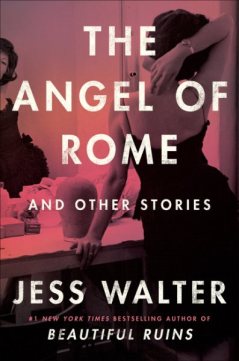 being the title story, “The Angel of Rome.” “To the Corner” was mentioned next frequently, and a couple of us called out “Mr. Voice.” Our first responder was impressed by how well the author captured the feeling of just coming out as gay and found his female voices also seemed authentic. One of us enjoyed reading the stories but felt they didn’t quite end, which can be more common in literary fiction. Another member felt that one of the unifying themes is the twist at the end of every story in which the characters are revealed to be more than we first assume.
We were all surprised that the angel of Rome was the seemingly flighty actor Ronnie Tower. What a wonderful gift for the narrator to write a script for him. A member in South Carolina shared by email that she researched and discovered that the co-writer on this story, Edoardo Ballerini, went to Rome on a scholarship to study Latin. I’ll include her full note as a comment on the blog.
Most did not even notice that “Before You Blow,” was written in the second person, but this was particularly remarkable to one of us. Another member appreciated how the author captured in “Magnificent Desolation” that teaching involves not just working with kids but also their parents. We discussed the ending of “Drafting,” wondering if “the road fell away and the cold clear summit rose into view” meant that the narrator died in a crash? Or was this just the metaphorical movement away from the illness that consumed her? One of us noted that with everyone else, the narrator was defined by the cancer, but with this seemingly irresponsible ex-boyfriend, she could live in the moment and find herself again.
The gun in “To the Corner” played a large role for some of us. A gift for protection? For suicide? Accidental violence? We loved how the narrator connected with the kids on the corner, bringing them into his life and allowing him to touch theirs. One of us mentioned how kindness gets passed on.
We touched on some of the other stories, too. No one seemed certain about the title or significance of “Balloons.” One of us would like to find a retirement home like the one in “Town and Country.” Many of us noted how we are not prepared for how hard it is to care for our aging parents. Did Jess Walter write “Famous Actor” before or after Matthew Perry admitted stealing drugs from people’s bathroom medicine cabinets?[i]One member hadn’t liked the first story she read, but she re-read it before the meeting and did like it! Sometimes we just aren’t in the right time or place or mood. Many of us kept notes to help us keep the stories straight. I will include in one of the comments my own notes, including spoilers.
This was our final meeting for 2023. If you’ve read along with us this year, let me know which of the books you read was your favorite. We will start off 2024 discussing a variety of classic novels or stories – much as we discussed this collection. Pick something that you have always wanted to read, tell us about a classic you remember, or pick a story from a recommended list. Let me know if you’d like some help finding a story. What makes a classic? You decide – then join our discussion.
- Other works discussed:
- Stephen King – he has a variety of short stories that are surprising and powerful.
- Anxious People (2020) by Fredrik Backman
- A Man Called Ove (2014) by Fredrik Backman
- Inkheart (2003) by Cornelia Funke
- Citizen Vince (2005) by Jess Walter (Winner of the Edgar Awards Best Novel 2006)
- Whitney Book Bistro previous short story selections:
- Exhalation (2019) by Ted Chiang
- Stone Mattress: nine tales (2014) by Margaret Attwood
- This Is How You Lose Her (2012) by Junot Díaz
[i] In the copyright information, “Famous Actor” is credited as published in Tin House, Best American Short Stories 2017, Pushcart Prize Anthology XLI. Most of the online references I found for Matthew Perry were published after his death this year. He is mentioned in interviews as saying that he would go to Open Houses on Sundays and steal from medicine cabinets. I didn’t find any early dates, but it could be possible. Matthew Perry’s autobiography, Friends, Lovers, and the Big Terrible Thing: A Memoir, was published in 2022.
 WhitneyBookBistro
From MM: I really enjoyed Jess Walker’s collection of short stories. . . I’m not a big fan of short stories, but these were great, with such a variety of characters and circumstances. He sure has an imagination! If I had to choose a favorite it would probably be The Angel of Rome. It was fun and witting, and I laughed out loud more than once, especially every time Jack tried to translate. Goofy Ronnie Tower sure put him in some tough spots.
I also really liked Mr. Voice. The people seemed genuine. Tanya’s mother cared more about herself than anyone. It was mean the way she used Claude and horrible how she went on dates with men, leaving Tanya home alone to fend for herself. Claude was a gem. After Tanya’s mother left her for her biological dad, Claude just took over Tanya’s care and loved her to boot. Brian was a wonderful, supportive stepbrother, who saved Tanya from listening to her mom and Claude have sex.
Town and Country was very touching, dealing with two human issues; growing older with dementia and being gay. The characters were very likable.
I really loved To The Corner. Leonard ‘s life “just stopped” after his wife Marjorie died. But then these lazy young high school boys got under his skin, and as the story went on, he ended up bringing meaning to his and their lives by getting involved, giving them his old clothes, and rehiring Timothy to help in his garden bed. The only thing I didn’t care for was the slang the boys used when talking amongst themselves. I really didn’t understand it! Ha ha!
I could go into a lot more detail here, but I think from what I’ve said, you can tell that I enjoyed the book! 😁 I bet the rest of the book club members did too!
CB from South Carolina: I wish that I could be with you and all the wonderful Whitney Book Club Members tonight. You are high on my list of “What I miss about Las Vegas.”
When I first saw that this month’s selection was a short story collection, I was disappointed. I had tried to read a collection by Hilary Mantel and just couldn’t get into it, although I had enjoyed some of her novels. It was a very frustrating experience, so I approached this one with zero expectations. But this collection was entirely different. My attention was immediately engaged and I really enjoyed the stories. I was reminded of the short stories I had read in school, particularly those by Hemingway and O. Henry. Like Hemingway, Jess Walter has a journalist’s eye for detail. Like O. Henry, his stories have unexpected twists, although not such dramatic ones. Also humor, like O. Henry’s “The Ransom of Red Chief.” (I can’t help thinking of Red Chief as a precursor So Kevin, from “Home Alone.”) I also enjoyed Mark Twain, who interestingly began writing for the Territorial Enterprise, a Virginia City, Nevada newspaper, after failing as a silver prospector. So I ended up happy that Angel of Rome was chosen and thinking that I might read more short stories.
You asked what ties the stories together. It was hard for me to think of a common theme; to me, the stories were all so different. However, my first impressions of the main characters turned out to be wrong in most cases. As the stories progressed, I discovered that many characters were not who I initially thought them to be, particularly in “Mr. Voice” and “To The Corner.” In the latter, I thought Leonard was a bitter, hateful old man who would shoot the boys and then himself. So, I guess the point is that people have hidden depths, and you shouldn’t judge a book by its cover. Also, I thought the endings of several stories conveyed a sort of Hope. People went on with their lives after discovering that their lives had not taken the direction they anticipated.
I liked all of the stories, but would have to say that the title story was my favorite. I laughed out loud at so many passages and found such poignancy in others. I loved Ronnie Tower and thought it was so fitting that he was the angel of Rome for young Jack. This story was written in collaboration with the narrator, Edoardo Ballerini. I was fortunate to have listened to the audiobook version and would highly recommend it. Ballerini is so talented and really brings the story to life. I googled him and found that the summer after his graduation, he was given a scholarship to study latin in Rome with Father Reginald Foster, a Vatican priest. While in Italy, he discovered a group of international actors who were forming a theater company. He quit his studies and joined the troupe.
As I stated in the Journal, I am posting below my review/synopsis of the various stories. They may (and probably do) have spoilers.
A collection of stories that are scenes from various lives that at first seem mundane, but by the end there is a “twist” or epiphany that gives insight to the depth and beauty in people and the world.
MR. VOICE:
Narrator tells the story of her father, who married her mother when she was ten years old. Her mother runs off with the stepbrother’s guitar teacher. The narrator comes into her beauty and when she is sexually assaulted by her stepbrother’s friend, it is her (step) father who tells her it is not her fault. He tells her that her body, like her face is hers. She looks like herself. She does not have her mother’s face. This story is told as memory, relating the things that resonate with us. The kind acts by people that help us, as well as an understanding of the people who hurt/leave us. I particularly appreciated the description of how people can resemble each other but bring with them an aura that eclipses this, much as narrator’s daughter emanates “the danger,” the risk-taking, that her mother had.
FRAN’S FRIEND HAS CANCER:
An older couple are having a conversation in a restaurant that is both mundane and provocative. A man near them appears to be writing down everything they say and even what they haven’t yet said, which calls the sanity/reliability of the narrator into question. Is he having a stroke? Is he meeting his maker? Is he dreaming?
MAGNIFICENT DESOLATION:
School science teacher becomes infatuated with the mother of an incorrigible 7th grade student. After a teacher’s conference in which the teacher takes a swing at the drunk and angry father, the father breaks the teacher’s nose/cheek bone. The story ends as he and the student and the mother visit a garden. The teacher seems sad and lonely at the beginning of the story, filled with the mundanity of life, but it ends with the magnificence of epiphany, infatuation, of life in the moment.
DRAFTING:
A young woman reconnects with an old boyfriend when she is diagnosed with breast cancer. She is in law school and moves home to have help from her mother during treatments. One day her druggie, married, and seemingly irresponsible ex-boyfriend takes her on a trip to Seattle in an old El Camino. Why is she drawn to him? In the midst of pain and loss and the possibility of no future, the person who gives her life meaning allows her to live in the moment.
THE ANGEL OF ROME:
College student goes to Rome to study Latin at the Vatican. While trying to give up and return home, he has a chance encounter on a movie set that changes the course of his life. Like the other stories, people are more than they seem. Although we learn the most about the narrator (Nebraska) and the actress (the first Angel of Rome), it is Ronnie Tower whose character is revealed and provides the twist and the end of the tale.
BEFORE YOU BLOW:
A woman is remembering her first serious, older boyfriend–when she was 16 years old and he was 21. She is driving with her younger daughter, who is just now at that same age and vulnerability. She sees an advertisement on a bus bench and remembers the night she was ready to have sex with him but the car they were driving rolls into the lake with the baby of another couple. She rescues the baby and the boyfriend doesn’t even get his clothes wet. “Seeing through love.” Why is this story written in the second person? Is it because the narrator is seeing herself as a separate person in her memory, perhaps imagining it now through a parent’s eyes, seeing the significance of the events on her future/current life, perhaps imagining this could be happening to her daughter. It all flashes in traffic, almost as if it is an accident waiting to happen.
TOWN & COUNTRY:
Man finding a home for his father, who has dementia. You wonder how he can put up with his father’s coarseness. Focuses on the quality of life, the things that matter, the value in a life that outwardly seems shallow, and the need to allow connections that aren’t perfect.
About his mother: “The one person who’s hopes for me were as profound as my own.”
From his father: “I know this: If you find something in this world that makes you happy – do that.”
CROSS THE WOODS:
The narrator wakes up alone, frustrated that she had hooked up with a man who she knew did not want to commit to a relationship. She had broken up with him the year before, but he comes to her father’s funeral and goes home with her. Even as she is coming to terms with it, she realizes that he didn’t leave. This is ultimately one of the most uplifting, perhaps sentimental stories. The importance of the epiphany and the moment; because we don’t know where the story will go from here, but we can appreciate the moment and the hope and comfort it brings.
TO THE CORNER:
Older man who lost his wife the year before is given a gun by his son. He crosses the street to give his clothing to the kids on the corner and the connection changes his and their lives in ways that could be profound. The dialect is odd and I wonder how accurate. It reminds me much of Fredrik Backman’s A Man Called Ove.
FAMOUS ACTOR:
Woman at a party leaves with a famous actor, describing the actor by describing his movies. She is distant to him and even to the reader. The language is coarse and rather sad. For me, this was the least uplifting of the stories so far. It captures a different perspective, though. There is sadness and depression that I couldn’t ever help because I can understand neither the narrator nor the famous actor. Yet the narrator had an epiphany at the end, a connection that is important.
BALOONS:
Young neighbor meets Mrs. Robinson. Her husband died a few years before and the older son of her neighbor had been sent over to help her with chores. He goes off to college and his mother pays his younger brother to assume those tasks. The young narrator’s naivete compared with the sadness and loneliness of the older neighbor is poignant. I can’t remember the significance of balloons and wonder at the meaning of the title. The randomness of balloons bouncing about, youthful, vulnerable? Things you fill with air?
THE WAY THE WORLD ENDS:
Two applicants for a biology-teaching position at a Mississippi University meet and leave a lasting impact on a young man who mans the desk at the University’s parent/visitor hotel. The story is filled with reported facts about climate change and global warming. Faced with the likelihood of the end of the world, do you give up or do you embrace life and do what you can? The narrators switch and references to the hotel’s front desk are remarkable, lightening and contrasting what might be otherwise a depressing tone:
“The Desk of Endless Suffering”
“The Desk of Unceasing Misery”
“The Desk of Infinite Awkwardness”
“The Desk of What the Hell Did I Just See”
“The Desk of Complete Confusion”
“The Desk of No Fun Whatsoever”
“The Desk of Ungodly Patience”
“The Desk of Blissful Ignorance”
“The Desk of Perpetual Wretchedness”
The desk clerk, Jeremiah, causes the epiphany for the scientist, which also causes a chain reaction for others:
“‘I’m not very old,’ Jeremiah says. ‘I haven’t figured out who I am. And in two hours, I’m supposed to go vote on whether our stupid little gay club should march through town so a bunch of backward people can line up to call us fags and tell us we’re going to hell. But I guess it seems to me,’—Jeremiah pauses, choosing his words carefully—‘that you shouldn’t give up hope until you’ve done everything you can.’”
Jeremiah gives a rousing speech that leads to “more than twenty-five hundred people marching for gay pride . . . Jeremiah keeps looking over his shoulder, smiling, on the verge of tears as he takes in the faces, the rainbows, the sheer love—stretching block after block, through traffic lights, down streets, as far as he can see.” “‘You’ve got to give them hope!’”