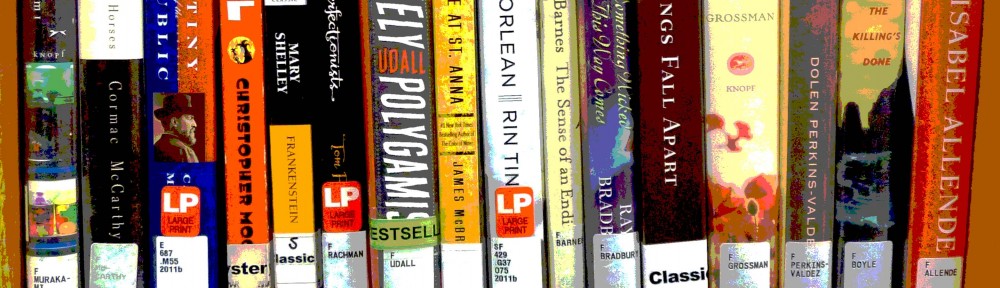
In January each year, the Whitney Book Bistro reads a classic. This year, we each chose our own classic – either from some readily available at the library during our last meeting, or something we found on our own. But what makes a book a classic? We agreed that a book should be at least fifty years old; but that is not a hard and fast rule, we would consider this on a case by case basis. One of us suggested that the author should no longer be alive. Others, that the book and author be recognizable by many. It should still be relatable, artistic, filled with rich language.
What if a story was ground-breaking for its time, introducing new ideas or styles, but it is no longer relatable and the artistry is perhaps a matter of opinion? I believe we would all take this on a case by case basis as well. With so many books in print now, could we even begin to have an accepted set of “classic” books for required reading? One member has heard that there are just seven basic plots.[1] At the end of our meeting, one of us reminded me that reading the classics used to mean Greek and Roman literature. Do students still read Homer?
As we went around the room, sharing the book we chose, we had several cross discussions, about how struggle happens for every generation, how literature speaks to people in different ways. Many of us recognized the books from the movies. Steinbeck was the most recognized of our choices. When I asked if any of us had a book we would want to have on a desert island, we all looked around the room, but I don’t remember anyone jumping up and down!
- Coyote Waits (1990) by Tony Hillerman – DG could not get interested in any of the classics he considered, so ultimately, he decided to read a book he has been wanting to read. Tony Hillerman’s Navajo-detective novels have been a favorite of his and he was not disappointed. Researching a little, he was surprised to find that Hillerman was not Native American, but he did receive the Navajo Tribe’s Special Friend of the Dineh award.
- Kidnapped (1886) by Robert Louis Stevenson – DR listened to the audiobook and found it engaging. He noted that many of Stevenson’s books are about shipwrecks.
- Leaves of Grass (1855) by Walt Whitman – JS is still reading the collected version that Whitman refined and added to until his death in 1892. She researched his importance and seemed to appreciate some of his poems, but sometimes he seemed to be just “blabbering on” – not just free verse but more like arrogant journaling.
- Of Mice and Men (1937) by John Steinbeck – KK enjoyed this book, but she found that even at just 100 pages, it was a tough read. She had to stop and read out loud.
- Maggie Girl of the Streets (1893) by Stephen Crane – MS actually read a collection of six stories, which she found to be hit or miss. The slang and language were challenging. “The Monster” (1898) was her favorite. She particularly enjoyed reading about the author whose reporter style was considered groundbreaking because he immersed himself in the life and war zones about which he was writing. His most famous book is The Red Badge of Courage, which most of us recognized.
- The Life of Josiah Henson: Formerly a Slave: Now an Inhabitant of Canada, as Narrated by Himself (1849) – JS found this to be a classic slave narrative. He was particularly intrigued by the difference in our mindset regarding slavery now versus then. We could have had an entire discussion about this, including another member’s choice of Uncle Tom’s Cabin, but that will have to be another day!
- Custom of the Country (1913) by Edith Wharton – KC had to order this from out of state to read a print copy of this book. He is a fan of Edith Wharton and would recommend any of her books, especially The Age of Innocence (1920). A tragic story about meeting society’s expectations. Since she is writing critically from and about the upper class, who had the money to buy her books, she has far-reaching impact.
- Dracula (1897) by Bram Stoker – WH was enthusiastic about this epistolary novel, which showed only individual and limited perspectives in the letters and journal entries included. He was surprised to learn that Bram stoker did not invent the vampire story but that he was the first to do it so well that he seems like the first.
- Grapes of Wrath (1939) by John Steinbeck – JSG wanted to read Don Quixote but decided that 1000 pages was just a little too long for December! Reading about characters moving from the middle of the country to California, seeking a better life but misled about the opportunities there, seemed particularly relatable given the continued immigration crisis in our country today.
- Tinkers (2009) by Paul Harding – VH said that at only ten-years old, this book may not be a classic by our definition yet, but it will be. It is a first novel that won the Pulitzer Prize in 2010. The prose is astounding as the author describes each character from their death bed. She found his description of death noteworthy.
- Rebecca (1938) by Daphne Du Maurier – MM had read and recommended Rebecca before. She wondered if she would still find it worthy. She did. The new wife is psychologically haunted by the previously deceased wife. The story is suspenseful and the language beautiful and colorful.
- Uncle Tom’s Cabin (1852) Harriet Beecher Stowe – MR was challenged to read this because of a class she took this last summer about under-recognized female authors. It is not an easy read, considering both the length (over 800 pages) and the dated language. She had not yet finished it, but she appreciated it. This lead us again to the importance of still reading things that were ground-breaking, original, important, even though there are so many books to read!
- The Stranger (1942) Albert Camus – I appreciated the philosophical considerations prompted by this short book, which was easy to read, relatable, even though the author was French and the story took place in Algiers. I’ll post a little more information as a comment.
Review for the following books were sent by email because the members weren’t able to attend. Their full remarks will be posted as comments as well.
- I, Robot (1940-1950) collected stories by Isaac Asimov – PM has only started reading science fiction in the last few years and wanted to read Asimov’s Foundation series but thought he would start with some of the ideas the author first processed through early short stories.
- Nero Wolf Series (1934-1975) by Rex Stout – AM first heard an audiobook of Too Many Cooks as a child in the early 2000s. Check out her review and recommendation for the importance of the books as a collection.
- Of Mice and Men (1937) by John Steinbeck – CB in South Carolina
This list isn’t even inclusive of all the ones we might choose if we had the time and inclination. So many books – so little time has never seemed truer!
Happy Reading! 2024!
[1] There is a book about this subject, available through the library: BOOKER, CHRISTOPHER. The Seven Basic Plots: Why We Tell Stories. 2005. From Wikipedia: “Overcoming the monster”; “Rags to riches”; “The Quest”; “Voyage and return”; “Comedy”; ”Tragedy”; “Rebirth.“
 WhitneyBookBistro
CB writes: The classic I chose was “Of Mice and Men” by John Steinbeck. I googled lists of classics, and this jumped out at me because I lived in the Imperial Valley in California until I was 12. It was an agricultural area, not like Salinas where Steinbeck was born, but similarly there were lots of migrant workers who passed through the area. I remember going to school with some of the children, who were always temporary and usually behind the rest of the class. Steinbeck’s novel is about two single men who band together, hoping to get enough saved to buy a small farm and escape their hand-to-mouth migratory existence. The novel has been required reading in some schools and at least four movies have been made, so I feel like I should have known the plot. I think I shied away from reading it because I knew it was sad. Well, spoiler alert, it is very sad. Most of the characters are unhappy, even to the point of taking out their feelings by being cruel to those who are less powerful. The ending, to me, had the impact of a Greek Tragedy. I thought the book was very visual, almost like a play or movie and the characters were very real.
I read somewhere in my online searches that a classic “brilliantly articulates universal themes.” I like that definition very much, and it certainly applies to this book. The themes that stood out to me were those of loneliness, isolation and the longing for, and pursuit of, impossible dreams. But there is much, much more packed into this short novella, and I would encourage everyone to read, or reread it.
Very nice response to the book, honest and insightful.
PM writes: Best Wishes and am bummed I don’t get to hear about all the different classics read by the members.
I enjoyed reading and was amazed at the vision of Asimov! He brings up big philosophical questions, about the meaning of life, personhood and morality. I was entertained to find out Asimov coined the word robotics and impressed that he used a female main character to tie the short stories together when they were published as a collection in 1950!
One would hope the three or four laws of robotics he developed would apply to real life robotics and AI today.
1. A robot may not injure a human being, or through inaction, allow a human being to come to harm.
2. A robot must obey the orders given it by human beings except where such orders would conflict with the first law.
3. A robot must protect its own existence as long as such protection does not conflict with the first and second laws.
Best Wishes for a lively discussion of the classics!
Pier
I had forgotten these laws of robotics (if I ever knew them), but I’ve always been a fan of Asimov. His identification of the “eureka” factor in research and discovery has been a guide to me, to give my mind a break and let it work without my obsessive focus. Answers emerge.
AM writes: When I went to pick a classic, one of the first things to come to mind was the Nero Wolfe books. I knew that they fit the time criteria—they were written between 1934 and 1975, so I could pick any one—and that was the hard part. I ended up picking the whole series, because although individual books may be short and have inconsistencies, and the seven main characters don’t age over forty years, each book is a time capsule of the time when it was written and the series as a whole is an experience. The books are engaging and interesting, well-written with clever plots that address facets of the human existence and intermittently bring in important events of the time. In passing, the author (Rex Stout) addresses racism, WWII, DDT, civil rights, and Watergate, among other things, as they touch on cases which the characters address. Occasionally, the only way to tell when a book is set (usually but not always the year it was written) is by a reference to current events. Descriptions of New York city are vivid and accessible, transporting readers to another time in the little ways that allow us to live history. The eponymous detective is an opinionated stick in the mud about most things that directly affect his person, but very open-minded about others for the time periods in which he was written. His assistant, who narrates, is bright and interested in the world in a way that lets you appreciate everything and everyone he encounters and acknowledges without ridicule other people’s blindness. They’re stereotypes in some ways of the detective and his assistant, but they’re also complex characters by the end of the series.
I am so fascinated by this response! I read it when Kristine first sent it, but didn’t identify the author. AM. Fine analysis. I love “in the little ways that allow us to live history.”
The Stranger by Albert Camus
Going into Albert Camus’ The Stranger, my assumptions were that it would be a philosophical story in two parts. The first part would be one man killing a stranger, perhaps as a test or an accident. The second part would be the trial.
I was entirely wrong about the title. The narrator, Meursault, does not kill a stranger – he is the stranger. The tone and observations are absorbing; and I was reminded how much I enjoy philosophical ruminations – outside the emotional and physical reality of our modern world! Is Meursault a classic example of a sociopath? Is he clinically depressed, getting by as best he can, perhaps finally appreciating life? How were his actions different from the society that condemned him? I particularly appreciated the absurdity of capital punishment. This short novel gave me a lot to think about, considering both philosophy and language choice – by the author and the translator. I wonder what an AI (artificial intelligence) might learn from such a story?
I will have to read The Stranger again, like a puzzle, a meaning of life challenge. Something I might consider tomorrow. For now, I’m glad I read it.
The Stranger, enigmatic first novel by Albert Camus, published in French as L’Étranger in 1942. It was published as The Outsider in England and as The Stranger in the United States.
I’m particularly interested in your comment about the “language choice” of the translator–what drew your attention. I’d like to have a copy of the translation you read to compare with my old copy I can find it). I remember receiving a teaching text of some work that I loved and disliking that translation because it didn’t have the beauty of the other.
WH writes to add some interesting insight into Dracula:
Here is my synopsis of Dracula. Might be more like a promo, but I don’t want to give any spoilers. Movies and television give us so many other aspects of books, it is mentally hard to go back to the original source. The working title was The Undead and the vampire was Count Wampyr. I am now learning about epistolary novel writing.
Mr. Stoker has acquired an epic story of survival. He has a steady career at the theater, but he wants this information out there. They trusted him with their personal diaries, so it could be published for us all. While vampires have been around for centuries, most survivors have not written it down, but have told the stories over campfires and bars. It is a solemn quest to kill a vampire, but releasing its soul to heaven makes the danger worth it. The tales of their powers are sketchy and vague, but danger is obvious to those who look. The hunt is different in daytime, but still precarious as everyone is at risk.
Count Dracula is smart, as with all vampires, and has lots of time to plan. Finding vulnerable humans is key, as getting new life sources is crucial. Any human can be manipulated and used for his ultimate goals. Police don’t bother with ghost stories, so vampires can kill and disappear easily. Just transform and hide and wait. The old folk know the stories though and warn others to stay away from the mountain. Don’t go searching for danger, or you just might get bitten and fade away.
Our heroes overcome personal heartaches, but fight for the greater good. How many died along the way. The new power of cameras, sound recordings and psychological testing is put to the test, but never forget the old powers of hypnosis, transfusions, and a well placed money exchange. Coming from the depths of evil to our neighborhoods. Keep holy wafers and a gun handy at all times. How many vampires are still out there? Will you survive the night?
I like the old characteristics of vampires, powers and limitations that you knew and could use to protect yourself or to identify the vampire–garlic, crosses, (holy water?), sunlight. Now, vampires have evolved or their creators have diversified the beings, and some of the old “facts” have become “myths” so there’s no security for us.