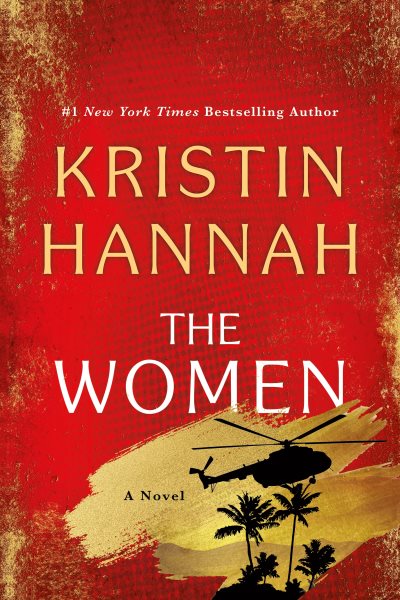
The Women came highly recommended, along with a couple of Kristin Hannah’s other historical-fiction novels, The Four Winds and The Nightingale. I read book club selections more critically than I might read a story on my own. If a book is popular, I am often over-critical, much like I might be anytime when expectations are high and it is easy to be disappointed. For me, The Women was not an exception, but the era, the tragedy of war, friendships born of shared trauma, lost innocence, romance, good writing – what’s not to like?
Feedback from the group was positive and straightforward. Our members are an open-minded mix of men and women, all of whom were glad to have read a woman’s perspective of the Vietnam War; were surprised by the vitriol experienced by Vietnam war veterans; had their own memories of the time and war; thought Henry was unbelievably supportive and Rye a monster.
We primarily shared memories spurred by the novel. One of us has a twin brother who served but has never really talked about his experience. We had two part-time Las Vegas residents from New Hampshire who joined us specifically because one of them was an Airforce nurse, stationed state-side in 1966. She shared her experiences—from a man setting brochures on fire at a recruiting event to orders not to keep evidence of her military ties in her car to avoid attracting protestors. She attested to the accuracy of the book. Her friend had been an anti-war protestor and was grateful to have read the book and been given a new perspective of the individuals who had served. Several members particularly appreciated Frankie’s growth as a nurse and shock at how undervalued she was after the war. How could her family say that she was in Florence?
We all seemed to agree that the book was easy to read, especially for a war novel. I believe that much of the appeal is how familiar the era is – from the music, Jean Nate perfume, TaB diet soda, the television series and movie M*A*S*H, and other references to shared cultural experiences. One member reminded us that this story is one person’s perspective and seemed cliched. He called out that between 1955-1975 three million Vietnamese died.[i] One of us mentioned that Florence Nightengale likely suffered from PTSD. Another shared that he once heard that the US spent over $322,000 per death during the Vietnam War and only $53 per person living in poverty.[ii] Others mentioned personal knowledge of veterans affected by agent orange. One of us kept shaking his head and saying Westmoreland—lies and success by body counts. Another member said, “. . . it all still happens.”
We did and could have talked about much more. Addiction isn’t just for sex, drugs, and alcohol. What about adrenaline? Survivor’s guilt? What about solutions? One of us shared that she worked in an inner city school in Chicago during the Vietnam era. Two inexperienced young men came to teach there to avoid the draft. By Christmas they had enlisted! So many stories. In the end, our meeting was about eleven people in person and several more in contact with me at the library, making connections and sharing insights and more. Have something to add? Share a comment here – or stop by the library. You never know when you might have the missing piece of the puzzle!
- OTHER WORKS MENTIONED:
- Waste Wars: The Wild Afterlife of Your Trash (2025) by Alexander Clapp
- Catch 22 (1961) by Joseph Heller (adapted to film and television also)
- Sisters Under the Rising Sun (2023) by Heather Morris
- Message from Nam (1990) by Danielle Steel
- The Overstory (2018) by Richard Powers
- The Island of Missing Trees (2021) by Elif Shafak. The book is told through the perspective of people but also a Fig and a Ficus tree.
- Healing Wounds (2020) by Diane Carlson Evans
- The Yellow Birds (2012) by Kevin Powers. Previous book club selection about the Iraq War. Film adaptation 2018.
- All’s Quiet on the Western Front (1928) Erich Maria Remarque. Recent 2022 film adaptation.
- Johnny Got His Gun (1939) Dalton Trumbo
- Parade’s End (1924) Ford Madox Ford. Television series adaptation 2012.
- M*A*S*H (1970) Film
- M*A*S*H (1972-1983)Television
- Thank You for Your Service (2013) by David Finkel. Film adaptation 2017.
BOOK GIRLS GUIDE WEBSITE LINK FOR LIST OF SONGS REFERENCED IN THE WOMEN AND ACCOMPANYING SPOTIFY PLAYLIST: https://bookgirlsguide.com/music-from-the-women-by-kristin-hannah/
ANGELS, NURSES, AND DONUT DOLLIES YOUTUBE VIDEO OF PICTURES FROM THE VIETNAM WAR, INCLUDES INTERSPERED ADS: https://www.youtube.com/watch?app=desktop&v=AKhLkVmQc3k
[i] “In 1995 Vietnam released its official estimate of the number of people killed during the Vietnam War: as many as 2,000,000 civilians on both sides and some 1,100,000 North Vietnamese and Viet Cong fighters.”
https://www.britannica.com/question/How-many-people-died-in-the-Vietnam-War .
I looked this up after the meeting. One of the most powerful things about historical-fiction is our belief that it is based on truth.
[ii] “I t is estimated that we spend $322,000 for each enemy we kill, while we spend in the so-called War on Poverty in America only about $53 for each person classified as “poor.” And much of that $53 goes for salaries of people who are not poor. We have escalated the war in Vietnam and de-escalated the skirmish against poverty. It challenges the imagination to contemplate what lives we could transform if we were to cease killing.” Address by Dr. Martin Luther King Jr.; April 15 Mobilization to End the War in Vietnam. New York City. Saturday, April 15, 1967. Civil Rights Movement Archive. https://www.crmvet.org/docs/mlkviet2.htm .
 WhitneyBookBistro
From MR:
Thank you for providing the book, “Healing Wounds” by Diane Carlson Evans. She grew up on a farm less than 20 miles from mine. Our high schools were 10 miles apart. We graduated from high school the same year. She went to Vietnam when my twin brother did so her story was relatable. Her stories were very similar to Kristin Hannah’s stories in “The Women.” She too, suffered from PTSD and considered suicide despite marrying a surgeon and having four children. I was intrigued by all the roadblocks she met trying to get the women’s memorial approved and applaud her persistence. It was enlightening to read the names of the people who supported her efforts (Chuck Hagel, Rudy Boschwitz) and those who never did (Jan Scruggs).