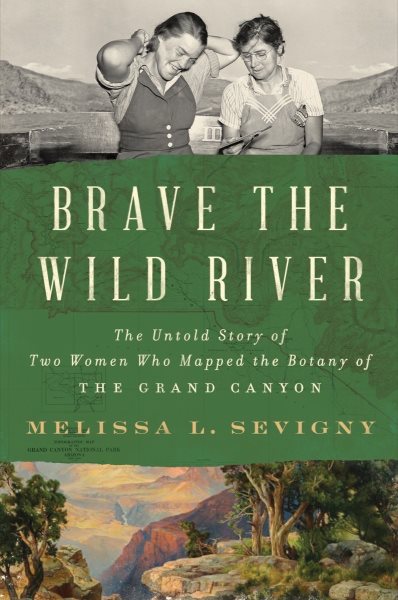
The Colorado River is hugely important to Las Vegas. Would our city have been able to thrive without Lake Mead and Hoover Dam? Imagine us without such close access to life-sustaining water and power for air conditioning! Brave the Wild River: The Untold Story of Two Women Who Mapped the Botany of the Grand Canyon by Melissa Sevigny combines history and adventure with social and natural sciences in an easy-to-read, well-researched package. This is important, local history.
That is not to say that we all finished the book or found it universally engaging. Many of us struggled at the beginning. The book is only 300 paperback pages, but it is filled with details that can be hit or miss, depending on the reader. A few of us mentioned that we got side-tracked looking up information as we were reading.
Our first responder loved the book, looking things up as he went. He had already watched the video I shared, showcasing Nevills and the Colorado River.[i] Our next responder made us laugh because she tried listening to the audiobook and now knows what to do to help her sleep! She took notes, inspired by connections she found. She is a retired teacher and the description of “botany’s virtues being women’s virtues”[ii] reminded her of the expectations of teachers in the late 1800s. She read about Clyde Eddy’s river documentary, “ominously [funded] by the company that made Mercurochrome to treat cuts and bruises.”[iii] She shared how Mercurochrome was banned by the FDA in 1998 but mercury is still being used, despite its being toxic. Like so many connections we find while reading, she mentioned the 2010 reality TV show Gold Rush. Mercury is used in gold panning. Are they desperate to make a living? Adventurers like those in Brave the Wild River?[iv]
Another member still had two chapters to go. The book was slow. She felt like she was plodding along. Yet, her sister has a river-runner friend . . . there it is, that connection again! Our next responder was captivated by the ecological impact discussed in the book. Recreation vs. preservation. She worked once in a Forestry visitor center in North Carolina, so she has had previous exposure to these ideas. She was also struck by the treatment of the indigenous people mentioned in the book – forced not only to move from their ancestral land but also not allowed to visit. Which led to a short discussion about how black people could work on the Hoover Dam, but they weren’t allowed in Boulder City, which was built to house the workers on the Dam.[v]
The next two members thoroughly enjoyed the book. Feminist themes. Change. Humor. Science! One particularly remembers the bravery – and that no one was murdered or died! Well, at least not during the 43 days of the expedition! A friend told him that traveling with women was fascinating because of how they decorated, or nested, a campsite. Jotter started out putting on makeup every morning; and we all marveled at how the men waited for the women to feed them, one of us commenting that the women weren’t really working if the men were sleeping and didn’t see it!
Another member had also listened to the audiobook and found it annoying, somehow patronizing. He liked the book’s subject matter, though, and noted how clever Nevills’ boat design was. Made of a plywood, a new product at the time, it was reversible so that the squared-off rear of the boat was reinforced for fighting the rapids. We briefly discussed James Wesley Powell, whose 1869 expedition is still a primary source for understanding the Colorado river and who lost his right arm below his elbow during the Civil War in 1862.[vi] Thanks to technology, we were looking this information up on our phones during the meeting. One of us mentioned that because of reading this book she learned that the school where she previously taught, Kit Carson Elementary School, had been renamed Helen Anderson Toland Elementary School.[vii] Several of us were then surprised to learn that Carson City is also named after Kit Carson.
This could have brought up a host of difficult conversations, but we respectfully moved on. More connections and food for thought. How much more could we discuss in an hour anyway? That one of us makes prickly pear jelly but didn’t have any to bring! Or that we would rather visit beautiful natural places around Las Vegas than casinos. Valley of Fire. The Sky Walk. Or maybe the historic Boulder Dam Hotel that still exists. What would a fiction book about Jotter and Clover’s expedition have been like? One of us said, if it was fiction, she wouldn’t have believed it!
If you couldn’t get through the book or would like to see the images more clearly, Melissa Sevigny published an article in the Atavist Magazine in 2019[viii] that is available online. I appreciate the ability to highlight interesting passages while reading a digital copy, but I struggle when I want to just flip back to the references. I definitely got sidetracked researching.[ix] Unfortunately, the notes I took don’t include the poetic descriptions of the landscape. The historic Grand Canyon North Rim was destroyed this last summer. Change is inevitable. The journals and letters of our botanists have captured a bit of history that is lost in reality but not in spirit. How will our future of remembering the past look like, locked in email accounts, blogs, and digital files? This journal is meant to remind us of our bit of history. Did I get it right? What do you remember? Join the discussion – we’re recording history.
- WORDS that stood out:
- Riffle – “a rocky or shallow part of a stream or river where the water flows brokenly.”[x]
- Travertine – “a spiky stone made from calcium carbonate precipitating out of water.” Pg. 154.
- Blancmange – “pudding with cream.” Pg. 158.
Plant connections: To be updated with a picture of DG’s neighbor’s night-blooming plant.
[i] Norman Nevills 1947 Colorado River Expedition Through Grand Canyon 60794
[ii] “Botany’s virtues were women’s virtues: gentility, innocence and modesty. Flowers, after all, reflected the qualities most treasured in women: fragility, purity, and loveliness.” Pg. 10.
[iii] Brave the Wild River page 98.
[iv] In our Books on Tap book club, which read the same book, one person asked, “What would you consider worth risking your life?”
[v] It’s always good to have a little back up information: https://www.pbs.org/wgbh/americanexperience/features/hoover-african-americans/
[vi] https://emergingcivilwar.com/2022/10/03/john-wesley-powell-and-the-wounds-of-war/
[vii] https://lasvegassun.com/news/2020/sep/14/kit-carson-name-change-pioneering-principal-vegas/
- “A group of former students spent two years coordinating with officials to rename the school Helen Anderson Toland Elementary School. The Clark County School Board on Thursday approved the proposal to rescind the name in favor of Toland, agreeing that Carson’s role in the death of hundreds of Native Americans during the colonization of the West couldn’t be overlooked.
- Carson led the Long Walk of the Navajo in 1864, forcing Navajo people to march from their land in modern-day Arizona to New Mexico in the middle of winter. At least 200 Navajo people died of starvation and exposure during the forced marches.”
[viii] https://magazine.atavist.com/author/melissa-l-sevigny. The Atavist Magazine, No. 96. Published in October, 2019. About the magazine: “The Atavist Magazine publishes one incredible true story every month. We specialize in longform narratives, the kind you want to read to the very last word.”
- “In 1930 . . . A college education wasn’t all that unusual for women of the era; they made up about 40 percent of the student population. But college was usually thought of as a stepping-stone to becoming a wife and mother.” Pg. 12
- “Preservationists then praised the wilderness as pristine and untouched by humans, when in truth, the land had been tended carefully by its Native inhabitants for generations.” Pg. 27
- “Powell’s keen vision and precise ecological knowledge couldn’t compete with the mirage of manifest destiny.” Pg. 45
- The Grand Cayon Deer Drive of 1924: Zane Grey was there, “‘roughing it’ with a Japanese chef, personal valet, and three assistants.” Pg. 173
- “Between 1938 and 1956 . . . just over 200 people ran the Grand Canyon. . . But in 1960, more than 200 people made the trip, and in 1970, the number was nearly ten thousand.” Pg. 241
- “The Colorado was, in the words of geomorphologist Teo Melis, a ‘Frankensystem’ of conflicting values and needs.” Pg. 242
[x] Amazon Kindle uses Oxford Dictionary of English definitions.
 WhitneyBookBistro
From Kristine:
I opened the meeting this month with my enthusiasm for the desert. I find it one of the most beautiful places on earth because its beauty is so unexpected. Like a sudden, sincere smile from a shy person. You can drive out just two hours from Las Vegas, past the North Rim of the Grand Canyon, head down the mountain and suddenly find yourself dumbstruck by the Vermillion cliffs. Or be walking in a barren, brown landscape and look down to see a delicate orange or purple flower, only to look further and realize that there is life all around you. The author of Brave the Wild River and the people she quotes were inspired as well.
For the meeting, Pier and I brought in plants from our house, a tall succulent, Christmas cactus, tiny succulents to give away, and a messy overgrown Aloe Vera. Pier collected sprigs of Mesquite, Catclaw Acacia, Desert Willow, and Tamarisk from Pittman Wash, a tributary to the Colorado River running through Henderson, Nevada.