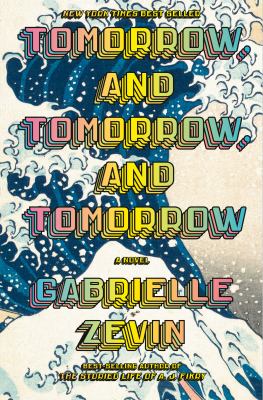
Our group’s response to Tomorrow and Tomorrow and Tomorrow by Gabrielle Zevin was mixed. My overall impression is that most of us did not like the book, either because we couldn’t appreciate the descriptions of video games or we found Sam and Sadie too selfish. I am never sure what to expect from our discussion, but prior to the meeting I was so inspired that I created a gate to mark our entry into the room. I also had dried persimmons to try, tuberose oil to smell, and paper cranes and various books on display. It was difficult to create a world in real time and objects that matched my imagination. It underscored the power of video games to offer that sense of wonder and control. It’s not just reading or watching as the story unfolds but actively being a part of it.
Our first responder liked the book, especially the human connection. She hadn’t expected to like it, because she doesn’t play video games. Her boyfriend does and she believes it helped her understand him better. Our next responder wasn’t thrilled, didn’t like the switching viewpoints and timelines, especially calling out the Pioneer video game that appeared with a different style and tone as if it were a real story. Like most of us, his favorite character was Marx.
One of us found all the trauma too stressful – Sam’s injury and loss, Sadie’s relationship with the contemptible Dov. She was glad that the ending was redemptive and hopeful. A book she loves can be ruined by an unhappy ending and vice versa!
Another member is a former nurse and identified Sam as autistic, rather than just introverted and traumatized. This gave us food for thought, something that could still be discussed. One of us hadn’t finished it, but she felt that the characters were real, passionate, and truth tellers.
Our next responder had liked the book at first, but she found Sadie too selfish. She believed that Sadie blamed Sam unfairly. She also thought that there were so many unusual words that the author must have written with a thesaurus in hand. How pompous! This is a book she will forget soon. She would rename it Yesterday and Yesterday and Yesterday!
In contrast, another member is interested in video gaming, but he felt that the book could have been about any industry. It was about the stages of life – the decisions we make at twenty and the reverberations at thirty.
Other members found it just okay, interesting but way too long, anticlimactic. Still another appreciated that it wasn’t about greed or avarice. Some of us appreciated all the new words, references, genderless Ichigo. We wondered if Ichigo and Solutions were real video games. We were particularly fascinated with how we would feel being made complicit in the holocaust while playing a game like Solutions.
Sam and Sadie were like an old married couple. One of us liked the idea that you should enjoy love when it comes. Not everyone has the opportunity for long-term relationships. He and his partner have been together 35 years. He identified with Ant and Simon who suddenly realized that legal marriage was desirable because it was possible. He and his partner were married in California before it could be outlawed in 2008. When his partner had a stroke, that legality made the difference in his ability to be considered family and a decision maker.
We discussed more than all of this. Snippets like those in the book. The hour passed quickly and we never discussed the title and the famous Macbeth soliloquy that inspired it. What we did do was create a shared experience, like those in the book, that will reverberate into the future. We just don’t know it yet.
- Words discussed:
- Dov (Hebrew)
- Echt
- Chiaroscuro
- Ludic
- Tautology
- Cicerone
- Bromide
- Grokking
- Ouroboros
- Weltschmerz
- Collogue
- Auteur
- Bloviating
- Viridescent
- Penumbral
- Palimpsest
- Tetrachromat
- Jejune
- Anfractuous
- Zweisamkeit
- Deictic
- Torschlusspanik
- Other works discussed:
- Choose Your Own Adventure (children books series 1979-1998) Created by Edward Packard and R.A. Montgomery (dates uncertain)
- The Chronicles of Thomas Covenent (1977-2013) by Stephen R. Donaldson
- Ready Player One by Ernest Cline (2011) book/(2018) film
 WhitneyBookBistro
From Me (Kalamity Kristine):
I was incredibly inspired and moved by Gabrielle Zevin’s novel Tomorrow and Tomorrow and Tomorrow. I didn’t expect to be. I don’t play video games and until I read this book, I couldn’t really understand their appeal. The story, however, was brilliantly epic, peppered with images, references and symbols that resonated with me – Magic Eye illusions, Necco Wafers, Japanese torii gates, the Oregon Trail computer game, Shakespeare, Hokusai’s The Great Wave, paper cranes – and filling my imagination with others – Al Khwarizmi, persimmons, Clownerina, tuberose perfume, William Morris’s Strawberry Thief design, Harvard University’s Natural History Museum’s Ware Collection of Blaschka Glass Models of Plants, LA’s ghost freeways, Torshlusspanik. We actually only see snippets of our main protagonists. They are celebrities. They are brilliant but flawed. The narrator is not omniscient, but we see the story through so many different perspectives, including their own, that we feel like we know the truth. A nurse watches them through a window, guessing at their relationships, we read interviews from the future, letting us know that big things are coming, and we transition through murder and loss with the awareness of an imagined bird and coma patient.
When Sadie did not loudly and violently protest being handcuffed for 13 hours, I felt done with her. Is this victim blaming? Gender expectations? Sadie’s promiscuity versus Sam’s asexuality? So much to think about. So many connections.
“Video games don’t make people violent, but maybe they falsely give you the idea that you can be a hero.” (pg. 300) I love that! Maybe video games don’t make people violent, but do they make us inured to the violence? We are at war now. Maybe we always are, in one way or another. But today, the children fighting our battles were raised on video games. The land of Al Khwarizmi, the man who gave us numbers and algebra and algorithms, is being bombed. Maybe destroyed. If we were in a video game, there’d be a reset.
From Carol (South Carolina):
I read about half of Tomorrow and Tomorrow and Tomorrow, but it was not a book I liked very much. I felt the same way I felt about the two books I read by Taylor Jenkins Reid. The two authors are enormously popular writers and highly praised, but their books do not hold my interest–not page-turners–and I can’t feel any connection to their characters. I think I downright disliked Sadie. She seemed to be totally lacking in empathy. I hated the way the characters incorrectly interpreted the actions of others. Their interpretations seemed to be colored by their own self-absorption, reframing actions and words to fit within their own storylines. I also disliked all the extraneous details. Why did the author have to describe every single apartment that anyone lived in? HaFaSoFa? Clownerina? I felt this bogged the story down; didn’t move the story along.
I understand this was a popular book and I’m eager to hear how the group felt about it.
I wish you could still join us in real time! Your insights are always great for discussion. Your Miss Benson’s Beetle comments matched my own reading so well!
Wish I could be there, too! I always gain so many insights. And the meetings are always so enjoyable. I really wish I could have tried all the items you brought. I googled Fracas perfume and it’s so expensive I don’t think I’ll ever know what it smells like.
So, the next book is Mad Honey? Are you going to read The Lion Women of Tehran? I thought it was next and read a few pages from the online sample. It sounded like a good story, but I know sometimes the library can’t aquire books.