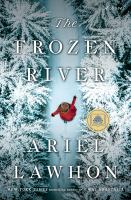
I had seen The Frozen River book cover before. Sharp frozen trees, more like huge snowflakes, with a blood red figure in the center. It seemed more modern than the eighteenth-century story it actually is. A spy thriller? In a sea of books on shelves and displays, what catches your eye? I originally overlooked the book, until it was recommended. What might we have chosen for a cover? A frozen mill? The fox? A canoodling couple? A frozen dead body? We didn’t discuss this, but one of our members did comment on the attractiveness of the cover.
The Frozen River by Ariel Lawhon was inspired by A Midwife’s Tale: The Life of Martha Ballard, Based on Her Diary, 1785-1812, a 1990 Pulitzer Prize-winning book by historian Laurel Thatcher Ulrich. Ariel Lawhon says in her author’s note that “roughly 75 percent of what happens on these pages closely follows the historical record. The rest is my version of what could have happened.” The power of historical fiction to make us feel like we are reading truth is huge! And sometimes how we feel about something is more accurately portrayed in fiction than in a dry non-fiction account.
We were definitely affected by the hardship of life in the eighteenth century. The cold and the constant work. Most of us know that we wouldn’t have been able to survive. What if we lost electricity? What if someone takes out Amazon? We’d be doomed! The author bore nine children while documenting over 800 births in 27 years! I had been concerned that the story didn’t convey the grime and difficulty, but one of our group astutely pointed out that the characters in the book didn’t know anything different. This is a powerful perspective because just as we might complain that an author brings modern sensibilities to the characters, we bring modern judgement both to the portrayal and content.
Our first responder had been intrigued by the oft-used phrase, “I left at … cleverly.” The author wrote the story and diary entries in modern-American English, but she kept this phrase. Who would have thought that to leave someone cleverly meant to leave them in good health! An interesting comment on how language changes.
Midwives versus doctors fascinated us the most. We had questions that would have to be researched. How did Martha have such a low mortality rate in a time before people understood the importance of sanitation?[i] In The Frozen River, Martha washes her hands often. Is that in the actual diaries or something added by Lawhon? When was the first cesarean section?[ii] The “trained” doctor mangled and killed two babies and falsely blamed Martha for giving another laboring mother laudanum. One of us was particularly bothered that the author chose to call the mysterious and skilled black doctor just Doctor. Another one of us felt that using the same simple title made the comparison between the Harvard-trained and inept doctor more significant.[iii] This highlights for me how fictionalizing true events gets tricky.
Our next responder thought the book was superb. He loved that animals are characters – Brutus, Tempest, and Percy (and I’ll add North’s wolf-dog Cicero!) Even the river is a character. Hard-of-hearing since his youth, this member related the most to Cyrus. He was also reminded that beer and ale were a food source. And he particularly appreciated that, after reading so many stories about how women are victimized and mistreated, we finally get a “revenge” story (His pun, not mine!).
Another member commented how courts and laws haven’t changed that much. If there are no witnesses to a crime, how can we convict people? Why would anyone, even today, want to get up in front of others and tell something they want to forget?
We had many other comments. The book was a slow read. We liked the happy endings for most. The preacher was too quiet about his wife’s rape. We reminisced about life on farms and seeing chickens killed. One of us spent a year on a dairy farm in her youth and it was an invaluable experience. Another was reminded about how much she hated childbirth. When is it ever okay to kill someone? Or throw a baby born out of a rape into a river? Who gets to decide these things?
We started our meeting socializing about books and movies. We always talk about so many different things that I don’t capture here. One of us mentioned how surprised he is by what I write, sometimes concerned that he didn’t convey his meaning well. My journal is just an impression of a moment in time. Fact versus fiction versus feeling versus articulation versus memory. Our next book will be Why We Remember: Unlocking Memory’s Power to Hold on to What Matters (2024) by Charan Ranganath. Coincidence? Always. And never.
- Words:
- Cock Robin – our first responder looked this up in depth and played us a version of the nursery rhyme “Who Killed Cock Robin” at the end of the meeting. It reminded me of the ballad “Barabara Allen.” The phrase brings out mythology and folklore.
- Housekeeping – When a married couple starts living together (not necessarily when they get married!)
- Pillion – sidesaddle
- Savine & Tansy – toxic herbs used for abortions
- Vernix – waxy coating on a newborn
What we’re reading and watching:
- Girl With All the Gifts (2014) by M.R. Carey
- The Boy On the Bridge (2017) M.R. Carey
- Remarkably Bright Creatures (2026) Netflix movie based on the 2022 book by Shelby Van Pelt
- Marco Polo (2016) Netflix
- The Testaments (2026) Hulu sequel to The Handmaid’s Tale (novels by Margaret Attwood)
- Interior Chinatown (2024) Hulu Mini-series based on the 2020 National Book Award winning book of the same name by Charles Yu
Other works discussed:
- Destiny of the Republic: a Tale of Madness, Medicine and the Murder of a President (2011) by Candice Millard
- Erik Larson’s books, in particular, Devil in the White City (2003)
- Hour of the Witch (2021) by Chris Bohjalian
- Call the Midwife (2012) by Jennifer Worth
- Call the Midwife (TV Series)
- Tea Girl of Hummingbird Lane (2017) by Lisa See
[i] When we read Destiny of the Republic (2011) by Candice Millard about the assassination and death of President Garfield, who died in 1881, the author emphasized how he died primarily because doctors put their dirty hands directly into the wound.
[ii]“Perhaps the first written record we have of a mother and baby surviving a cesarean section comes from Switzerland in 1500 when a sow gelder, Jacob Nufer, performed the operation on his wife. After several days in labor and help from thirteen midwives, the woman was unable to deliver her baby. Her desperate husband eventually gained permission from the local authorities to attempt a cesarean.” From The National Library of Medicine, “Cesarean Section – A Brief History.” Web accessed 5/14/2026: https://www.nlm.nih.gov/exhibition/cesarean/part1.html.
[iii] “Her diary in 1793 documents the appearance in town of what had to be a truly unusual event, the arrival of an itinerant “Negro woman doctor.” Just who this unfortunately unnamed physician was remains a mystery, but the fact that she was identified as a doctor rather than a midwife or caregiver has to be considered significant.” Web accessed 5/14/2026: https://historichallowell.mainememory.net/page/1495/display.html.

