Our discussion of Red Queen by Juan Gómez-Jurado was complex and revealing. Because the book was written in Spanish, I specifically asked our readers to pay particular attention to proverbs and pop-cultural references. How much is universal? How much of what we read is the translator? I was worried that the increasingly disturbing violence and possibly cliched superheroine and sidekick would be off-putting. I shouldn’t have been worried. Most of our readers found the book to be a page-turner, even if not their favorite – and they were ready to delve deeper into specifics of writing, story, and character development.
Our first responder had started out listening to the audiobook and found the story to be difficult to follow. She was unable to take advantage of how the author changed perspectives by chapter because the narrator was too monotone. Despite the difficulty, she moved back to the printed page and felt the brain challenge was worth it. A new member had trouble with the audio book because the narrator was too dramatic – like listening to a Spanish telenovela.
Our third responder zoned out trying to listen to the audio! Fortunately, she also did not give up. She was engaged by the story, but her first comments were that the pacing seemed strange, with unnecessary historical details about buildings and tunnels. She felt like it was written and ready for the television series it has already inspired! She wondered if anyone else had considered that Mentor was behind the murders just to get Antonia working again? We all seemed shocked by this idea, so I’d answer, “No!”
The story was confusing enough for several of us who wondered about the motivations behind the murders: why were the criminals using the religious references, what happened to the reporter, what about the housekeeper who lost her son, must we read the other two books to find closure, was that the author’s plan all along? We definitely wanted to understand more about the characters’ motivations and were not satisfied that we were expected to read more books. Probably half of us will continue in the series – or at least watch the English-dubbed television series.
What about the characters? One of us thought that Antonia Scott was created like Captain America, but all for Spain. Another member called Antonia a freak and wanted to know more about the housekeeper. Another loved that the author included a gay character without his sexuality being a major part of the story. He felt the characterization was spot on. John had to be super good, just to be a cop. He reminded our reader of Jonathan Kellerman’s LAPD Detective, Milo Sturgis.[i] We still wondered if the gay theme wasn’t offensive, but another member suggested that although depictions in the book might be distasteful, they were realistic to a traditionally machismo society and role. Currently in law school, she also appreciated the scene in which Ortiz’s lawyer manipulated Ortiz into putting his company ahead of his daughter’s rescue. Another of us commented that she is constantly amazed at people’s ability to rationalize anything.
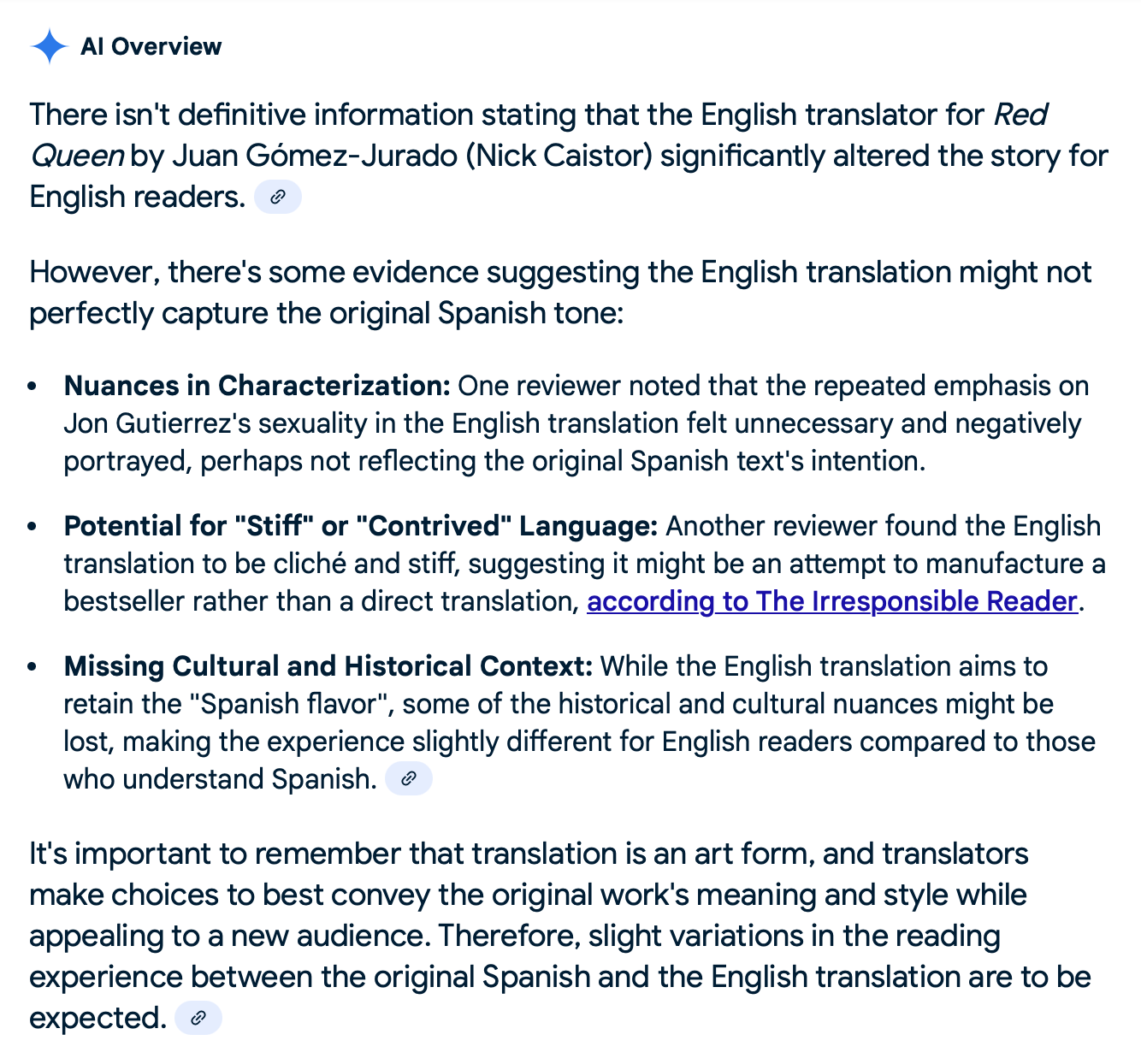
We noticed and talked about so many things. Even though the story took place in Spain, at least one of us mentioned their disappointment that it could have been in anywhere USA. Was that because the translator was doing too good a job making the story accessible? What else might have changed? At a member’s suggestion, I let AI answer that question – apparently other readers and reviewers elsewhere have had the same concern. One member said that she was just reading along and ready for the next book – as if she were too accepting and not critical enough. But isn’t being engaged also important? Entertainment, education, shared experiences. There’s a time and a place for everything. I hope you’ll find that time and place with us in the future.
- WORDS:
- Amnosia – loss of smell
- Campero eggs – a type of chicken
- Cocochas – “Kokotxas is a traditional Basque fish stew. The dish is made from stewed fish necks / dewlap (normally from a fatty fish like cod or hake) served with a sauce made from white wine, garlic, flour and olive oil.”[ii]
- Koan – an unanswerable question or riddle
- Panniers – a pair of bags that fasten around the back tire of a bicycle or motorcycle
- Phaeton/phaeton – “a vintage automobile of the touring-car type”[iii] or specifically in the book, a VW Phaeton. But also, according to multiple sources, Son of the Sun-God in mythology.
- Philology – the study of literary texts, specifically for linguistics

[i] “[Jonathan Kellerman’s] next idea was for the guy who would become the bestselling, longest-running gay character in all of crime fiction: Delaware’s best friend and crime-solving partner, LAPD detective Milo Sturgis, a 6-foot-3, 250-pound, gruff, brilliant detective, ostracized by his colleagues, tolerated only because he has the highest solve rate in the department. As Kellerman describes Milo’s life in that manuscript, ‘A gay cop was a person in limbo. You could never be one of the gang back at the station, no matter how well you did your job. And the homosexual community was bound to be suspicious of someone who looked, acted like and was a cop.’”
I found previous description of Jonathan Kellerman’s character in an article in Tablet Magazine titled, “When Whodunnits Become Woke.”
https://www.tabletmag.com/sections/arts-letters/articles/kellerman-milo-sturgis
[ii] There are a lot of interesting reference for this. For ease of explanation, I chose Wikipedia: https://en.wikipedia.org/wiki/Kokotxas
[iii] Dictionary.com
 WhitneyBookBistro