Unknown's avatar

About Kristine

I am the current moderator of the Whitney Library Book Club

My Ántonia Discussion Journal

There was only –spring itself; the throb of it, the light restlessness, the vital essence of it everywhere: in the sky, in the swift clouds, in the pale sunshine, and in the warm, high wind–rising suddenly, sinking suddenly, impulsive and playful like a big puppy that pawed you and then lay down to be petted.   —  Willa Cather, My Ántonia,      chapter XVII.

For the last few years, we have met to discuss a classic novel in January.  Last year, we discussed Pudd’nhead Wilson (1894) by Mark Twain—before that, Frankenstein (1818) by Mary Wollstonecraft Shelley,  and Pride and Prejudice (1813) by Jane Austen. This week, we discussed Willa Cather’s My Ántonia (1918).

We start our meetings a little early, giving us time to snack and mingle, but sometimes it’s hard not to talk about the book at hand. I had to explain the tomatillos sitting on the table because they reminded me of the ground cherries described in the book (only greener, and bigger, and more sour!). Rye bread and cheese with Harvest Song strawberry preserves seemed to fit, too; and ginger snaps substituted for ginger bread. Books like My Ántonia make book club food more fun and meaningful.

We decided to try a book circle before the meeting started, taking turns around the table to talk about other books we were reading or favorite ones we wanted to recommend. Cheryl had read Joanne Fluke’s Apple Turnover Murder and had made one of the book’s recipes, chocolate crack, to share. A delicious treat.

When I finally asked who would like to be our first responder, the room seemed myantoniacoversurprisingly quiet. As if we had been holding our breath, I heard a quiet sigh of “I liked it.” Another member asked if we hadn’t read something like this previously, referring to the Nevada Reads selection of Twenty Miles from a Match by Sarah Olds, about homesteading in Northern Nevada. We also stumbled over how to pronounce Ántonia, finally deciding on the pronunciation of Ant(h)ony plus ah. Or just Tony.

The discussion proceeded slowly and in many directions. We discussed the beauty of Cather’s language and one member quoted the selection describing the wind as a playful pup. Another member had lived on the plains and found the sound of the wind whistling through the grass so remarkable that she had been surprised not to find it in the story. Why hadn’t Willa Cather been as acknowledged a talent as her friend Edith Wharton? Because she wrote about the poor. How could she have claimed not to be interested in feminism and write such a book about strong, independent women? Willa Cather had dressed as a boy in Nebraska and even gone by the name of William. What did that mean? One member mentioned that in her family, many years ago, a woman who was doing a man’s work could dress as a man. Who was the woman on the train in the introduction? Perhaps the reason the book lacked descriptions of sexual attraction was because Cather couldn’t describe it as the character of Jim.

One of us had the annotated version of My Ántonia and shared pictures from Willa Cather’s life and the inspirations for the story, including pictures of her grandparents and the “real” Ántonia. We discussed the inspiration for Peter’s tale about the wolves and the likelihood that wolves would take down an entire wedding party, even in the black forests of Germany. We talked, and thought, about hard work, survival, immigration, sex, and children.  One of us shared that, years ago, while visiting family members with many children, she had been startled to be limited to two squares of toilet paper (four for solid waste!). Another member said that in some places (and times) you might be offered a page from a magazine. No one seemed to dislike the novel. The only question from the discussion question we addressed was about the novel’s epigraph, a quote from Virgil: “Optima dies… prima fugit: ‘The best days are the first to pass’.” Did this mean that the best days are first forgotten? Or that our first days, our childhood, are the best. Like time is relative?

So many things influence our reading and our understanding of our world. Like our discussions. They remain with us, perhaps not remembered but also not forgotten. Somehow a part of who we are and who we have, and will, become.

  • Other Works Discussed:
  • Death Comes for the Archbishop (1927) by Willa Cather
  • One of Ours (1922) by Willa Cather
  • O Pioneers (1913) by Willa Cather
  • Giant (1952) by Edna Ferber
  • Little House on the Prairie Series (1932 – 1943) by Laura Ingalls Wilder
  • See Member Recommendations for books mentioned during the Book Circle Discussion

The Universe Playing Strings Discussion Journal

Tuesday night was the last Super Moon for 2016 and our Book Bistro met for our last discussion of the year as well. I chose The Universe Playing Strings, by R.M.Kinder because it is a beautifully written book that offers great insight into a world of passion and heartache and music that many of us know little about—even here in Las Vegas, where superstars grace our stages and arenas regularly. I also have the privilege of knowing the author and knew that this connection could offer tremendous insight into the world of writing, publishing, and reading.universeplayingstringscover

The discussion started off slowly and our first responder was interested mostly in my connection to the author and the book. Then another member said the book was so realistic that she didn’t like the characters and was actually angry at Amy for putting up with George. Another couldn’t understand how Carl could give up half his savings, although as the book progressed he understood Carl’s character better. Others remarked that Carl needed to be needed, which is why he chose a relationship with his bi-polar neighbor. We discussed that although Jack was privileged, he seemed to live simply and not take advantage of his father, to be respectful, even though he seemed naïve. One of us liked how Amy fell in love with the guitar. Another really liked Cora.

Although one or two members felt that Carl was the main character in the story, several in our group dissented.  One of us had not finished the book because it didn’t have a plot and he believed he knew the characters well enough. He found them egotistical, always interested in being better than someone else. Another believed that the characters used sex and music to try to connect with one another, never succeeding. Still others liked the happy ending, although they wondered if it was as realistic as portended.

Since I know the author, I enjoyed sharing her dedication—writing and re-writing—her love for her characters and her great talent with both music and words. We discussed her choice to make this book positive and the choice she made to shorten it and focus on fewer characters.

And what was the significance of the Tennessee Tenor? I suggested that he represents Nashville, the heart of country music, the talent and success just out of their reach but rubbing shoulders with them briefly. I’m sure I didn’t say it that way— nor as elegantly as the author does herself. That’s why this is just a taste of what it’s like to connect with us in the book club . . . the rest is up to you!

  • Other works discussed:
  • The Art Forger (2013) by B.A.Shapiro
  • The Banger Sisters (2002) DVD
  • Crazy Heart (2009) DVD
  • Genius (2016) DVD
  • Go Set a Watchman (2015)/To Kill a Mockingbird (1960) by Harper Lee
  • Ricki and the Flash (2015) DVD

The Art Forger Discussion Journal

  • “All the world’s a stage,
  • And all the men and women merely players”[1]
  • — Shakespeare

This last week, we met to discuss The Art Forger by B. A. Shapiro. Nine of us met in the theater, on the stage, the last hour of the 2016 presidential election counting down, politics on our minds and art and morality in our discussion. The theater was lit, but the stage was half in shadow, creating a murky atmosphere to compliment a murky subject!

Our first responder liked the book, as did we all (I think!). One of us hadn’t liked it as much artforgercoverat first, uninterested in the artist’s detail—while others found the descriptions of painting and forgery to be the best part. One member described herself as a “Sunday painter” and shared how expensive painting supplies can be and wondered about the author’s use of the word “cotton wool” which is primarily a British term. Another recommended a virtual tour of the Gardner Museum, offered on their website.[2]

We talked a lot about the value of things and the importance of provenance. The discussion actually became quite heated for a moment, not so much from disagreement as from the difficulty inherent in ascribing value. If a copy is as good as the original, why is the original worth more? Why is a baseball from the Cubs’ recent historic win really so much more valuable than any other? Provenance, of course. What about art appreciation and knowledge? We remembered the Calder Mobiles mentioned in The Circle and by Isabelle Gardner in this story.[3] We discussed them but weren’t all impressed. We were, though, astounded to learn that “it is estimated that 40 percent of all artworks put up for sale in any given year are forgeries.” [4]

Most of us found the mystery and development of the story to be well done. When we discussed Claire’s complicity in the forgery and in Isaac’s ruin, we were surprisingly forgiving. Claire was young and naïve and yet amazingly disciplined, dedicated, and talented. According to one member, Claire’s outing of Isaac was appropriate for what he did to her.  Another member reminded us that there is “nothing like a woman scorned!” We discussed how her struggle made her stronger. Like the painting she stripped and then built back up to create her forgery, she was stripped down and then built back up. We weren’t certain how her volunteering at the juvenile center fit, though we discussed possibilities. Perhaps it was the small group size, or maybe it was the book itself, but we seemed to delve especially deep, finding the story layered like the paintings baked in Claire’s oven.

Am I missing details of the discussion? Of course! As always, it was a performance piece.

For our next discussion, we should be back in the conference room, still studying the effects of obsession and artistry and relationships, but with music! I hope you can join us! In person and on-line!

  • Other works discussed:
  • The Billionaire’s Vinegar: The Mystery of the World’s Most Expensive Bottle of Wine
  • by Benjamin Wallace (2008)
  • The Girl with a Pearl Earring (Book and DVD) by Tracy Chevalier (2001)
  • Indecent Proposal (DVD) 1993
  • The Mystery of Al Capone’s Vaults (DVD) 1986
  • Tim’s Vermeer (DVD Documentary) 2013

[1] “As You Like It” Act II Scene VII. Shakespeare. https://www.poets.org/poetsorg/poem/you-it-act-ii-scene-vii-all-worlds-stage

[2] http://www.gardnermuseum.org/resources/theft

[3] In case you’d like to see one follow this link: http://www.calder.org/work/by-category/hanging-mobile

[4] Discussion question #5 issued by publisher and provided by litlovers.com: http://www.litlovers.com/reading-guides/13-fiction/8989-art-forger-shapiro?start=3

The Circle by Dave Eggers

  • Outwitted
  • He drew a circle that shut me out.
  • Heretic, rebel, a thing to flout.
  • But love and I had the wit to win.
  • We drew a circle that took him in.
  •        – Edwin Markham

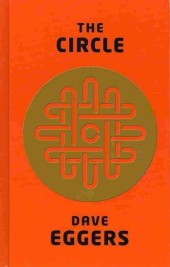
As I read The Circle by Dave Eggers, I wondered if I should even write a journal for this circlecoverimagemonth’s discussion. I felt a distinct need for privacy and anonymity. One of the elements that fascinates me about the book is how it combines philosophies for collectivism and individualism. I found myself reading essays by Ayn Rand (skimming them really), enjoying the chance to wax philosophical, horrified by the application of real-world technology, yet confident that it will never happen—after all, we are reading the book, like we read 1984, Brave New World, The Handmaid’s Tale and many others.

Did you know that there is a National Banned Books Week that was celebrated September 25th through October 1st this year? In the world of The Circle, absolute transparency is the ultimate goal. So there could be no banned books. But could they, or would they, be written? The movie Snowden was released in September; Apple Inc. is building a huge circle-shaped facility in California; Google just introduced a new phone. I am so thankful for so many possibilities. I hope our humanity can keep up.

As for the meeting . . . a small group gathered last Tuesday. Voluntarily, I hope! But not everything needs to be shared to be remembered! Join us next month if you’re curious!

The Children Act Discussion Journal

We gathered this week to discuss Ian McEwan’s The Children Act. Ian McEwan is the award-winning author of Atonement. The story of a British High Court judge who presides over cases in the family court while struggling with her own domestic strife fit in nicely with our recent discussions of Necessary Lies by Diane Chamberlain and Landline by Rainbow Rowell.

Our first responder shared that she found the main character to be whiney, dropping the ChildrenActCoverball on her professional and ethical duties.  She also shared that one of our absent members had disliked the novel enough to stop reading. Another member had really liked the book until the end, when she felt tricked and cheated. The author set up the boy as a charismatic angel, entering and then abandoned in a brave new world. Others then chimed in that the book seemed contrived and predictable—obviously Fiona would decide to save the boy because otherwise the conflict would be over too quickly! Fiona’s husband was petulant and selfish. Wasn’t he too old for a midlife crisis? One member shared that she had recently read that 58% of all divorces are of couples over the age of 60.[i] We discussed briefly the common need as we age to fulfill a bucket list, to appraise the value of our lives, to search for meaning.

Since most of the comments were negative, placing blame on Fiona for failing to save Henry Adam, blame on her husband for not being able to help Fiona with the stress of her difficult cases, I asked if anyone found the characters admirable.  One member said she felt that Fiona was not responsible for Henry Adam’s suicide—she wasn’t even sure it was suicide. Ultimately he was an adult who was tired of dealing with a terminal disease.  Another said that although she didn’t exactly like Fiona, she found the way she approached and considered her cases to be admirable. She also noted that she was struck by the description of Henry Adam’s parents’ relief that the court had forced the transfusion that could save their son.  The same realization that shattered Henry Adam’s faith brought us a new understanding of such legal-religious struggles.

One member mentioned that he liked the early descriptions in the book; another had once worked across from the Old Bailey and followed the story’s geography from London to Newcastle on a map. Still another had recorded passages that were striking, such as “She belonged to the law as some women had once been brides of Christ”(p.49) or the author’s description of the legal wrangling of a divorce as “the whole circus rising, but so slowly, through the judicial hierarchy like a lopsided, ill-tethered hot-air balloon” (38).

Despite the negative comments, many found it to be easy to read and would read others by Ian McEwan.  Atonement was highly recommended by at least one of us. I read aloud some of the acclaim in the author’s biography. I also mentioned one reviewer who said (in a scathing review) that the ending seemed to be right out of James Joyce’s story The Dead.[ii] We touched on but didn’t discuss the potentially hot topic of religion. The discussion was measured, perhaps like Fiona’s tone, outwardly calm and controlled, but filled with an underlying poetry and music for those able to hear it.

Notes:

[i] I briefly researched this (divorce) on the internet and could not corroborate these same statistics, however, I did find several articles on what NPR labeled “Gray Divorce.” Web accessed 9-16-2016:  http://www.npr.org/2012/03/08/148235385/gray-divorce-over-50-and-splitting-up http://www.nytimes.com/2015/10/31/your-money/after-full-lives-together-more-older-couples-are-divorcing.html

[ii] I misstated during the meeting that a reviewer had said the entire novel resembled The Dead. And I did not mention the review’s title:  “Improbable, unconvincing and lazy – Ian McEwan’s latest is unforgivable” web accessed 9-15-2016: http://www.spectator.co.uk/2014/09/the-children-act-by-ian-mcewan-review/


Landline Discussion Journal

I chose Landline by Rainbow Rowell as an easy summer read: something different than our book club’s usual fare and yet concerning a comparable and relatable married with children theme.LandlineFlyer

As usual, our members did not disappoint! Overall, the book was not liked, but we had one of the best discussions ever. Several members had not finished the book. One member had looked ahead and discovered the “magic” phone line and completely lost interest. One threw the book across the room at home. Another member concluded that the book was “much ado about nothing”!

I asked if anyone had liked the book and a few people nodded and one woman acknowledged it wasn’t deep but had been enjoyable to read.  One member had been interested to know what would happen, even as another said – nothing happened, that’s the problem. I asked for us all to consider why we needed something serious, such as the forced sterilization issue in Necessary Lies? One member concluded that Landline needed more of a plot and maybe even a dead body! Did we feel sorry for Georgie? Maybe, but did we like her? Several of us forgave Neil as an introvert while others found him too grumpy and uncommunicative. Was he even really unhappy or was that all Georgie’s construct? Was the landline magic or was it all Georgie’s imagination? We discussed Georgie’s personal hygiene. Why did she buy only one bra and no underwear? Why didn’t she just go home to get a bag of clothes? Georgie was used to being in control and when Neal left, she was thrown into a tailspin. And what about those pugs in the dryer?! I heard more comments from my end of the table while animated debates were happening all at once and all around. It was pleasant to experience but difficult to record!

We discussed gender roles and we shared some stories from our own experiences. After the meeting, one member said what a great group of people we all were. Another agreed. And so do I. Thank you all for joining us!

  • Other works discussed:
  • Gone with the Wind by Margaret Mitchell
  • The Husband’s Secret by Liane Moriarty
  • Necessary Lies by Diane Chamberlain
  • Faulkner and Twain (authors: mundane topics well written)

Necessary Lies Discussion Journal

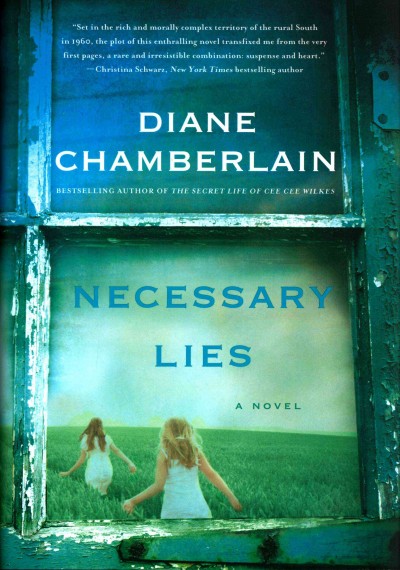
Our discussion of Necessary Lies, by Diane Chamberlain, started quietly but had moments of intense passion. Our first responder said she liked the book—she found it so easy to read that it didn’t seem like a book club book! This prompted a discussion about NecessaryLies“good literature” versus “popular.” One member had a professor who kept murder mysteries hidden in a closet! Another member said she is often bothered by long, detailed descriptions that don’t necessarily add to the story and wondered if that was a trademark of some “good” literature that made it hard to read. We discussed James Patterson, a highly popular and prolific author, as well as our next book club pick, Landline, by Rainbow Rowell, which will give us the opportunity again to discuss our expectations and likes for entertainment and more.

Our second responder liked that Necessary Lies was filled with dialog and personal thoughts and discussions. She cared about the characters. She had lived in North Carolina, working on a doctoral thesis. She had travelled to schools in some poor areas, giving intelligence tests to young children, and she had had no knowledge of the Eugenics Program. Now she can’t help but wonder if she wasn’t somehow complicit in the selection of children for sterilization.

Another member shared that eugenics programs continue in other parts of the world, amounting to genocide.  Our own government admitted to the sterilization of “3,406 American Indian women without their permission between 1973 and 1976.”[1] She said this is the equivalent of one in four Native American women, significantly impacting the gene-pool for native people in the United States, and her anger was palpable.

The author included a link to a video of the actual North Carolina hearing she mentions at the end of her book and one of our members watched the entire two and half hour video.[2] She was still powerfully moved by the stories and the reality behind the fiction in Necessary Lies.

When we discussed the book more specifically, we were just as passionate.  Why hadn’t the discussion questions included anything about the relationship between Jane and her husband?  They must have been written by a man! When did we first realize that Jane and Robert were so mismatched? Times were different then. It was over 50 years ago! We’ve come a long way baby! The ACLU has fought hard for basic rights. Has intelligence testing changed? Was Ivy smart or just “street smart?” One of our male members was adamant that Robert knew exactly what he wanted in a wife and was at fault. Would we have taken little William from the family? Why in the world did Jane tell Mary Ella the truth when no good could come of it? Didn’t she need the proof to persuade Ivy that she was in danger? Did Mrs. Gardiner know of her husband’s abuse? Did Nonnie – how could she not? The social workers were evil! How could we know what it is like to be that poor? The discussion actually got overheated for a moment.

I am surprised that we never discussed Jane’s decision to hide Ivy. What would we have done?  It was a powerful, informative, yet easy-to-read book. We mostly agreed that the happy ending was a little bit unlikely, but would we have liked the book without it? Could we have handled it? Although there was more we could have discussed, I think we were ready, as the hour ended, to move back into our world, a world that is perhaps stranger than fiction but better because of it.

  • Other works discussed:
  • Call the Midwife (2005) by Jennifer Worth
  • A Fine Balance (2001) by Rohinton Mistry
  • The 100 year-old man who climbed out the window and disappeared (2012) by Jonas Jonasson
  • A Man Called Ove (2014) by Fredrik Backman.
  • Vinegar Girl (2016) by Anne Tyler

[1] U.S. National Library of Medicine. Web accessed 7-13-2016. https://www.nlm.nih.gov/nativevoices/timeline/543.html

[2] Victims of sterilization tell their stories. Web accessed 7-13-2016. http://www.wral.com/news/video/9755940/

The Boys in the Boat Discussion Journal

This month we met to discuss our greatest generation – as revealed through the eyes of Daniel James Brown, Joe Rantz and The Boys in the Boat. The group did not unanimously enjoy it, but everyone seemed to have been moved by it.  Some found it slow, easy to put down. Others were gripped from the beginning. One member believed that the book should be required reading for young adults and several others agreed. We realized that the story had the sheen of a tall tale, like when our grandfathers told us they had walked nine miles to school, in the snow, uphill both ways! And yet we were still awed by the hardship and the resilience, the power, strength, and opportunity.BoysInTheBoatCover

We shared stories from our own parents’ and grandparents’ experiences during the Great Depression. Thula was generally considered a villain. But is it fair to judge her from our modern parenting beliefs? After learning of their struggle, can we imagine what would have happened to the boys in the boat if the United States had boycotted the 1936 Olympics? What about the Olympics in Brazil—the Zika virus and reports of dirty water? How fortunate the boys were to have had each other, to have had their boat builder, George Pocock, and his outstanding insights and skill. How different the world is now, with fiberglass boats and technology for tools and obstacles.  How will our descendants view our world and our struggles in another eighty years?

We discussed the Olympics, sports and fitness.  One of us described the athleticism in elite bicycling. Only one of us had played a team sport in school—basketball—and she corroborated the camaraderie. We discussed how little we knew about the precision and skill necessary for rowing. I had done some minor internet research into the fittest sport and found it to be quite controversial.  ESPN listed boxing first and rowing 39thForbes listed squash first and rowing second. Men’s Fitness reported in 2013 that rowers have the healthiest hearts.[i]

One member found it hard to believe that the anti-Semitism would not have played a bigger role in the story and the boys’ experience; but then we remembered that the ongoing prejudice in the U.S. allowed us to ignore the realities of the Holocaust for as long as we did, to continue to discriminate against African-Americans, even those fighting the war for us, and to relocate and incarcerate Japanese-American citizens – all of which we’ve read about and discussed before.

I first decided to select The Boys in the Boat for our book club because my husband kept exclaiming and reading me sections out loud. Enthusiasm is contagious. One of the members mentioned once that my recap is a lot more organized than our meetings seem. It reflects my memory, just as the book is the author’s impression of a memory. Every member of our group brings something to our meeting – presence, attention, ideas, experience. Thank you for joining the discussion.

  • Other works discussed:
  • Barskins by Annie Proulx (2016)
  • In the Garden of Beasts by Erik Larson (2011)
  • Miracle at St. Anna by James McBride (2002)
  • Tallgrass by Sandra Dallas (2007)


Station Eleven Discussion Journal

Station Eleven is a novel about the time before and after a pandemic that kills 99.99 percent of the world’s population. But unlike some other apocalyptic stories, it didn’t focus on as much of the violent aftermath, or the worst of humanity. Instead, author Emily St. John Mandel focused on what was worth saving, what was lost and what was gained.StationElevenCover

Our first responder liked the book and found the descriptions vivid and easy to envision. One member liked the writing but found much to criticize. Another said that the book could be picked apart 2000 ways, but that wasn’t the point. Perhaps she didn’t say it in quite that way – but I remember the number 2000 and the suggestion that what makes a book worthwhile isn’t always in the details so much as in the complete package.

We did tear the book apart for some of the details (or lack of them). We discussed the location around the great lakes (fruit country). Why didn’t they collect books? Surely there would have been more resources to help people survive.  Why did the author have the Prophet come from Israel? We discussed Shakespeare’s timeless themes and iconic characters. We didn’t directly discuss the core concept of “survival is insufficient.” When we discussed our choices to add to the Museum of Civilization, we mentioned eye glasses and toasters and waffle irons, but nothing really personal. I was fascinated that the majority of us thought of catalogs and newspapers and books.

One of the highlights of the discussion for me was when we considered whether anyone in the book was the main character: most thought Kirsten, the young girl who met each character and survived into the future; someone mentioned Clark, the curator of the Museum; another defended Arthur as the most fully developed, if most unlikeable, and the definite link between everyone.

We discussed so many things.  Isaac Asimov and Emerson. M.C. Escher’s “Hand with Reflecting Sphere.” Arthur’s development into a performer in life as well as on stage. The use of present tense as a transitional device. The author said that her “idea was to write about the modern world through writing about its absence.” [1] I put out battery-powered lanterns to help set the mood and make the meeting memorable, but after awhile the darkness was distracting. Staion Eleven is a wistful novel.  Perhaps absence does make the heart grow fonder.

  • Other works discussed:
  • Dog Stars (2012) by Peter Heller
  • Nightfall (1941) by Isaac Asimov
  • The Stand (1978 )by Stephen King
  • Walking Dead (Television series)
  • Works of Shakespeare (especially King Lear and Macbeth)

1 Wilder, Amy. “Deeper into ‘Station Eleven’ with Emily St. John Mandel.” Web log post. Art Axis. Columbia Daily Tribune, 06 Sept. 2015. Web. 11 May 2016.


The Double Bind Discussion Journal

Homelessness, mental illness, hunger, unreliable narrators, The Great Gatsby, and author cheating permeated our discussion of The Double Bind by Chris Bohjalian. After a friendly session of chatting, we turned low-key and thoughtful. We were divided about the book, but in agreement about the seriousness of its subject.

DoubleBindCoverOur first responder spoke for his wife, who found reading The Double Bind tedious.  Several members agreed.  Others of us found it unengaging, until the second half, when we became curious about its resolution. One noted that the novel lacked the humor, passion, or warmth that have driven other selections.  Most were completely surprised by the twist at the end and one member said she re-read the last chapter, thinking that she must have fallen asleep and missed something! One member actually felt punched; another was angered, feeling that the author had not given enough clues, writing as if from the perspective of real characters who turned out to be entirely imagined.

Yet still, we know that the imagined is completely real to the person with mental illness, which is how the story felt to us as well. One member shared that he had spent some time “hoboing” and that resources are available; yet how do you solve the problem of homelessness, especially when mental illness makes a person unable to fit into the rules and regulations of communal life? We discussed the need for asylums and the abuse that abolished them.  Shelters, food pantries, military veterans, PTSD: people walk, even in our Las Vegas heat, miles and miles. One member mentioned his high regard for the Las Vegas Rescue Mission as we discussed how hard it is to make a difference in the midst of so much need and so much fraud.

We all agreed that the imagined Great Gatsby connection was fascinating and well done. One of us had read The Great Gatsby just before The Double Bind and another had been a nurse in a psychiatric facility and had been fascinated by the accuracy. One member noted that both were stories of broken people trying to reinvent themselves.

As we closed the discussion, we considered the meaning of the title, The Double Bind, and wondered if the author intended to suggest bad parenting as a part of the narrator’s problem. Many of us laughed as someone suggested that the book should have been called Catch 22.

I was especially impressed that the author commented on our Whitney Library Facebook page when we advertised our meeting and book choice:  “Why thank you so much. Best part of the novel? Bob Campbell’s remarkable photographs.”

It’s truly a small world, imagined or not. It’s never too late to join the discussion!

  • Other Works Discussed:
  • A Beautiful Mind (Book 1998 and Movie)  Sylvia Nash
  • Shelter (2016 Movie)
  • The Great Gatsby (1925) F. Scott Fitzgerald
  • The Yellow Birds (2012) Kevin Powers
  • The Language of Flowers (2011) Vanessa Diffenbaugh (not mentioned but related)
  • Play Dead (2007) David Rosenfelt