An American Marriage Discussion Journal

I am often asked how I choose our book club selections.  Do members make recommendations?  Do I favor any genres? Members do make recommendations, but we try to find titles for which I can get a lot of copies through the library – enough so that we could perhaps catch the attention of new members to bring new perspectives to our discussions, enough copies in large print and in audio versions for different needs.  I try to make sure I choose books by female and male authors equally throughout the year, including at least one non-fiction book.  I think mysteries and historical fiction tend to be popular, but we also like to learn and be challenged.  Some members don’t finish a book if they don’t like it, others read our selections like homework. AmericanMarriageCover
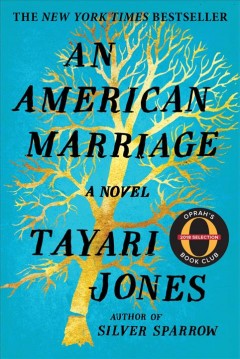
I chose An American Marriage by Tayari Jones for our February selection because the book came highly recommended, longlisted for the National Book Award, winner of the 2019 NAACP Image Award for Outstanding Literary Work in Fiction, winner of the 2019 Women’s Prize for fiction, and the February 2018 Oprah’s Book Club 2.0 selection.  February is also African-American Heritage month and it’s Valentine’s Day week!

Our discussion got off to a bit of a rocky start. We had been discussing movies and the Oscar winners when we seamlessly slid into our book, with mixed reviews. Different. Not interesting. Liked.  Since none of our members are black, I shared that one of my coworkers felt that the story captured well the African-American woman’s sense of being subjugated to black men.  The subjects of innocent incarceration, prison in general, infidelity, abortion, and women’s rights are huge and we rambled.

So, earlier than usual, we referred to the publisher’s discussion questions to give us direction, starting with the appropriateness of the title.  Which marriage? Several of us seemed to think that the story was primarily about Roy.  And he was unfaithful during the short marriage, so if Celestial had been incarcerated . . . He didn’t even wait when he wanted to save his marriage.  Andre was sweet.  We didn’t like Roy or Celestial much.  I think we liked Big Roy and Olive.  What did the tree Roy attacked represent? Was Roy attacking Celestial indirectly?  Why did she go into the house and watch Roy beat up Andre? Why did she have the abortion so quickly?  Was the author just proselytizing? Why didn’t they communicate better?  Do we communicate any better in our own lives?

One of us had worked in a prison in Utah and felt that it was highly unusual for an innocent person to be in prison.  She understood Celestial’s unwillingness to be treated like the majority of women who visited, smuggling in drugs made to look like M&Ms or who knows what.  We believed in Roy’s innocence and one of us said she had expected me to bring pears for our snack.  If only I had thought to bring pears and M&Ms!

We ended by discussing the writing.  We had mixed opinions here, too.  Well-written, with interesting metaphors, yet we wondered if the author wasn’t trying too hard. One of us had read reader reviews and said that the book seemed to be rated either a five or a two – they either hated it or loved it.  My impression is that if you averaged our responses, we would rate the book a three.  One of us ended by reading  the following excerpt:  “Human emotion is beyond comprehension, smooth and uninterrupted, like an orb made of blown glass.” What does that mean?  Our hour was up. But the discussion doesn’t have to stop here.  What do you think?

  • Other Works discussed:
  • Just Mercy (1919) film and book by Bryan Stevenson
Our Town: a play in three acts Discussion Journal

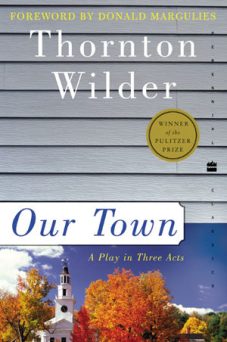
That place where everyone knows your name. Where milk bottles are delivered to your door and the horse doesn’t let the driver miss your house. Ice blocks are delivered, too; and the deliveryman breaks off pieces for children in the street. Everyone leaves doors unlocked.  At delivery, the birthing mother first learns that her newborn will come out the same way it got in! Such is the nostalgia that opened our discussion of Thornton Wilder’s Pulitzer Prize-winning play, Our Town.

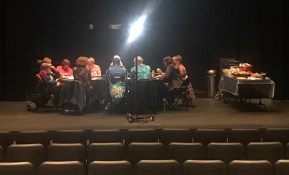
The week before our discussion, some of the book club members joined a few other TableReadingDistancelibrary patrons for our first Table Reading.  We read out loud, sitting around a table on the stage of our beautiful theater – not as a performance, but as a chance to step outside our comfort zone and do something different and challenging. As a bonus, I found that hearing the play read, imperfectly and yet movingly, helped me appreciate this outwardly nostalgic and simplistic play all the more. For those of us who participated in the reading, our experience and understanding could not be but different than those who did not. During this month, as people at the library noticed the book selection, several stopped to share that they had performed in this play during high school!
[i]

OurTownWe discussed how the play’s stage manager role, minimalistic set and lack of props was groundbreaking for 1938. Our Town won the Pulitzer Prize in 1938 “For the original American play, performed in New York, which shall best represent in marked fashion the educational value and power of the stage, preferably dealing with American life, $1,000.”[ii] Does “in marked fashion” mean obvious?  One of us had trouble visualizing the story through reading. Was the author the stage manager? Thornton Wilder did actually portray that role on stage.[iii] We discussed the change in gender roles and society over time.  If Emily had lived, would she have achieved her “dream of greatness?” Probably not. [iv] What did we think Mrs. Webb meant when she says that sending girls into marriage is cruel?[v] Work? Sex? Dr. Gibbs doesn’t want to travel because he might then be dissatisfied with Grover’s Corners. Well, what about Mrs. Gibbs and her dream? If the town takes care of those who can’t take care of themselves, why does the drunken choir director commit suicide?
None of us had seen the 1940 film version and I believe all of us were surprised that the dream-sequence third act was not a Hollywood happy ending but a choice by Thornton Wilder: “He wrote to Sol Lesser, the film’s producer, ‘Emily should live … in a movie you see the people so close ‘to’ that a different relation is established. In the theatre, they are halfway abstractions in an allegory, in the movie they are very concrete … It is disproportionately cruel that she die. Let her live.’”[vi] Ah, allegory. Life. Love. Death.

We discussed many more things in snippets. Comparisons with previous book club selections, films, our wages over the years. One of us wondered if anyone else had found the play just too saccharine. No real drama or action, compared to say, Tennessee Williams.[vii] I had researched the relevance of Our Town in the Twenty-First Century for that very reason! Our discussion helped, but we wondered about the validity of updating such a classic to reflect modern times.[viii] Perhaps it should remain as a time capsule.

We could have continued, but our discussion lasts for just an hour. And like the characters in the play, I don’t remember all the details. We ended with one member’s comment about something like a dose of daily joy.  If we take anything away from this play, it should be to notice the joy in what appears to be mundane, everyday life. And for many of us, that is certainly not simplistic.

Other works discussed:

  • The Adventure of Huckleberry Finn by Mark Twain
  • Clock Dance by Anne Tyler
  • War of the Worlds by HG Wells
  • A Street Car Named Desire by Tennessee Williams
  • Glass Menagerie by Tennessee Williams
  • Paterson 2016 film starring Adam Driver


[i] Even in 2019, Our Town, first produced in 1938, made NPR’s list of Top Highschool Plays and Musicals #4: https://www.npr.org/sections/ed/2019/07/31/427138970/the-most-popular-high-school-plays-and-musicals. The play came to my attention because one of the main characters in the  2017 film Wonder plays Emily in her high school production. The play ranked sixth in a 2010 list of most important American plays https://www.denverpost.com/2010/02/11/the-10-most-important-american-plays/.

[ii] https://www.pulitzer.org/winners/thornton-wilder-0

[iii] The Stage Manager, played by Wilder himself for two weeks in the 1938 Broadway production, breaks the fourth wall by directly addressing the audience. http://www.twildersociety.org/works/our-town/

[iv] Discussion question 2: https://www.arts.gov/national-initiatives/nea-big-read/our-town

[v] Discussion question 5: https://www.arts.gov/national-initiatives/nea-big-read/our-town

[vi] https://www.mentalfloss.com/article/528278/15-remarkable-facts-about-thornton-wilders-our-town

[vii] Two of Williams’ plays made the Denver Post’s list of top ten American plays:  A Street Car Named Desireand Glass Menagerie. https://www.denverpost.com/2010/02/11/the-10-most-important-american-plays/

[viii] Here we discussed the alteration of Mark Twain’s classic, The Adventures of Huckleberry Finn: https://www.theguardian.com/books/2011/jan/05/huckleberry-finn-edition-censors-n-word.


Elevation Discussion Journal

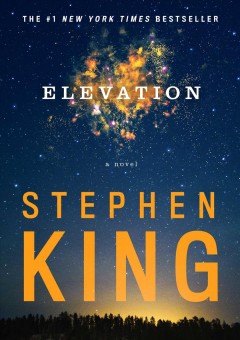
This last month we read Elevation by the King of Horror[1], Stephen King.  The book is ElevationCovermore novella than novel and when I announced the selection, most members were glad the book was short.[2]  Stephen King is the author of 62 novels, 20 collections, 32 novellas, and 11 non-fiction works[3], including On Writing, which was required reading in my younger daughter’s ninth-grade English class.  King graduated from the University of Maine in 1970 with a degree in English.  After graduation, he worked in an industrial laundry and then as a high school English teacher. His first major publication was Carrie in 1973.[4]  Even if we haven’t read any Stephen King, is there anyone who hasn’t heard of Carrie?  A google search reveals that 83 films, television series and other remakes and adaptations have been made from King’s work.[5]

So what did we think of Elevation?  Most everyone liked the story. We found it easy to read, uplifting, and thought-provoking, even if a bit vague with details.  Our first responder listened to the audiobook, which was read by the author. He found it a good book and particularly liked this well-placed summation, “She remembered something she’d read in college—Faulkner, maybe: Gravity is the anchor that pulls us down into our graves. There would be no grave for this man, and no more gravity, either. He had been given a special dispensation.”

Our second responder found three messages worth noting:  The importance of friendship, making a difference the way Scott did for his neighbors and the town, and elevation as a good description of dying.  Another of us liked the book and the characters but wondered, what did it really mean?  It isn’t clear, although as the discussion bounced about the table, most felt that Scott’s acceptance and eventual ascension was his reaching a state of Nirvana.[6]  We wondered at descriptions of the book as “eerie”[7] because none of us found it creepy at all.

One of us is a huge fan of Stephen King and felt a personal tie because so many of his works seem to reference places in Colorado, her own home ground.  She considers his books less horror than weird, although she remembers reading Salem’s Lot in little bits because it was so scary.  She believes that Stephen King trusts that his readers are smart enough to take what they need/want from his fiction.

We found plenty to discuss. After reading several blogs about the book, I had learned that King has been making some seriously anti-Trump tweets on twitter and I wondered if this book is his effort to practice what he preaches.[8]  I had found Scott Carey’s acceptance of his demise to be eerily similar to suicide and wondered if anyone else had considered this.  Mostly, we were moved by the positive messages in the story.  Scott elevated people all around him.  His enemy, Deirdre, became his confidant.  Were the numbers in the story significant? One of us particularly appreciated how she felt invested in the characters, unlike Magpie Murders!  Another member remarked that the hallmark of a well-written book is that you don’t notice it—and we agreed that he is a good writer.  We ended the discussion talking about closure and someone pointed out that the cover of the book shows the fireworks set off by Scott as he ascended.

Stephen King dedicated the story to Richard Matheson, who wrote The Shrinking Man and whose protagonist is also named Scott Carey. If any of us had read that book, or seen the movie adaptation, we might have had even more to discuss!  As always, connections abound:  Several members remembered a recent article about students standing up for a fellow student and reporting a substitute teacher for anti-homosexual shaming.[9]  Keep reading, think about it, discuss it, stay connected!


  • Other Works Discussed:
  • I am sure we discussed some, but I don’t remember anything other than what’s mentioned in the journal!

[1]When I googled “which author is King of Horror?” the picture and biography of Stephen King appeared. At the library he is the go-to author when people ask for horror, but I never before wondered if his name helped him gain this moniker!

[2]Elevation, listed as a novel, is 160 pages.  In comparison, The Standis 1200 pages long and ITis 1184 pages!

[3]Web accessed 12-12-2019: https://www.fantasticfiction.com/k/stephen-king/

[4]Web accessed 12-12-2019: https://www.stephenking.com/the_author.html

[5]Web accessed 12-12-2019:  Looking past the general google search, I liked this list of his adaptations, https://www.businessinsider.com/stephen-king-novels-and-stories-adapted-movies-tv-shows

[6]Random House Dictionary definition of Nirvana: “a place or state characterized by freedom from or oblivion to pain, worry, and the external world.” Web accessed 12-12-2019: https://www.dictionary.com/browse/nirvana?s=t

[7]2018Publishers Weeklyreview referenced on the lvccld.org website: “In this surprisingly sweet and quietly melancholy short novel, King (The Outsider) weaves an eerie, charming tale of the ways that strange circumstances can bring people together.”

[8]“What’s most surprising about “Elevation” is that this would seem the perfect moment for King to twist the fury of his Twitter feed.” Web accessed: 12-12-19:  https://www.washingtonpost.com/entertainment/books/stephen-kings-halloween-book-is-shockingly–heartwarming/2018/10/29/82bc41f6-db1d-11e8-b3f0-62607289efee_story.html

“The political divisions running wild through the country are absolutely part of the story, which in the end turns out to be a wish-fulfillment tale in which people actually are able to be friendly despite their differences.  All it takes is for the right spark to come along.”—Bryant Burnette. Web accessed 12-12-19: http://thetruthinsidethelie.blogspot.com/2018/11/a-brief-review-of-elevation.html

[9]“Classmates act as boy with two dads draws sub’s wrath.” The Associated Press. Salt Lake City. Las Vegas Review-Journal (NV) – December 2, 2019 – page 4

Magpie Murders Discussion Journal

We met last night to discuss Magpie Murders by Anthony Horowitz. We read Horowitz’s first Sherlock Holmes novel, The House of Silk, in 2015 and several of us had seen his television contributions/creations, Foyle’s War and Midsomer Murders.[i] Magpie Murders received starred reviews from Publishers Weekly and Kirkus and was billed by the publisher as a “classic whodunit worthy of Agatha Christie [woven] into a chilling, ingeniously original modern-day mystery.”MagpieMurders

So what did we think?  Our first responders were enthusiastic. They liked it.  It was complicated with thirty different characters and several of us stopped to take notes while reading. One of us thought it was the most complicated story we have read. Another said it was the most complicated story she had liked! We had been frustrated when the vintage-style murder mystery suddenly stopped just shy of the final denouement. Some of us had paged forward. And some of us had lost interest.

At 496 pages, Magpie Murders is long for a book club selection and one of us thought the author was too clever for his own good; she felt left out by not understanding all of his literary, cultural and geographic references. Another had not yet finished it and after our spoilers probably won’t! One of us looked up place names even as we met – such is the wonder of the Internet.

We discussed the author’s purpose, wondering if his reference to plagiarism was personal.  One of us mentioned that Nora Roberts had sued Janet Dailey and another of us found that Roberts had recently sued a Brazilian author who is accused of stealing material from “more than 40 writers and nearly 100 books” so far.[ii] Is it stealing if it is not intentional? Horowitz also highlights how authors can create characters from the people around them and how stories are filled with more murders than could possible occur.  One of us even quoted how many deaths are in Midsomer Murders.[iii]

Others noted that the novel had been formatted with different fonts for the separate story lines and even different page numbering styles. The audio book had a male and female reader to distinguish the stories.  The kindle version was less helpful.

Our discussion was light and peppered with references to other books and facts. I misspoke when I said that The Word is Murder is a second book in the same series as Magpie Murders – it is actually the first in another series that looks to me to be more promising. If you decide to give The Word is Murder a try, let me know what you think.

  • Other works discussed:
  • Rhys Bowen
  • Sandra Brown
  • Malcolm Gladwell (Talking to Strangers 2019)
  • John Grisham
  • Murder She Wrote (T.V. Series with Angela Lansbury)

[i] According to litlovers.com, which references Wikipedia, born in 1955,“Anthony Horowitz, OBE is a prolific English novelist and screenwriter specialising in mystery and suspense. His work for children and teenagers includes The Diamond Brothers series, the Alex Rider series, and The Power of Five series (aka The Gatekeepers). His work for adults includes the novel and play Mindgame (2001) and two Sherlock Holmes novels, The House of Silk (2011) and Moriarty(2014). He has also written extensively for television, contributing numerous scripts to ITV’s Agatha Christie’s Poirot and Midsomer Murders. He was the creator and principal writer of the three ITV series—Foyle’s WarCollision and Injustice.”

[ii] León, C. D. (2019, April 24). Nora Roberts Sues Brazilian Writer Who She Says Plagiarized Her Work. Retrieved November 13, 2019, from https://www.nytimes.com/2019/04/24/books/nora-roberts-plagiarism.html.

[iii] “Up to and including episodes 1 – 8 of series 14, the Midsomer Murders death toll is 246 murders; twelve accidental deaths, eleven suicides and eight deaths from natural causes.” Facts and Trivia. (n.d.). Retrieved November 13, 2019, from https://www.visitmidsomer.com/facts-and-trivia/.


Clock Dance Discussion Journal

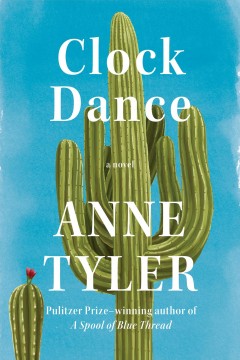
Our group has now read three books by Anne Tyler: The Beginners Goodbye, Digging to America, and Clock Dance.  I chose Clock Dance because, after our last few serious books, we could all use the subtle humor and optimism for which Tyler’s literary fiction is well known, especially as we head into the winter holidays.

The group’s reaction was low key, perhaps indicative of the calming effect of a good story, boredom or a reaction to the early darkness. Our first responder took exception with the title. Why Clock Dance? We discussed the girls’ slow, ticking movement versus Willa’s vision of a “spinning blur of color.” One of us used her Kindle to look up the actual passages, helping us to remember and understand. She suggested that the Clock Dance was important because the girls’ dance represented society’s expectation and later the “racing . . . madly whirling” dance was Willa breaking free.ClockDanceCover

One of us had listened to the audiobook and gave a concise yet negative summary of the story.  She hadn’t liked any of the characters and had not been hooked. She even found the young girls at the beginning to be annoying.  Although one member agreed with that unfavorable assessment, we wondered if the audiobook performance was less engaging than it could have been.

We discussed why Willa was willing to fly across the country to help a stranger. Would any of us? Not only did Willa desire purpose, she needed to be needed. I was particularly struck by a member’s observation that Denise and Cheryl cared for Willa. One member was glad that Willa finally wised up! How could she have put up with Peter so long?

One of us had been so appalled by Willa’s mother that her passion jumped onto the table, drawing our attention to the fact that Willa’s turbulent, traumatized, childhood made Willa a mother “whose prime objective was to be taken for granted.”  We disagreed about Willa’s father’s innocence. Was he truly clueless about his wife’s madness? Shouldn’t he have protected his children?

Willa took after her father. Her son seemed to have chosen a new girlfriend like his mother. Neat, perhaps obsessive Cheryl was not like her messy mother Denise – but she obviously loved her.  And was Denise a bad mother? Negligent? Especially in comparison with Willa’s mother? We discussed cleanliness and someone said, “Nobody’s headstone says she went to heaven for a clean house!” Still others mentioned how they were raised to keep the house “company ready” or remembered keeping the house ready for the minister’s unexpected visit!

The majority of us liked the novel. We found it easy to read.  Anne Tyler is a “good stylist.”  We discussed funny parts.  There is no such television show as Space Junk—we know because one of us looked it up. And can’t we just imagine crime tips in the back of comic books?  We knew how things would likely turn out, but we enjoyed the telling. Anne Tyler makes the ordinary interesting. I know that I found myself looking forward to reading Clock Dance, not for the suspense of the story so much as for a visit with a friend.

Before the meeting we discussed books and trains and grilled cheese sandwiches. You’d just have to be there to see how it all fit together!

  • Other works discussed before and after:
  • Enemy Women by Paulette Jiles
  • The Indian Lawyer by James Welch
  • Lolita by Vladimir Nabokov
  • Valley of the Dolls by Jacqueline Susann
  • Where the Crawdads Sing by Delia Owens
  • The Whistler by John Grisham

Fruit of the Drunken Tree Discussion Journal

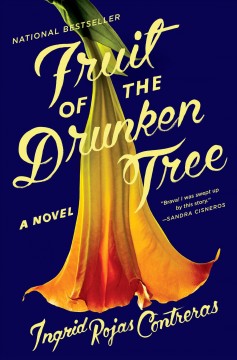
Fruit of the Drunken Tree was inspired by author Ingrid Rose Contreras’ experiences in Colombia, South America, from 1989 – 1994 during the reign of drug lord Pablo Escobar. Reviews for the book include “simple but memorable prose and absorbing story line” (NY Times Book Review), “dazzling and devastating” (San Francisco Chronicle), “simultaneously propulsive and poetic” (Entertainment Weekly), “politically daring and passionately written” (Vogue), “a seemingly unlimited reservoir of striking details” (Booklist).1  I was concerned that the book might be a little too devastating, a little too timely and political; I had been warned that another library book club had universally disliked the book, or as our multi-book clubber member said: “it wasn’t hated, it just wasn’t a favorite.”FruitOfTheDrunkenTreeCover

We had a good attendance for our meeting. Out of fifteen, only two of us hadn’t read it. Our first responders seemed to like the book – not gushing as many had for The Tea Girl of Hummingbird Lane or The Rosie Project, but reflective and thoughtful. Our discussion was personal. We remembered the hardships of our parents and grandparents. We shared our own experiences with domestic abuse. We wondered how we could ever leave the house with such reality of kidnapping and violence outside our doors. We wondered about the impact of media that keeps violence in front of us, whether or not it is even in our community. We compared it to other book club selections: the drought in The Dry, the potato famine in News of the World, American complicity in The Lost City of the Monkey God.

Some of us were disappointed in missing details. We considered the young narrators and how their innocence heightened our sense of fear and dread. We discussed more details than I remember. Were the characters fully developed? We didn’t understand the mother’s behavior entirely. Did we prefer Chula or Petrona as a narrator? Gorrión seemed to truly love Petrona, but still he allowed her to be brutally raped.  Can and should we ever be forgiven for our mistakes? There was so much we could have discussed. Layers and layers.

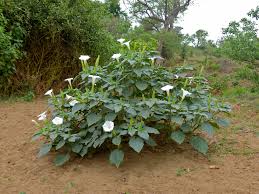
We reviewed a list of some of the many books we have read together over the years. We chatted and snacked and discussed the Sacred Datura plant that grows wild in SouthernSacredDatura Nevada and is related to the Drunken Tree used for the title – another shared experience through a book!
1 Litlovers.com website offers summaries, author bios, and reviews from various sources, discussion questions and more.  I often refer to their popular book list for ideas and we have read several books on their lists.

Lundquist, M. (n.d.). Fruit of the Drunken Tree (Contreras) – Book Reviews. Retrieved from https://www.litlovers.com/reading-guides/fiction/11333-fruit-of-drunken-tree-contreras?start=2


News of the World Discussion Journal

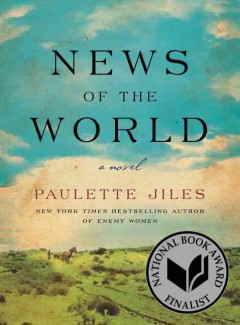
Our usual meeting place was in use, so we met on our concert hall stage to discuss News of the World by Paulette Jiles. A painted black wooden floor, a table made of four smaller tables surrounded by sixteen chairs, a single bulb on a stand, centered at the edge of the stage, both a lure and a warning! The air seemed foggy, the overhead light filtering down to us unevenly, the back and edges of the stage in relative darkness. A grand piano, heavy curtains, and 250 empty seats. In retrospect, it helps me imagine Captain Kidd setting up to read in strange venues, lit by lanterns, collecting dimes and performing. The news of the world he read was as fantastical to many of his audience as this story seemed to us today, depicting a post-Civil War Texas where handguns were illegal and abducted children wanted to stay with their captors.NewsOfTheWorldCover

Our first responder volunteered by email: “This is an incredible reminder of just how tough ordinary life was for our ancestors. I wish everyone who complains about their quality of life could read this book. I didn’t suspect it was based on a true story until the very end. My only criticism is that the title led me to think that this would be an ordinary novel about contemporary life. It needs a much more dramatic title. Can we put our heads together and come up with a better title? I’ll start the ball rolling. The Kiowa Maiden.” Later she added: “Return of the Kiowa Maiden.”

After some discussion, we decided against changing the title. Some of the appeal of the book was thinking about the news of the world, in the book and in today’s reality: immigration, political polarization, gun control.

We considered why the author wrote without using punctuation for dialogue – again with mixed results. Some of us hadn’t noticed it, some had been annoyed, mostly it didn’t seem to matter. One of us found the story predictable. Another was pleased to have a book that “moved.” It was refreshing, easy to read, informative, and with a happy ending. However, one of us wondered if Captain Kidd’s rescuing of Johanna in the end was a bit out of character. We seemed to feel that the author was reliable, but we did not delve in to many details. Discussing the publisher-provided questions, we did feel the author followed the arc of the hero’s journey, much like the story of Odysseus, with some of us championing Captain Kidd, some Johanna, and some for both. We felt that Johanna had benefited from her captivity, learning much needed life skills and then adapting to her return. One favorite scene was when Johanna used dimes for ammunition and then later charged forth, ready to scalp her attacker.

Our discussion bounced around considerably, including comparisons with previous book club selections Orphan Train, The Perfectionists, Mrs. Sherlock Holmes, and Dragon Teeth. One of us had read parts of Captured by Scott Zesch, the book Paulette Jiles recommended for further study. We came back repeatedly to the topic of why children would not want to return home, wondering about the appeal of the native lifestyle and religion, even to people today.We briefly discussed Stockholm syndrome and the Irish Potato Famine (An Gorta Mor)[i]

Although I’m fairly certain our club liked News of the World, it’s only an impression. An impression intensified by the birthday cake we shared before the discussion started and the good feeling of friendly, caring people surrounding me.

  • Other Works discussed:
  • Dragon Teeth (2017) by Michael Crichton
  • Man’s Search for Meaning (1946) by Viktor Frankl
  • “A Modest Proposal” (1729) by Jonathan Swift
  • Mrs. Sherlock Holmes (2017) by Brad Ricca
  • Orphan Train (2013) by Cristina Baker Kline
  • The Perfectionists (2018) by Simon Winchester
  • Book Circle recommendations:
  • Historical fiction by Susan Wittig Albert


[i] The author says in her afterword that Doris best explains Johanna’s situation by comparing it to the Irish Potato Famine: “You can put her in any clothing and she remains as strange as she was before because she has been through two creations. . .”(pg 56).

The Perfectionists: how precision engineers created the modern world

I was the first responder this month because, although I enjoyed parts of Simon Winchester’s book, awed by the talent, dedication, and obsession that made our world possible, the detail was sometimes overwhelming—enough that I skimmed much and worried what I was missing. Before the meeting, I wrote on our white board over 60 words I had looked up or highlighted while reading. Simon Winchester is the author of one of my favorite books, The Professor and the Madman, and his use of language is superb, inspiring, and intimidating.PerfectionistsCover

Many of our next responders seemed to agree with my assessment. Many of us hadn’t finished, though we might keep reading. One had finished it just that afternoon; another considered it homework; one of us had divided the page count by days between meetings and set a goal of 13 pages a day, still finding herself five pages short! We are glad we read it. Nods about the room agreed that we were educated by it. I also heard the comments: too wordy, too much detail, repetitive.

Still, we found much to contemplate. Fascinated by the section about cars, we discussed Ford’s choice to make his cars affordable, the details between the precision that created the assembly line and the perfection of the Rolls Royce; and details from other resources than this book, such as that Ford gave his workers a wage higher than the minimum wage and praise for the Henry Ford Museum in Dearborn, Michigan.[i] One of us remembered the deployment of the Hubble Telescope and particularly enjoyed reading those details. We wondered at how much they don’t teach us in school, such as the chicanery of Eli Whitney. We discussed greed versus altruism in invention, the affordability of silicon, the absence of women, the woman who wrote the first transistor calculator code on the back of a napkin, and the woman who died in a box warning about the Japanese tsunami of 2011. We reviewed Simon Winchester’s list of books, amazed at the depth of knowledge and wondering how many research assistants he employs.

Simon Winchester celebrates the precision that created the modern world, but by the end, he seems to join the luddites in a fear for the future and an appreciation for the beauty of craftmanship and its inherent imperfection. In comparison to other non-fiction books we have read, one of us felt that The Wright Brothers by David McCullough had more personality. Many felt that The Perfectionists is more scientific than historical. How much more science and history might we have learned in school if our textbooks had been this appealing? Yet Winchester has been criticized for writing “popular science.”[ii] How thick would a book be that had all the necessary information. One of the strengths of our book club, as with any discussion in general, is in making us think about what we read, to challenge us and give us new perspectives, to encourage us to search further and deeper, to make connections.

I hope you choose to connect with us next month!

  • OTHER WORKS DISCUSSED:
  • The Reckoning (1986) by David Halberstam
  • The Wright Brothers (2015) by David McCullough
  • Becoming (2018) by Michelle Obama
  • Enders Game (1985) by Orson Scott Card
  • The World is Flat: a brief history of the 21st Century (2005) by Thomas L. Friedman


[i] https://www.thehenryford.org/

[ii] https://www.wired.com/2011/03/writing-popular-science-books-doesnt-make-you-a-scientist/

The Dry Discussion Journal

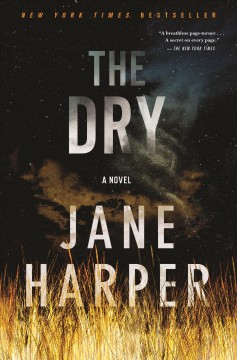
Whitney Book Bistro’s June selection, The Dry, is Australian journalist Jane Harper’s debut novel. The internet is an amazing tool for readers and at the start of the meeting we looked at some pictures of Victoria, Australia, including zooming in on Google Maps, watching perhaps just 60 seconds of a video about Australia’s drought[i], and just ten seconds of a potentially harrowing video of someone driving on the wrong side of the road![ii]Published in the US in 2016, members were interested that The Dry won the 2015 Victorian Premier’s Literary Award for an Unpublished Manuscript.  In a video we didn’t watch, Jane Harper describes her writing process, from taking a Curtis Brown Creative Course in 2014 to motivate her to write it, through five drafts to bring the book up to its current 90,000 words.[iii]

Most of us did not know the background information before reading the novel.  One TheDryCovermember wrote from Alaska that she couldn’t make the meeting but really liked the book and was sorry to miss the discussion! Around the table reviews were favorable. Many read the book quickly and at least one of us skimmed ahead.
We liked reading about Australia but found the small-town dynamics to be the same as here in the U.S. The flashbacks were difficult in the audiobook, and alternating between Aaron and Falk in the audio made it sound like it was two different people! Someone mentioned that the author did a good job describing the atmosphere of the drought and another noted that it was a woman writing a male lead character. One of us thought the characters were one-dimensional, another found them interesting. We still wanted to know more about them.  Would the principal really have killed people? What was Gretchen’s backstory? We didn’t agree about whether Luke was the father of Gretchen’s baby or if Falk would use the information from Ellie’s backpack.  We shared some of our own stories about abuse, neighbors, and fear of retribution.  Aaron was lucky to have gotten away, despite the suspicion that remained.

We agreed that the author kept us guessing throughout.  One of us knew that we didn’t learn about the gambling until page 272!   Another remarked that the biggest red herring was that the person who killed Luke and his family would be the same person who killed Ellie. Still another had been disturbed by the fire at the end but upon reflection and re-reading found it to be redemptive.  One member read a descriptive passage that stood out:  “Luke Hadler may have had a light on waiting for him when he came home, but something else from this wretched, desperate community had seeped through that front door and into his home. And it had been rotten and thick and black enough to extinguish that light forever.”

I couldn’t help but mention our John Grisham selection and comparisons with his first books. I am intrigued no one at the meeting seemed repulsed by the descriptions of violence as they were in God Help the Child or The Tea Girl of Hummingbird Lane. Is it the mystery and suspense that allows us to plow ahead undisturbed?

Before the meeting, the room was abuzz with discussion. An Australian theme gave us interesting opportunities for snacks.  We tried Australian-made root beer and ginger beer (nonalcoholic!), mango licorice, chocolate honeycomb candy, and Vegemite on crackers. None of these related to the story, but it’s all part of the shared experience.

  • Other Works Discussed:
  • The Great Alone by Kristin Hannah (2018)
  • The Thorn Birds by Colleen McCullough (1977)
  • Law and Order television series
  • A Town Like Alice by Nevil Shute (1950)
  • John Grisham (author)
  • Kate Atkinson (author)
  • Tana French (author)


[i] Blue, Circle of. “The Biggest Dry Australia’s Waning Rivers & Worried Towns.” YouTube, YouTube, 1 Apr. 2009, www.youtube.com/watch?v=bNLek0FPmZo.

[ii] Slater, Aaron. “10 Minutes Driving in the Australian Countryside.” YouTube, YouTube, 3 Sept. 2014, www.youtube.com/watch?v=PafkrgDQ-BU.

[iii] •Creative, Curtis Brown. “Curtis Brown Creative Talks to Jane Harper, Bestselling Author of The Dry (Part 1).” YouTube, YouTube, 2 May 2017, www.youtube.com/watch?v=pd6ZgYy2YvI.

•Creative, Curtis Brown. “Curtis Brown Creative Talks to Jane Harper, Bestselling Author of The Dry (Part 2).” YouTube, YouTube, 6 June 2017, www.youtube.com/watch?v=BMvSU6M6YWQ.


Spoonbenders Discussion Journal

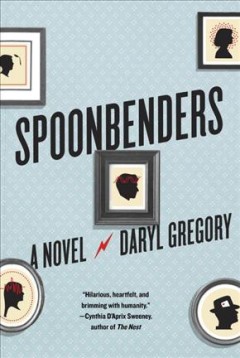
Spoonbenders by Daryl Gregory did not receive glowing reviews during the book club discussion, but most members present seemed to like it or find it interesting. We were thoughtful.  Our first responder liked it and particularly mentioned the writing style. For many of us, the multiple character shifts led often to confusion. For some, the psychic powers were too much fantasy.  At least two readers let me know they disliked it enough to stop reading and not attend the meeting. A couple of others didn’t like it, but they accepted the challenge!SpoonbendersCover

We discussed how to classify the novel, and how important that can be to help us filter the multitude of reading options down to manageable and rewarding selections.  One or two mentioned fantasy and science fiction, because of the family’s special powers.  Yet one of us thought it was realistic fiction. He thought that patriarch Teddy, conman and non-psychic, actually seemed to possess all the powers of his children without the magic! In his afterword, the author actually states, “. . . none of it’s real, folks.”  Which makes me think of Arthur C. Clarke’s Third Law:  “Any sufficiently advanced technology is indistinguishable from magic.”[1]

We discussed personal experiences with psychics and the real-life government program called Star Gate[2]. During our meetings we have often discussed how things we read open our eyes to the world around us, and just this morning, the front page of our local newspaper reported, “A lawyer was steadily swindled out of $1.5 million after authorities said she responded to a flyer for ‘Psychic Readings’ she found on the door of her Summerlin home.”[3] Science fiction, fantasy fiction, realistic fiction or all of the above?

We discussed details, like why Teddy chose the name Telemachus, the name of the son of Odysseus and Penelope.[4] Irene is a favorite character. Buddy is endearing. Characters are absolutely original (if not believable?). As funny as the book is, the hand crushing detail is jarring. And why did Buddy’s first intimate experience have to be with a man? Which brought us to recent library staff Gender training and our previous book club selection, This Is How It Always Is. What seems odd to one of us might not to another of us.

I read a passage that had stood out for me:  “The problem with getting old was that each day had to compete with the thousands of others gone by. How wonderful would a day have to be  to win such a beauty contest?” Another member read “Wide awake in the thin hours of the night, her mind churning along on the All-Star Tour of Embarrassments and Mistakes. The tour could visit any decade, and feature any number of characters from her past . . .”

Time in Spoonbenders was the most interesting concept for me.  At the end of the book, I realized how the author had given clues for the ending that I only enjoyed on a second reading. My mother, who lives in Missouri but still often reads our selections, suggested that the confusing nature of the book is like reality, never so clear as in hindsight. I researched the concept of time in books and came across an article listing the Top 10 Books About Time. The author highlights the fourth century Confessions by St. Augustine, “He [Augustine] noted that what we call three tenses are really just shades of one: our present experience of the past (otherwise known as memory); our present experience of the future (anticipation), and our present experience of the present (attention).”[5] Spoonbenders is rife with anticipation.

  • OTHER WORKS:
  • Men Who Stare at Goats (2009) Film
  • This Is How It Always Is (2017) by Laurie Frankel
  • Water for Elephants (2006) Sara Gruen

[1] This quote is well known and many sources can be found. This is just one:

Mascarenhas, K. S. (2011). Arthur c Clarke: Father of Satellite Communication. Science Reporter, 48(03), 14-15. Retrieved May 16, 2019, from http://nopr.niscair.res.in/bitstream/123456789/11159/1/SR 48(3) 14-15.

[2]               ESP: Inside the government’s secret program of psychic spies. (2018, March 18). Retrieved May 16, 2019, from https://www.cbsnews.com/news/esp-inside-the-governments-secret-program-of-psychic-spies/

Burton, B. (2017, January 20). CIA releases psychic experiment documents. Retrieved May 16, 2019, from https://www.cnet.com/news/cia-releases-psychic-experiment-documents-online-stargate-project-stranger-things/

[3]               Ferrara, D., & Ferrara, D. (2019, May 15). 3 charged in Las Vegas swindle that scammed attorney out of $1.5M. Retrieved May 16, 2019, from https://www.reviewjournal.com/crime/courts/3-charged-in-las-vegas-swindle-that-scammed-attorney-out-of-1-5m-1663714/

[4]               Britannica, T. E. (2018, February 07). Telemachus. Retrieved May 16, 2019, from https://www.britannica.com/topic/Telemachus-Greek-mythological-character

[5]               Burdick, A. (2018, January 10). Top 10 books about time. Retrieved May 16, 2019, from https://www.theguardian.com/books/2018/jan/10/top-10-books-about-time

St. Augustine quote:  “In you, my mind, I measure time.”