The River We Remember -One reader’s response

Our book club has read two books by William Kent Krueger, Lightning Strike, a prequel to his Cork O’Connor mystery series, and Ordinary GraceThe River We Remember is similar to both of these, in their small-town Minnesota setting, time period (1958-1963), and coming of age themes. From our previous two discussions, William Kent Krueger’s books have been well-liked, reliably-engaging, comfort reads. 

I chose The River We Remember because our meeting fell on Veterans Day, which is in the middle of Native American Heritage Month. Veterans’ Day is one of the few holidays that sticks to one date, November 11th, in honor of Armistice Day, 1918. I hoped this story about a Native-American veteran accused of killing a wealthy landowner would heighten the connections we build through our shared-reading experience while also honoring our veterans and Native Americans. 
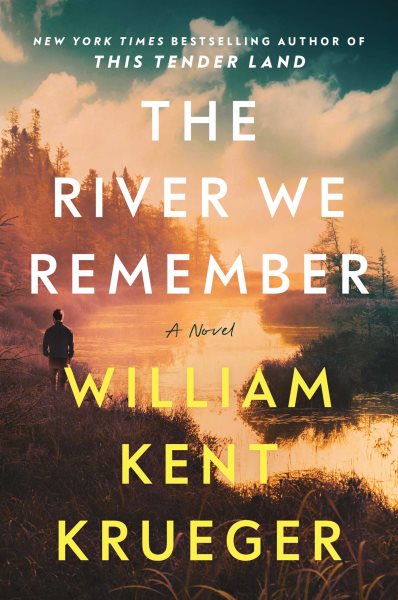
The book was well written, the mystery and storylines woven together believably and fairly. I read choppily, at the end of long days, but I was able to keep up without re-reading. The themes and characters weren’t exactly stock, but they were familiar and poignant. The stoic Native American working the land. The Battle of Wounded Knee in 1890. Betrayal. John Wayne. “The Purple People Eater.” The Naked and the Dead by Norman Mailer. The Catcher in the Rye by J.D. Salinger. Tortilla Flat by John Steinbeck. For me, the most important theme of The River We Remember is the danger of keeping secrets. The most poignant is when the author reminds us, “it’s always boys who go to war.” The youth who are now our veterans.

Krueger’s descriptions pleased me and painted images of people and concepts in new ways that I appreciate. Summer as a season “that breathed promise.” The sky “was beginning to salt with stars.” A gesture that “nailed hate to his heart.” “When the world throws at you nothing but stones, maybe to survive you simply become stone yourself.” While he was serving in Vietnam, my uncle wrote a poem he titled, “Eyes of Stone.” How could this not resonate with me? I can’t help but wonder, though, what the response of twenty-somethings might be. 

Why do we read? To escape, to learn, to simply pass the time? Someone recently told me that to hope is not just to wish, but to expect. Since I was unable to attend the meeting this month, I am missing the most important part of the experience! I hope you’ll share your thoughts about the book and the meeting.
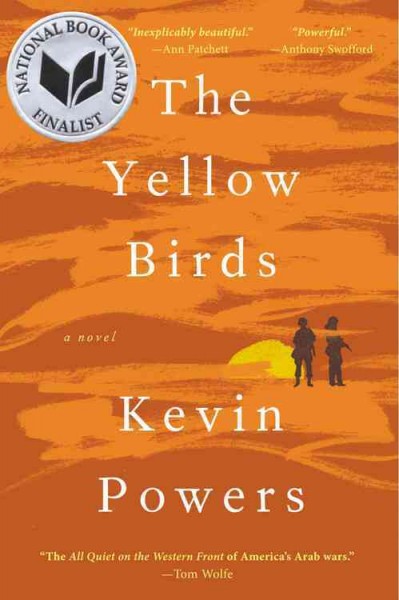
The Yellow Birds Discussion Journal

The Yellow Birds, by Kevin Powers, was not easy to read – and not just because of the subject matter. It is definitely not a book to read late at night, when you are tired and falling asleep. I re-read pages, sometimes just trying to understand content, but other times just to savor the concept or imagery. “Where little drifts of snow sketched the December wind.” “When I got fed up with nothing.” “Empathy is an imaginative act.”YellowBirdsCover

I was not surprised at all that our first responder emphatically shared that she hated it – and several members agreed. Several had not finished the book, and one member had nearly vomited trying to read it. I had skimmed through many of the hardest scenes, but members were often able to clarify what happened, even quickly find the necessary passages. One member liked the book. She found the writing beautiful, and several others then agreed. Some of us would want to have our children’s bodies returned to us, whatever the condition.  Others adamantly would not. All seemed to agree that Bartle should not have been imprisoned for his part. Fifteen people at our meeting – the same yet different.

We discussed how family members and friends never talk about what happened during their service and how different our wars have been.  The world wars were fought to fight great evil and veterans are generally admired.  The Vietnam and Korean war veterans met disdain at home; their wars seemed lost and purposeless to those at home.  Veterans of our current wars are often met with gratitude and thanks for their service, even though we may disparage the war itself. Yet the author shared his own sense that in fighting a senseless and purposeless war, he was ashamed and uncomfortable with the gratitude. “It was a sign and we knew what it meant, that hours had passed, that we had drawn nearer to our purpose, which was as vague and foreign as the indistinguishable dawns and dusks with which it came.”

The Yellow Birds was a National Book Award finalist. But the author is primarily a poet, and as we discussed whether his writing was any good, I read from an interview in which Kevin Powers was asked about “the deeply lyrical quality” of his prose. He responded in part: “In trying to demonstrate Bartle’s mental state, I felt very strongly that the language would have to be prominent. Language is, in its essence, a set of noises and signs that represent what is happening inside our heads.” (Kindle Version)*

One member mentioned that to truly understand the author’s intent, she would have to read it again and again.  Another member said he would like to read it, now that we had discussed it. But would we? Could we? Does our understanding make a difference? Do we have any power? One member said that we should give the book to our politicians to read.

Even then, the author often describes rather than tells, and the reader’s perception is everything.  I read aloud a passage that had moved me, “I knew that at least a few of the stars were probably gone already, collapsed into nothing. I felt like I was looking at a lie.” One member quickly responded, “Why a lie. History.”

Our next book is more main stream, the sixth in a mystery series that includes dogs. After The Yellow Birds, I think we are all ready for something lighter. I seldom read books before I select them. I have read reviews, looked at lists, thought about themes, diversity, and content. If I read them first, I’d be hard pressed to choose a book I didn’t like, so we’d be limited. As one member commented, “We’re all in this together!” Thanks for joining the discussion.

*A conversation with Kevin Powers and Jonathan Ruppin of Foyles Bookshop, London

All book and interview quotations taken from the electronic version of The Yellow Birds by Kevin Powers. Little, Brown and Company, New York, 2012.

  • Other Works Discussed:
  • All’s Quiet on the Western Front by Erich Maria Remarque
  • Goodbye to All That by Robert Graves
  • Parade’s End by Ford Maddox Ford
  • Rudyard Kipling
  • Wilfred Owen (Poems by)
  • Redeployment by Phil Klay (Short Stories – 2014 National Book Award Winner)
  • Thank You For Your Service by David Finkel (2013 Non-Fiction)

We discussed a few more, but I didn’t get the names. Most of these are from the First World War. If you have additions, please comment!