Unknown's avatar

About Kristine

I am the current moderator of the Whitney Library Book Club

War of the Worlds Discussion Journal

Every January we discuss a classic novel that is always available in e-book format, to challenge ourselves with reading and technology.  As much as most of us love the feel of a book, the ability to access our books on modern devices is increasingly acceptable and even desirable—particularly when it comes to reading in large print without holding a heavy book and reading in the dark. Plus, from our library’s viewpoint, it is the way of the future.

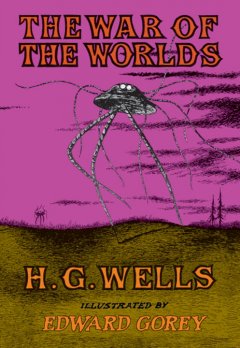
A week ago today, the Whitney Book Bistro met to discuss H.G. Wells’ War of the Worlds.WarOfTheWorldsCover  Our first responder had put off reading the book until the last minute, dreading the gravity of the story, but she accepted the challenge (an assignment she took seriously!) and finished it just two hours before the meeting.  She paused, “It was rather imaginative.”

Two of us had read The Complete War of the Worlds Book: Mars’ Invasion of Earth From H.G. Wells to Orson Welles (2001), which included a CD recording of Orson Welles 1938 radio broadcast, sharing details about that production as well.  The hysteria created by Orson Welles’ broadcast is credited with cementing Wells’ story in history.

We discussed the language, vocabulary that was fascinating – from the use of wonderful[i]to archaic words that kept us looking in our dictionaries. I particularly liked phrases such as, “amidst the scattered splinters of a fir tree it had shivered to fragments in its descent” and “rhythmic shocks that had kept our ruinous refuge quivering.”   Another liked the description of the British gung-ho approach to fighting the aliens.   Some of us found the book depressing through the middle. We all laughed when one person mentioned Wells referring to the curate “as lacking in restraint as a silly woman,” and another answered with – “page 185!” One of us liked the narrator’s brother best, and we all wondered why Wells just dropped that character.

We discussed that science fiction has always been predictive, impressed that Wells imagined the future of warfare with tanks and gas and atomic bombs.[ii]One member who joined the discussion even though she hadn’t read the book said that the novel seemed like an “adult fairytale.” This was an apt description given Wells’ moralizing: “And before we judge of them [the Martians] too harshly we must remember what ruthless and utter destruction our own species has wrought.”

One of us likened the nightmares our narrator suffered to what we now call Post-Traumatic Stress Disorder (PTSD). We discussed how reality mirrors our reading, such as the recent headlines about the explosion in New York City that turned the sky blue, prompting people to fear an alien invasion.[iii]  Another member voiced what many of us feel, which is that our news today is unreliable. News used to seem credible. Walter Cronkite. Tom Brokaw. Who can we trust now? Which led to a discussion of other books we have read, particularly a book club favorite, Destiny of the Republic. Sometimes, books remind us how little things change.

As usual, we discussed more than this.  Wonderful things. Mundane[iv]things.  Contradictory things.  In my research for this discussion I was both impressed and appalled by what I learned about H.G. Wells.  All because of this group.  Sometimes it’s work, sometimes it’s play, always it’s worth it.

ENDNOTES:

War of the Worlds quoted here is the Ibook, Inc., 2002 edition, kindle version

[i]“The early morning was wonderfully still.”

[ii]“HG Wells first imagined a uranium-based hand grenade that “would continue to explode indefinitely” in his 1914 novel The World Set Free.” “Was HG Wells the First to Think of the Atom Bomb?” BBC News, BBC, 4 July 2015, http://www.bbc.com/news/magazine-33365776.

[iii]New York Sky Turns Bright Blue After Transformer Explosion.” By Matt StevensRick Rojas and Jacey Fortin.New York Times, 28 December 2018, http://www.nytimes.com/2018/12/27/nyregion/blue-sky-queens-explosion.html

[iv]adjective

  1. common; ordinary; banal; unimaginative.
  2. of or relating to this world or earth as contrasted with heaven; worldly; earthly:mundane affairs.
  3. of or relating to the world, universe, or earth.

“Mundane.” Dictionary.com, Dictionary.com, http://www.dictionary.com/browse/mundane. Based on the Random House Unabridged Dictionary, © Random House, Inc. 2019


‘Round Midnight Discussion Journal

It has been exactly one week since we met to discuss ‘Round Midnight by local author Laura McBride. We read her first book, We Are Called to Rise, in December of 2015. Her newest book was more critically received by our group and our discussion jumped around between characters and ideas, including Las Vegas as a character in the novel.

Our first responders had not liked the book. One had stopped by the library before the RoundMidnightCovermeeting to let me know that she couldn’t finish it and another had skimmed through the end but just didn’t like it! Many of us didn’t like going back and forth between characters. We had trouble keeping people and lineages straight. Doesn’t the author teach writing? The characters were vivid, contrived, passive.

As with her first book, the strongest part of our discussion came as we discussed the history and locations in Las Vegas. We decided that the El Capitan casino in the novel was based on the El Cortez casino downtown. One of us had worked at the El Cortez and told us how admirable and generous were the owners. We talked about the Moulin Rouge and its history as the first desegregated hotel in Las Vegas. I and several others had been unaware that Las Vegas was considered the Mississippi of the West. We wondered why the paperback and e-book titles were changed to In the Midnight Room, especially since the stories revolved around the Midnight Room more than they were inside.

In the end, I still wasn’t sure whether the majority liked or disliked the novel. I asked this outright and believe that the majority of us enjoyed the book and were glad we read it. But did it make an impression? Will we recommend it or would we re-read it? After just a week, my memory is already a bit fuzzy. What I do remember is a group of pleasant people, gathered together, eating trail mix, baklava and cupcakes, talking about books, movies, art and life. One of us even referenced McBride’s character Honorata quoting Kierkegaard: “Life can only be understood backwards; but it must be lived forwards.”[i]

Happy Holidays everyone! Forward to the new year!

  • OTHER WORKS DISCUSSED:
  • The Double Bind (2007) by Chris Bohjalian
  • The Man Who Mistook His Wife for a Hat (1998) by Oliver Sacks

[i] https://www.brainyquote.com/quotes/soren_kierkegaard_105030


This Is How It Always Is

The title of Laurie Frankel’s This is How It Always Is refers to the uncertainty of parenting in general, although the meat of the story is about parenting a transgender child. I was concerned that our discussion would be either sanitized or contentious, but ThisIsHowCoverin the end the group was respectful, concerned, uncertain, emotional, educated. We shared stories from our own experiences, both as children and as parents; stories from neighbors and family members; stories from work and research.

Our first responder shared that she had struggled to read the novel, not because of the writing but because of the topic. She struggled with the permissive parenting style. Parents are supposed to parent. She apologized if she offended anyone. I reiterated that we must be able to share opposing opinions! I too, had been distracted by the parenting style, and disappointed by the writing.  I felt like I was reading a paper describing a theory of parenting rather than reality – and an affluent one.

Our next responder wanted to share her opposing view.  She loved the writing style.  She thought the author used fresh descriptions such as “insomniac mosquitos” and “a moment that stretched on like Wyoming highways.” Several people laughed and nodded.  We discussed children born with both female and male genitalia, bi-polar disorder, teenage body image, drugs and surgeries, bullying and suicide. One of us brought the GenderRevolutionNationalGeographicJanuary 2017 “Gender Revolution Issue” of National Geographic magazine. She was obviously moved and emotional, sharing that 40% of transgender teenagers attempt suicide.[i]

What did people do before now? What teenager would choose to be gay? People are made that way. Homosexuality and gender are two different issues. Gender is not binary. Why do people judge others anyway? Why do we care if a transgender person uses the bathroom with us? What if it is a locker room? What if your assigned college roommate is transgender? It is a religious issue.  Religion dictates behavior and beliefs. Maybe Jesus was gay. Which lead to a discussion of conversion camps and a recently released film, Boy Erased, starring Lucas Hedges, Nicole Kidman, and Russell Crowe.

One of us said that the issues brought up in This Is How It Always Is were eye-opening and she felt enlightened and glad to have read it.  Many, if not most of us, felt that way—even as we discussed the flaws in the story. Who could pick up and move to Seattle? What’s the likelihood the mother would have the opportunity of going to Thailand, unprepared, exposing Poppy to the idea of a third gender? Boys are mean, why would anyone want to be a boy? That statement was not a flaw in the story, just another part of a discussion that filled our hour and will no doubt continue to over-flow into our lives.  In the end, someone thought that the author wrote the book to help her deal with the journey she is taking as a mother to a transgender child. Perhaps she intended it to be an example of how parenting could or should be.

Not all of our books are so complex or feel so momentous. Like life, the books we read are sometimes just entertaining, sometimes depressing, sometimes boring, and at times awe-inspiring—never the same for all of us. But in reading the books and joining the discussion, we have created a community with shared knowledge and shared experiences, reminding me of a quote from a poem by Edwin Markham, “none goes his way alone.”[ii] If you missed it, join us next time!

  • Other works discussed:
  • Boy Erased (2018) based on the memoir by Gerrard Conley
  • The Danish Girl (2000) by David Ebershoff
  • Gender Revolution: a journey with Katie Couric (2017) National Geographic DVD
  • Gender RevolutionJanuary 2017 National Geographic Magazine
  • Transparent (2014) Amazon studios television show

[i] Toomey, R. B., Syvertsen, A. K., & Shramko, M. (2018, October 01). Transgender Adolescent Suicide Behavior. Retrieved November 15, 2018, from http://pediatrics.aappublications.org/content/142/4/e20174218?sso=1&sso_redirect_count=1&nfstatus=401&nftoken=00000000-0000-0000-0000-000000000000&nfstatusdescription=ERROR: No local token.  Pediatrics October 2018, VOLUME 142 / ISSUE 4

https://www.nationalgeographic.com/magazine/2017/01/


  • [ii] “There is a destiny that makes a brothers:
  •         None goes his way alone;
  •     All that we send into the lives of others
  •         Comes back into our own.”

Johnson, C. (1982). To see a world in a grain of sand. Norwalk, CT: C. R. Gibson.  Edwin Markham poem, page 39.


The Whistler Discussion Journal

John Grisham is a lawyer- and politician-turned writer. He is on the board of the Innocence Project, whose goal is to exonerate the wrongly convicted.[i] His first book was published in 1989. Our selection, The Whistler (2016), is his 29thout of 32 novels, not counting six young-adult Theodore Boone: Kid Lawyer books, one short story collection, and a few non-fiction titles. Several have been made into movies. I mention this because I was surprised that at least two of our members had never before read John Grisham and I started the meeting by asking members to list their favorite John Grisham book on our board (see below).WhistlerCover
The Whistler was not a favorite. Although I have read favorable reviews, they were often generic and full of praise for his cause-driven subject matter. Our first responder this month burst forth from the dead quiet in the room, “It was fine. It was educational. Sort of.” For a new member to our group, it was the first book she had been able to read in four years that wasn’t for school— and she was disappointed. We seemed to agree that people never came alive. How could Greg Myers, the informant, just disappear, leaving Carlita? There was no suspense, mostly soapbox and exposition. Later in the discussion, one member said he liked the book, but if his favorite, The Pelican Brief,  was a 9, The Whistler was a 6. Another member noted that the author could have left out 150 pages or so.

We discussed how parts of the story seemed farfetched: Would they really have gone out to the Reservation alone, so late at night? How do you disable an airbag and seatbelt without indicator lights showing the problem? The risk involved in causing an accident seemed unbelievable – why not just shoot them there in the remote dark?

One of us was surprised by the level of corruption. Another found the family’s reaction to Hugo’s death believable and especially interesting. He also liked that Hugo was African-American and that his race was not an issue in the story. Someone else, though, wondered why Hugo’s race had to be mentioned at all. And wasn’t it awfully convenient that Lacy had a brother who could rescue her with an airplane? Which brought us back to our expectation of a higher level of suspense. We considered that Gunther might have been involved in the corruption. Or perhaps her FBI confident, Allie Pacheco, had been bought out. No such luck.

The first formal discussion question mentioned that “Grisham has been accused of ignoring strong females for his lead characters.”[ii]We didn’t all agree with this statement, but upon discussion, we definitely felt that Lacy Stolz was a strong female lead. One of us particularly admired her—she didn’t take no for an answer, she got injured and got right back up and off to work, she had no desire for the traditional female role of wife and mother, and she seemed to like living alone.

One of us had researched the whistleblower reward laws and  told us details about the largest payout in US history, $104 million to Bradley Birkenfeld.[iii] We discussed famous whistleblowers like Edward Snowden[iv]and Daniel Ellsberg[v]. We also discussed the long hours required by private law firms and the difficulty women lawyers have faced, referencing a recently released CNN documentary “RGB” about Ruth Bader Ginsberg.[vi]Truth being stranger than fiction, we couldn’t help but draw parallels between The Whistler and the FBI investigation into supreme court nominee Brett Kavanaugh last week; and even the drunken, high-school party charges that paralleled the incident in our July book club selection, Beartown.

We discussed very little of the Native-American aspect of the book – casinos, tribe membership, law or leaders—and we got off track a few times. Although I enjoyed the gathering as always, there was a lackluster feel to the discussion that mirrored the book. Or perhaps that was just my impression. One of us hadn’t finished the book, but even after the discussion, she still intends to finish it. And I am considering re-reading an old Grisham favorite (mine or someone else’s!) The days are finally getting cooler, with a briskness in the air that should invigorate us for our next selection: This Is How It Always Is, a fiction book about family, secrets, parenting choices, and a transgender child.  I hope you will join us.

  • OTHER WORKS DISCUSSED:
  • Beartown (2017) by Fredrik Backman
  • Hell or High Water (2016 DVD)
  • Nature Girl (2006) by Carl Hiaasen
  • Thank You for Being Late: An Optimist’s Guide for Thriving in the Age of Accelerations (2016) by Thomas L. Friedman
  • FAVORITE JOHN GRISHAM TITLES:
  • The Client (1993)
  • The Innocent Man (2006) Non-fiction
  • The Pelican Brief (1992)
  • The Rainmaker (1995)
  • The Runaway Jury (1996)
  • A Time to Kill (1989)


[i]“The Innocence Project, founded in 1992 by Peter Neufeld and Barry Scheck at Cardozo School of Law, exonerates the wrongly convicted through DNA testing and reforms the criminal justice system to prevent future injustice.” Web accessed 10-11-18:  https://www.innocenceproject.org/about/

[ii]Lundquist, P. (n.d.). Whistler (Grisham) – Discussion Questions. http://www.litlovers.com/reading-guides/fiction/10860-whistler-grisham?start=3. Web accessed 10-11-18.

[iii]Wilmoth, M. J. (n.d.). National Whistleblower Center.  https://www.whistleblowers.org/meet-the-whistleblowers/934-bradley-birkenfeld. Web accessed 10-11-18.

[iv]Edward Snowden is a former National Security Agency subcontractor who made headlines in 2013 when he leaked top secret information about NSA surveillance activities. https://www.biography.com/people/edward-snowden-21262897. Web accessed 10-11-18

[v]Daniel Ellsberg strengthened public opposition to the Vietnam War in 1971 when he leaked the Pentagon Papers to the New York Times. https://www.biography.com/people/daniel-ellsberg-17176398. Web accessed 10-11-18.

[vi]Biskupic, J. (2018, August 13). The making of a judicial phenomenon: Ruth Bader Ginsburg marks 25 years on the bench. Retrieved from https://www.cnn.com/2018/08/10/politics/ruth-bader-ginsburg-25th-anniversary-supreme-court-notorious-rbg/index.html. Web accessed 10-11-18.
 

The Other Einstein Discussion Journal

Our members were passionate about The Other Einstein. They loved it. They distrusted it. It was an easy, quick read. It wasn’t long enough. We all wanted to know more. One of us hadn’t been able to attend, but she volunteered in an email to be the first responder:

“I knew that Albert Einstein was a jerk, but this book portrays him as both a jerk in his personal life and dishonest as a scientist, taking credit for Mileva’s idea. I did a little Internet research, and the theory that Mileva originated the theory of relativity is known, but is probably a minority opinion. I don’t suppose we will ever know the truth, but the message remains the same: There are many obstacles that can prevent someone from being able to live up to his/her potential. Mileva suffered from several of them: she was female, and disabled, and Serbian. Historically, the human race has denied certain people the chance to contribute fully. Imagine where we would be if we had always allowed everyone to participate.” (CB)

With lots of nods about the table, we seemed to agree.  The statement is concise. How could we top that? But then, what if the book is more fiction than real? What if Albert Einstein wasn’t a jerk? Our male second responder got a loud WHAT!!! No way!! Obviously Einstein was a jerk! And we were off.

Another of us said she had also to keep reminding herself that this was fiction. She felt that the writing and the letters laid out the signs of an abuser to perfection, but the extent of Mileva’s contributions to science is not clear.  Still another wanted to have the story color-coded to indicate fiction versus non-fiction.

Perhaps Einstein was just lazy–a family trait indicated by his father’s struggles in business. We compared his traits to those of other successful people: “1.) Stay Busy 2.) Just Say No 3.) Know What You Are 4.) Build Networks 5.) Create Good Luck 6.) Have Grit 7.) Make Awesome Mistakes 8.) Find Mentors.”[i] We used words like ego, failure, thoughtless. We laughed when one of us asked if Elon Musk has failures! Another member compared our success list, and Albert and Mileva, to the Wright Brothers, the book we read last September.

Albert was charming and gave “lip-service” to Mileva as he wooed her, but he did not marry her despite her pregnancy. I wondered about his youth, but I was reminded by members that, at the turn of the century, men and women took on more at a younger age. Did Albert suffer because of anti-Semitism?  This was not handled much in the book, but Mileva certainly suffered as a Serbian and a woman. Mileva was reserved and humble. Perhaps she didn’t want to have her name on the papers. One member, who gave up a career to raise her children, considered her contribution implicit as part of the family. In hindsight, for Mileva, it definitely wasn’t.

We referred to research we had done, and I am including some links to articles at the end of this journal.  We could have kept discussing the book and the Einsteins. We did not refer to any of the publisher’s discussion questions. None of us doubted Mileva was brilliant. All of us were moved by her struggles and ultimate obscurity. There is no doubt that the story engaged us, but we struggled with believing what we read, particularly on how it reflected on someone as influential and iconic as Albert Einstein.

Other Works Discussed:

[i] What Do Successful People Have In Common? 8 Things. (2016, June 01). Retrieved September 09, 2018, from https://www.bakadesuyo.com/2013/12/successful-people/

Exit West Discussion Journal

Our members had mixed reviews for Exit West by Mohsin Hamid. I believe we all agreed that the subject is timely and important. Our first responder said she liked it better than she thought she would; another liked it better after she had finished reading. For one of us, the early imagery of a war-torn town was effective, especially the scene when Saeed  watches a seemingly normal game of empty-lot soccer and then realizes the football is a human head.[1]  Many of us like the writing but we couldn’t describe the style or why. I asked one member if he had finished it, since he didn’t care for the book, and he responded, “Of course! It’s homework!”ExitWestCover

As expected, the use of magic doorways for immigration was particularly troublesome.  We agreed that it enabled the author to focus on the immigrant experience in each country, rather than getting bogged down in migration, but in many ways that also minimized the hardships that immigrants are willing to endure just travelling to a new home. We discussed immigrants crossing the desert in the same heat that melts us just moving from car to building;  the leaky, crowded boats, waiting in the water for a place to land in Malta; and the  news that “Syrian government officials vowed Monday to ensure the safe return of refugees and urged Western countries to encourage the process by lifting sanctions.”[2] I mentioned a review[3] that compared the doorways to C.S. Lewis’ wardrobe in Narnia, and although we weren’t sure about that connection, perhaps it highlights the needed contribution the immigrants bring, since the children in those books rescue the country.

I was affected by how Saeed searched out familiarity in groups with other immigrants, while Nadia embraced the freedom and individuality of London. This reminded us of other books we have read that showcase the varied and personal immigrant experience:  The Namesake, Digging to America, and The Kite Runner. One of us is an immigrant, married to an American. Although she became immersed in American culture, she knew many others who clung to British foods and British goods. Another member has a hard-working Arab-immigrant brother-in-law whom she admires greatly, and she loved the book.

Some of the author’s references particularly resonated with us. “In exchange for their labor . . . migrants were promised forty meters and a pipe,”[4] reminiscent of the promised 40 acres and a mule promised to freed slaves after the Civil War.[5] Or how “one’s relationship to windows now changed in the city. A window was the border through which death was possibly most likely to come.”[6] We take so many things for granted.

I mentioned that reading fiction increases empathy[7] and how important reading books like Exit West are for helping us understand our world and neighbors, even if it doesn’t help us solve our problems. Exit West is a difficult book to discuss because its primary impact is about the immigrant experience, which brings up some hotly debated issues that can break up friends and marriages!  But we must discuss them, just as we must discuss politics. One of us mentioned how television shows choose people for their opposing opinions because it increases ratings – and we are all influenced by our media. Perhaps we need to remind and teach people how to discuss important issues politely. Differing opinions and experiences are essential for out-of-the-box thinking and solutions!

We didn’t discuss everything we could have and even finished a little early.  Read below for some other books to consider. Next month we will continue the discussion with The Other Einstein (2016) by Marie Benedict.

  • OTHER WORKS DISCUSSED:
  • Becoming Leonardo : an exploded view of the life of Leonardo da Vinci  (2017) Mike Lankford
  • Digging to America : a novel (2006) by Anne Tyler
  • The kite runner (2003) Khaled Hosseini
  • The little old lady who broke all the rules : a novel  (2016) Catharina Ingelman-Sundberg ; translated from the Swedish by Rod Bradbury
  • The namesake (2003) Jhumpa Lahiri
  • The Reluctant Fundamentalist (2007) Mohsin Hamid
  • Ready Player One (2011) by Ernest Cline


[1] Exit West, Chapter 5 (page 87).

[2] DMITRY KOZLOV AND SERGEI GRITS, ASSOCIATED PRESS, 13 August 2018. ABC News.Web accessed 8/17/18: https://abcnews.go.com/International/wireStory/syria-vows-refugees-return-sanctions-lifted-57150844.

[3] Kakutani, Michiko. “Review: In ‘Exit West,’ Mohsin Hamid Mixes Global Trouble With a Bit of Magic.” The New York Times, The New York Times, 27 Feb. 2017, http://www.nytimes.com/2017/02/27/books/review-exit-west-mohsin-hamid.html.

[4] Exit West, Chapter 9 (pages 169-170),

[5] Acres, “Forty, and a Mule.”. “Forty Acres and a Mule.” Gale Library of Daily Life: Slavery in America, Encyclopedia.com, 2018, http://www.encyclopedia.com/history/dictionaries-thesauruses-pictures-and-press-releases/forty-acres-and-mule.

[6] Exit West, Chapter 4 (page 71)

[7] Chiaet, Julianne. “Novel Finding: Reading Literary Fiction Improves Empathy.” Scientific American, 4 Oct. 2013, http://www.scientificamerican.com/article/novel-finding-reading-literary-fiction-improves-empathy/.

Beartown Discussion Journal

Last year, in July, the Whitney Book Bistro discussed The Art of Fielding by Chad Harbach, a book about baseball. Since the Golden Knights took Las Vegas by storm this year, reaching the Stanley Cup Finals in June during their first season as a hockey team, it seemed fitting to read and discuss Beartown by Fredrik Backman, a book about hockey.  Although, of course, the books are never just about the sport.  They are about the players and the spectators, the lovers and the haters, with a lot of details in between. And Beartown is more about the culture of hockey and the community that relies on it.BeartownCover

Our discussion group was small—five women, one who hadn’t read the book and four who don’t care too much about sports in general. Our first responder had not liked the first part of the book at all, but had become more interested as the plot started to develop in the second half. Another had been a pediatrician in Minneapolis and shared how children had to start skating at four years old if they were to be able to play hockey in junior high. Kids would come in with injuries and parents would be angry that their children couldn’t keep playing. We continued to discuss our personal experiences with sports and injuries.  I was incredulous that people could experience the injuries and pain as described and continue to play. Another one of us was angry that people can allow someone to compete when injured or ill, as happened in The Boys in the Boat by Dan Brown.  One member reminded us how Benji would step on his broken foot because the physical pain was easier to deal with than the emotional pain.

We discussed the movie Concussion, starring Will Smith, “based on the true story of the doctor who discovered chronic traumatic encephalopathy, known as CTE in football players, and the uphill battle he faced in bringing the information to the public.”[i]We also discussed Dick Francis, who as a professional jockey probably understood the injuries and pain he describes in his heroes. One of us thought that people too often watch the sport specifically for the injuries and fighting, or the crashes in NASCAR. But then one of us is a NASCAR fan and described the skill and talent necessary to successfully drive a sports car at high speed. As always, issues and perspectives are so much more complex than they first appear.  If ever we needed more people in a discussion, it was then!

The second half of the novel deals with the aftermath of a rape and its effect on the girl, the family, the team and the town. We wondered how backward the town seemed in dealing with the rape, especially considering the evidence produced by the girl’s bruising.  Since I worked for several years at the Rape Crisis Center in Tucson, I felt that the author dealt with the rape too stereotypically.  We discussed the MeToo Movement, Bill Cosby, and more.

I liked the book because it explained the town’s obsession with hockey, but others found it not interesting enough and depressing. Hockey is a violent sport, especially as described in Beartown. It was a hot, humid and melancholy July evening.

I started moderating the Whitney Library book club over five years ago.  The group has been meeting for many more years.  I learned just before the meeting that one of our long-time members, Norm Henderson, passed away. He will be sorely missed.  My husband always reminds me to find out what Norm thought of the book! Our heartfelt condolences go out to Carol and her family.

  • Other Works Discussed:
  • The Art of Fielding(2011) by Chad Harbach
  • The Boys in the Boat: Nine Americans and Their Epic Quest for Gold at the 1936 Berlin Olympics(2013) by Daniel James Brown
  • Author Dick Francis and son author Felix Francis
  • Concussion(DVD) Will Smith, 2015
  • Smooth Talk(DVD) Laura Dern, 1985


[i]Landesman, P. (Director). (2016). Concussion[Video file]. United States: Sony Pictures Home Entertainment. Retrieved July 12, 2018, from https://lvccld.bibliocommons.com/item/show/1988587134


Before the Fall Discussion Journal

“I loved it!”

That was our official first responder for our discussion of Before the Fall by Noah Hawley.  Heads nodded around the table. We were still laughing because we had met at 6pm to mingle and discuss other books, but as usual, at least some of us can’t resist starting early! Our discussion took off, with comments bouncing around the table.

How did the co-pilot pass the required psychological tests? Of course, we were then BeforeTheFallCoverreminded of the October 1st, 2017, Las Vegas tragedy in which a wealthy man killed 58 people, injuring physically, and psychologically, many many more. Still without explanation. Or “the young co-pilot who deliberately crashed a Germanwings airliner into the French Alps on 24 March 2015, killing himself and 149 other people.”[1] One of us commented that the extreme psychological testing of astronauts did not help identify “a NASA astronaut who the authorities say attacked a rival for another astronaut’s affection at Orlando International Airport on Monday after driving more than 900 miles from Houston to meet her flight.”[2] Is there any way to protect ourselves from this kind of insanity? And then we discussed the recent heroic act of a Mali immigrant who climbed up the side of a building to rescue a child in France.[3]

One of us couldn’t help but picture Larry King in the description of news anchor Bill Cunningham. She was also inspired by the references to Jack LaLanne[4] and his belief that anything is possible. We were all impressed by the author’s character development and some of us wanted to know more. We shared possibilities for the future of Scott and Eleanor, discussing the need for romance – or not.  And what about the title?  Although we agreed that we understood the significance of Before the Fall, since the author describes each character’s thoughts and actions leading up to the crash, we disagreed about the effectiveness of the title. One of us was certain that she wouldn’t remember the book if someone asked her if she had read it.  She wanted a more striking and relevant title.

Another member mentioned how confident and strong Scott was to stand up to Bill Cunningham in the end, and we decided that Scott had grown strong because he was needed.  He was needed to rescue the boy and, like the old saying, if you save a life you are responsible for that life (forever). This led to the question about whether the crash and its story were the result of fate or coincidence.  It could be either, with one of us concluding that man always looks for meaning rather than accept coincidence.

In general, we enjoyed the mystery and some were surprised by the ending. The discussion actually started even before the meeting, as members who visit the library stop to chat. The similarities to real-world events and references to other works, including our discussion, are now part of our shared experiences. We have gained empathy and insight.  Please join us!

  • Other works discussed:
  • Ape House (2010) by Sara Gruen
  • In the comments section, I have included the notes from CB, who couldn’t attend because she worked at a local voting site today.

[1] (March 23, 2017). Germanwings crash: Who was co-pilot Andreas Lubitz?.Available: [online] BBC.com. Available at: https://www.bbc.com/news/world-europe-32072220. [Accessed 18 Jun. 2018].

[2] Newman, M. and Hauser, C. (2007). Astronaut Charged With Attempted Murder. [online] Nytimes.com. Available at: https://www.nytimes.com/2007/02/06/us/06cnd-astronaut.html [Accessed 14 Jun. 2018].

[3] CBS News. (2018). “Hero” granted French citizenship after rescuing child dangling from 4th-floor balcony. [online] Available at: https://www.cbsnews.com/news/paris-toddler-rescued-balcony-hero-mamoudou-gassama-mali-migrant-spiderman/https://www.nytimes.com/2007/02/06/us/06cnd-astronaut.html [Accessed 14 Jun. 2018].

[4] “Known as the “godfather of fitness.” [online] Biography.com. Available at: https://www.biography.com/people/jack-lalanne-273648 [Accessed 14 Jun. 2018]

“In this age of fitness gurus, personal trainers, and exercise videos devoted specifically to achieving “buns of steel,” it is difficult to imagine a time without health clubs, when weight training and aerobic exercise were viewed by doctors as extreme and potentially dangerous activities. However, in 1936, when LaLanne opened the first fitness club in the United States, many considered him a kook and a fanatic. Though he was arguably a fanatic on the subject of health, his exercise show foreshadowed a national obsession with fitness, and LaLanne himself set many of the current trends by inventing the first weight machines and producing the first exercise video. LaLanne’s simple and accessible approach to exercise continued to gain wide popularity until and beyond his death, and his show is seen as a predecessor to nearly all fitness shows, from Wai Lana’s yoga program to Jillian Michaels’s The Biggest Loser.”                                                                      Jack LaLanne. (2013). In St. James Encyclopedia of Popular Culture. Detroit: Gale. Retrieved from http://link.galegroup.com.ezproxy.lvccld.org/apps/doc/K2419200678/BIC?u=lvccld_main&sid=BIC&xid=e27599ea


Year of Yes Discussion Journal

Year of Yes: How to Dance It Out, Stand In the Sun and Be Your Own Person by Shonda Rhimes was a different kind of book for our group. We do read non-fiction, but usually historical. We read Quiet: the power of introverts by Susan Cain. And Shonda Rhimes is a self-proclaimed introvert who fits Susan Cain’s perfectionist, hard-working profile for successful introverts. Yet what exactly is the book about and did we benefit?

Our first responder didn’t like the book. She found it boring and wouldn’t have finishedYearofYesCover it if she hadn’t been listening on audio.  Another really liked it, his face almost glowing. The chatter around the table was mixed. One member hadn’t liked it, although he agreed with some of her comments, and he wondered why we had read it.  We already know all this—why would we care? The author is still in the middle of her career, raising children, while the majority of our group is retired, presumably done with all that.

Well, I chose the book to give us something different to discuss. It’s good for us to think about the differences and similarities in the world—between races, between social classes, between generations. Shonda Rhimes is a successful African-American writer and speaker, a strong female and single mother by choice. She espouses some pretty old-fashioned ideas while embracing new ones.

Our biggest complaint was that she didn’t give us more. She was repetitive and although this can be a literary and educational technique, many of us wanted more details, not more yes, yes, yes. How did she get to Dartmouth, and into the USC film school? Scholarships? Why did she want to adopt? Why would anyone ask her to write a book on motherhood? She had nannies and seemed hardly to be home? She definitely seemed self-centered. We talked quite a bit about her television shows, especially Grey’s Anatomy. We liked that she had her character Christina acting out her own desires and challenges. One of us liked the concept of covering up problems with food and we were surprised that such a successful person had anxiety to the point that she lost memories.

We disagreed about whether this was a self-help book or a memoir. We talked about play and quality time and the magic of driving in a car with children. One of us referenced Men are from Mars and Women are from Venus, suggesting that men are more comfortable talking without looking and women prefer talking face to face. We also discussed the Wonder Woman pose Shonda Rhimes mentioned as a way to feel and act more powerful.  Is it real? Is it helpful? Or is it like the alcohol-removed red wine I served, effective only as a placebo?

So was Year of Yes a good book for our group? Those of us who come out for our meetings every month, reading a variety of books – even ones we don’t like—are already saying yes to a challenge, yes to socializing, yes to being part of something bigger. Like Shonda, even yes to saying no to chocolate cake, macaroni and cheese, and buttered popcorn! Practice makes perfect!

  • Other works discussed:
  • Landline (2014) by Rainbow Rowell
  • Men are from Mars, Women are from Venus (1992) by John Gray
  • Quiet: the power of introverts (2012) by Susan Cain
  • Round Midnight  (2017) by Laura McBride (possible future book club selection)
  • Grey’s Anatomy (television) 2005 – 2018
  • Scandal (television) 2012 – 2018
  • How to get away with murder (television) 2014 – 2018
  • Station 19 (television) 2018


The Martian Discussion Journal

Our first responder doesn’t like science fiction, but she liked The Martian by Andy Weir. She thought it read like an adventure story. Another member mentioned that most true science fiction is about make believe science but that this story is using existing possibilities.  We had some disagreement and talked about classic authors such as Jules Verne and Isaac Asimov.MartianTheCover

We wondered how reliable was the science in the story. A few of us skipped the details or slugged through the science, relieved when the narration added people. One of us had looked up information on the internet from Kahnacademy.org and the University of Texas and found that it worked out. Another of us stumbled on 25 pictures of Mars just two days before our meeting. Someone mentioned North Las Vegas company Bigelow Aerospace, which has developed an inflatable module for the International Space Station. We discussed Elon Musk and his plan for Mars, reminded of stories where the wealthy escape to the stars and leave the rest of us to rot on Earth.

Most of us did not believe the author dealt with the psychological impact of being alone on Mars, although one member liked the diary-style narrative. We discussed how access to 1970s television shows could have made the difference and how Mark’s attitude was the most important to his survival.  He was more like a pioneer than shipwrecked.  His dual skill as botanist and physicist was essential. None of the other crew members could have survived. And could Mark have survived if similarly lost in the Amazon? Some members thought only a man could have written this book and even believe only men appreciate duct tape. We had an entertaining disagreement then![i]

Only half of us had seen the movie, but we couldn’t help but discuss it also.  We found it to be a faithful adaptation. Since the movie did not include all of the adventures from the novel,  we stayed interested, even if we had seen the movie first. Though some of Mark’s ordeals seemed more harrowing in the book, one of us noted how unrealistically dramatic the ending for the movie had been.

We also discussed the cost of Mark’s rescue mission. Should we or would we spend the billions of dollars to rescue one individual? Was the scientific knowledge to be gained worth it? Wouldn’t it be great if we could get together internationally to solve world hunger or to educate adequately? Would we have devoted 1/2 hour on the news every night for years? Wouldn’t another disaster or war have redirected our attention? But then we remembered how people step up to give blood and search for the missing during disasters. We remembered the rescue of Baby Jessica. And one of us mentioned The Parable of the Lost Sheep (from the Gospels of Matthew and Luke) in which a shepherd will leave unguarded 99 to rescue just one sheep.

In the last six months, our group has read four adventure stories: The Wright Brothers, Dragon Teeth, The Lost City of the Monkey God, and now, The Martian. I didn’t plan it that way. My goal is for us to read a diverse range of books, balancing between male and female authors, but I am limited to books that are popular enough that we have over twenty copies available in our library district. Sometimes, I am drawn to similarities, stories and concepts that we can compare, just as these selections connect us from the 19th century into our quite possible future, life on Mars. Actually, these are connections that we can make in all of our readings, shared experiences that we will carry with us.  Next month, we will read about a strong, talented woman, Shonda Rhimes. I hope you can join us.

  • Other Works Discussed:
  • Isaac Asimov
  • Jules Verne
  • Endurance (2017) by Scott Kelley
  • 2001: A Space Odyssey (1968) by Arthur C. Clarke
  • Apollo 13 (DVD) 1995
  • Elysium (DVD)  2013 starring Matt Damon
  • The Martian (DVD) 2015 starring Matt Damon
  • David Baldacci  The Escape?
  • ‘Round Midnight by Laura McBride (local author’s new book)
  • In Sunlight or In Shadow (2016) edited by Lawrence Block, stories inspired by the paintings of Edward Hopper.

[i] As an interesting side note, Duck Tape was invented by a woman, Vesta Stoudt, during WWII.  https://www.kilmerhouse.com/2012/06/the-woman-who-invented-duct-tape . Also, there were five men and nine women at our meeting.