Before the Fall Discussion Journal

“I loved it!”

That was our official first responder for our discussion of Before the Fall by Noah Hawley.  Heads nodded around the table. We were still laughing because we had met at 6pm to mingle and discuss other books, but as usual, at least some of us can’t resist starting early! Our discussion took off, with comments bouncing around the table.

How did the co-pilot pass the required psychological tests? Of course, we were then BeforeTheFallCoverreminded of the October 1st, 2017, Las Vegas tragedy in which a wealthy man killed 58 people, injuring physically, and psychologically, many many more. Still without explanation. Or “the young co-pilot who deliberately crashed a Germanwings airliner into the French Alps on 24 March 2015, killing himself and 149 other people.”[1] One of us commented that the extreme psychological testing of astronauts did not help identify “a NASA astronaut who the authorities say attacked a rival for another astronaut’s affection at Orlando International Airport on Monday after driving more than 900 miles from Houston to meet her flight.”[2] Is there any way to protect ourselves from this kind of insanity? And then we discussed the recent heroic act of a Mali immigrant who climbed up the side of a building to rescue a child in France.[3]
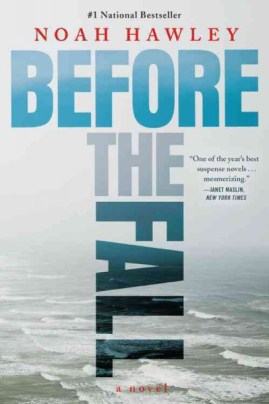
One of us couldn’t help but picture Larry King in the description of news anchor Bill Cunningham. She was also inspired by the references to Jack LaLanne[4] and his belief that anything is possible. We were all impressed by the author’s character development and some of us wanted to know more. We shared possibilities for the future of Scott and Eleanor, discussing the need for romance – or not.  And what about the title?  Although we agreed that we understood the significance of Before the Fall, since the author describes each character’s thoughts and actions leading up to the crash, we disagreed about the effectiveness of the title. One of us was certain that she wouldn’t remember the book if someone asked her if she had read it.  She wanted a more striking and relevant title.

Another member mentioned how confident and strong Scott was to stand up to Bill Cunningham in the end, and we decided that Scott had grown strong because he was needed.  He was needed to rescue the boy and, like the old saying, if you save a life you are responsible for that life (forever). This led to the question about whether the crash and its story were the result of fate or coincidence.  It could be either, with one of us concluding that man always looks for meaning rather than accept coincidence.

In general, we enjoyed the mystery and some were surprised by the ending. The discussion actually started even before the meeting, as members who visit the library stop to chat. The similarities to real-world events and references to other works, including our discussion, are now part of our shared experiences. We have gained empathy and insight.  Please join us!

  • Other works discussed:
  • Ape House (2010) by Sara Gruen
  • In the comments section, I have included the notes from CB, who couldn’t attend because she worked at a local voting site today.

[1] (March 23, 2017). Germanwings crash: Who was co-pilot Andreas Lubitz?.Available: [online] BBC.com. Available at: https://www.bbc.com/news/world-europe-32072220. [Accessed 18 Jun. 2018].

[2] Newman, M. and Hauser, C. (2007). Astronaut Charged With Attempted Murder. [online] Nytimes.com. Available at: https://www.nytimes.com/2007/02/06/us/06cnd-astronaut.html [Accessed 14 Jun. 2018].

[3] CBS News. (2018). “Hero” granted French citizenship after rescuing child dangling from 4th-floor balcony. [online] Available at: https://www.cbsnews.com/news/paris-toddler-rescued-balcony-hero-mamoudou-gassama-mali-migrant-spiderman/https://www.nytimes.com/2007/02/06/us/06cnd-astronaut.html [Accessed 14 Jun. 2018].

[4] “Known as the “godfather of fitness.” [online] Biography.com. Available at: https://www.biography.com/people/jack-lalanne-273648 [Accessed 14 Jun. 2018]

“In this age of fitness gurus, personal trainers, and exercise videos devoted specifically to achieving “buns of steel,” it is difficult to imagine a time without health clubs, when weight training and aerobic exercise were viewed by doctors as extreme and potentially dangerous activities. However, in 1936, when LaLanne opened the first fitness club in the United States, many considered him a kook and a fanatic. Though he was arguably a fanatic on the subject of health, his exercise show foreshadowed a national obsession with fitness, and LaLanne himself set many of the current trends by inventing the first weight machines and producing the first exercise video. LaLanne’s simple and accessible approach to exercise continued to gain wide popularity until and beyond his death, and his show is seen as a predecessor to nearly all fitness shows, from Wai Lana’s yoga program to Jillian Michaels’s The Biggest Loser.”                                                                      Jack LaLanne. (2013). In St. James Encyclopedia of Popular Culture. Detroit: Gale. Retrieved from http://link.galegroup.com.ezproxy.lvccld.org/apps/doc/K2419200678/BIC?u=lvccld_main&sid=BIC&xid=e27599ea


Year of Yes Discussion Journal

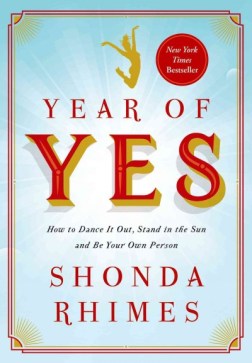
Year of Yes: How to Dance It Out, Stand In the Sun and Be Your Own Person by Shonda Rhimes was a different kind of book for our group. We do read non-fiction, but usually historical. We read Quiet: the power of introverts by Susan Cain. And Shonda Rhimes is a self-proclaimed introvert who fits Susan Cain’s perfectionist, hard-working profile for successful introverts. Yet what exactly is the book about and did we benefit?

Our first responder didn’t like the book. She found it boring and wouldn’t have finishedYearofYesCover it if she hadn’t been listening on audio.  Another really liked it, his face almost glowing. The chatter around the table was mixed. One member hadn’t liked it, although he agreed with some of her comments, and he wondered why we had read it.  We already know all this—why would we care? The author is still in the middle of her career, raising children, while the majority of our group is retired, presumably done with all that.
Well, I chose the book to give us something different to discuss. It’s good for us to think about the differences and similarities in the world—between races, between social classes, between generations. Shonda Rhimes is a successful African-American writer and speaker, a strong female and single mother by choice. She espouses some pretty old-fashioned ideas while embracing new ones.

Our biggest complaint was that she didn’t give us more. She was repetitive and although this can be a literary and educational technique, many of us wanted more details, not more yes, yes, yes. How did she get to Dartmouth, and into the USC film school? Scholarships? Why did she want to adopt? Why would anyone ask her to write a book on motherhood? She had nannies and seemed hardly to be home? She definitely seemed self-centered. We talked quite a bit about her television shows, especially Grey’s Anatomy. We liked that she had her character Christina acting out her own desires and challenges. One of us liked the concept of covering up problems with food and we were surprised that such a successful person had anxiety to the point that she lost memories.

We disagreed about whether this was a self-help book or a memoir. We talked about play and quality time and the magic of driving in a car with children. One of us referenced Men are from Mars and Women are from Venus, suggesting that men are more comfortable talking without looking and women prefer talking face to face. We also discussed the Wonder Woman pose Shonda Rhimes mentioned as a way to feel and act more powerful.  Is it real? Is it helpful? Or is it like the alcohol-removed red wine I served, effective only as a placebo?

So was Year of Yes a good book for our group? Those of us who come out for our meetings every month, reading a variety of books – even ones we don’t like—are already saying yes to a challenge, yes to socializing, yes to being part of something bigger. Like Shonda, even yes to saying no to chocolate cake, macaroni and cheese, and buttered popcorn! Practice makes perfect!

  • Other works discussed:
  • Landline (2014) by Rainbow Rowell
  • Men are from Mars, Women are from Venus (1992) by John Gray
  • Quiet: the power of introverts (2012) by Susan Cain
  • Round Midnight  (2017) by Laura McBride (possible future book club selection)
  • Grey’s Anatomy (television) 2005 – 2018
  • Scandal (television) 2012 – 2018
  • How to get away with murder (television) 2014 – 2018
  • Station 19 (television) 2018


The Martian Discussion Journal

Our first responder doesn’t like science fiction, but she liked The Martian by Andy Weir. She thought it read like an adventure story. Another member mentioned that most true science fiction is about make believe science but that this story is using existing possibilities.  We had some disagreement and talked about classic authors such as Jules Verne and Isaac Asimov.MartianTheCover

We wondered how reliable was the science in the story. A few of us skipped the details or slugged through the science, relieved when the narration added people. One of us had looked up information on the internet from Kahnacademy.org and the University of Texas and found that it worked out. Another of us stumbled on 25 pictures of Mars just two days before our meeting. Someone mentioned North Las Vegas company Bigelow Aerospace, which has developed an inflatable module for the International Space Station. We discussed Elon Musk and his plan for Mars, reminded of stories where the wealthy escape to the stars and leave the rest of us to rot on Earth.

Most of us did not believe the author dealt with the psychological impact of being alone on Mars, although one member liked the diary-style narrative. We discussed how access to 1970s television shows could have made the difference and how Mark’s attitude was the most important to his survival.  He was more like a pioneer than shipwrecked.  His dual skill as botanist and physicist was essential. None of the other crew members could have survived. And could Mark have survived if similarly lost in the Amazon? Some members thought only a man could have written this book and even believe only men appreciate duct tape. We had an entertaining disagreement then![i]

Only half of us had seen the movie, but we couldn’t help but discuss it also.  We found it to be a faithful adaptation. Since the movie did not include all of the adventures from the novel,  we stayed interested, even if we had seen the movie first. Though some of Mark’s ordeals seemed more harrowing in the book, one of us noted how unrealistically dramatic the ending for the movie had been.

We also discussed the cost of Mark’s rescue mission. Should we or would we spend the billions of dollars to rescue one individual? Was the scientific knowledge to be gained worth it? Wouldn’t it be great if we could get together internationally to solve world hunger or to educate adequately? Would we have devoted 1/2 hour on the news every night for years? Wouldn’t another disaster or war have redirected our attention? But then we remembered how people step up to give blood and search for the missing during disasters. We remembered the rescue of Baby Jessica. And one of us mentioned The Parable of the Lost Sheep (from the Gospels of Matthew and Luke) in which a shepherd will leave unguarded 99 to rescue just one sheep.

In the last six months, our group has read four adventure stories: The Wright Brothers, Dragon Teeth, The Lost City of the Monkey God, and now, The Martian. I didn’t plan it that way. My goal is for us to read a diverse range of books, balancing between male and female authors, but I am limited to books that are popular enough that we have over twenty copies available in our library district. Sometimes, I am drawn to similarities, stories and concepts that we can compare, just as these selections connect us from the 19th century into our quite possible future, life on Mars. Actually, these are connections that we can make in all of our readings, shared experiences that we will carry with us.  Next month, we will read about a strong, talented woman, Shonda Rhimes. I hope you can join us.

  • Other Works Discussed:
  • Isaac Asimov
  • Jules Verne
  • Endurance (2017) by Scott Kelley
  • 2001: A Space Odyssey (1968) by Arthur C. Clarke
  • Apollo 13 (DVD) 1995
  • Elysium (DVD)  2013 starring Matt Damon
  • The Martian (DVD) 2015 starring Matt Damon
  • David Baldacci  The Escape?
  • ‘Round Midnight by Laura McBride (local author’s new book)
  • In Sunlight or In Shadow (2016) edited by Lawrence Block, stories inspired by the paintings of Edward Hopper.

[i] As an interesting side note, Duck Tape was invented by a woman, Vesta Stoudt, during WWII.  https://www.kilmerhouse.com/2012/06/the-woman-who-invented-duct-tape . Also, there were five men and nine women at our meeting.

The Lost City of the Monkey God Discussion Journal

LostCityCoverThe Lost City of the Monkey God by Douglas Preston is a detailed description of a modern exploration of a Central American jungle, including advanced technology, archaeologists, ethnobiologists, writers, photographers, Honduran soldiers, and other adventurers. Douglas Preston wrote shorter journal articles about the same subject for the New Yorker Magazine and National Geographic in 2013 and 2015.
Since I found the book a little dry—engaging at times but full of names and details that got lost if I was reading before going to sleep—I was concerned about the reception by our book club members.  I shouldn’t have been worried.  We had a great turnout and most of us seemed fascinated by this tale of adventure and discovery in the twenty-first century. We couldn’t imagine being willing to take the risks involved in exploring the jungle. We had not considered the delivery of blankets, laden with viruses, as biological warfare, killing off an entire civilization.

I brought a National Geographic video documentary and wasted quite a bit of discussion time trying to locate the pictures of the dense jungle and Lidar equipment I wanted to share. The book talks about the filming of a documentary for the German financial backer Bill Benenson, but this documentary is a short, repetitive one by Steven Elkins. It lacked the excitement of Preston’s descriptions of sand flies and spiders and monkeys and Fer-de-lance snakes.

One member captured it best when she said she started reading, expecting an adventure tale, only to have it turn into a horror story about a predicted pandemic. We talked about the Zika virus, Lyme disease, third-world versus first-world diseases, pharmaceuticals, doctors, and more. We started to get into heated political debate about definitions and responsibilities until one of us got us back on track, talking about archaeology.

Our next book, The Martian by Andy Weir, will be an interesting comparison.  I hope you can join us.

  • Other works discussed:
  • Bury My Heart at Wounded Knee: An Indian History of the American West (1970) by Dee Brown
  • Dog Stars (2012) by Peter Heller
  • The Relic (1995) by Douglas Preston and Lincoln Child
  • Station Eleven (2014) by Emily St. John Mandel

The Secret Garden Discussion Journal

When we meet to discuss our monthly reading, we gather around four tables pushed together as one, in a small, plain room with vinyl flooring. Plastic blinds cloak a window that looks out into a covered and enclosed dirt and rock garden.  We start with twelve chairs but as more people arrive, we crowd together at corners and in-between spaces. We have had as many as 24, and as few as five, but generally we fill the table and then some, especially for classic reads like The Secret Garden. We nibble on trail mix, or cookies, or fruit, and if we are lucky, the book inspires me to find something for us to try, bringing our connection to the stories, and each other, to another level.

On Tuesday, ten of us ventured out on a drizzly day that saw the first rain in nearly four months fill gutters and flood streets—a slow, drenching rain that brought a chill to the Las Vegas Valley that is sorely needed. Perhaps serendipitous. Like the moors in Yorkshire, our desert is often considered harsh and bleak, but it is teaming with beauty and life if we take the time to look for it and care for it. In the story, nourishing rains heralded the start of Spring. January is, of course, early, even for the desert, but the natural ‘magic’ in the story is contagious!

According to publisher W.W.Norton & Company, “Frances Hodgson Burnett was the SecretGardenCoverhighest paid and most widely read woman writer of her time, publishing more than fifty novels and thirteen plays.”1 Yet, one-hundred years later, she is best known for a children’s novel that was first serialized in a “magazine for adults.”2 One of us commented that children’s books are read differently by people of different ages. Adults choose and publish the books that become children’s classics.  We discussed what makes a novel for children versus teens versus adults.

Our collective joy in reading this novel was in both the message and the vehicle. We enjoyed the descriptions of an earlier age and greener landscape, noting that the need to allow children to be children is even more pertinent today. We discussed how important it is for parents to, well, parent! The novel was easy to read. One of us heard of the meeting the day before and read it in one night. We are so bombarded by ugliness in our news, gruesome murder in our adult mystery novels, and sex in our romance, that it was just pleasant. Although we can enjoy complex language and the challenge of learning sophisticated words, we appreciated the simplicity of the vocabulary in the novel.

Our first responder commented on how much he enjoyed the Yorkshire language, which was a truly remarkable part of the story. Regional dialects are often considered uneducated, acknowledged in the story when Mrs. Medlock says of Dickon’s mother, “Sometimes I’ve said to her, ‘Eh! Susan, if you was a different woman an’ didn’t talk such broad Yorkshire I’ve seen the times when I should have said you were clever.’”3 Yet the author has Mary Lennox choose to learn Yorkshire in the same way she might learn French. “It’s like a native dialect in India. Very clever people try to learn them.”4 And Colin, as Lord of the manner, must learn to speak his native language. And those of us who listened to the audiobook recommended it.

I also recommended reading the short story, The Yellow Wallpaper, by Charlotte Perkins Gilman, which was published in 1892. Ultimately, Frances Hodgson Burnett was an astounding feminist, supporting herself and her family, divorcing two husbands, surviving bouts of depression and fatigue, as well as the loss of both of her sons. Although we only briefly discussed the Christian Science elements of Burnett’s novel, The Yellow Wallpaper addresses the more adult side and dangers of “the rest cure.”6

We discussed books and movies that reminded us of this one, the importance of positive thinking, the ‘magic’ of science; we discussed our frustrations with social media, common core math, and personal experiences. We thought Mary’s finding of the key was contrived and more for children. We dismissed the magic. We are ultimately quite jaded! I challenge us to revert more often to our inner child.  Before the crushing heat is upon us, get outdoors and see the beauty in our secret garden, filled with creosote, sage, mesquite, willows, hummingbirds, wildflowers, rabbits, and more.

  • Other works discussed:
  • Being There (1979 Film) with Peter Sellers (Jerzy Kosinski novel author)
  • Heidi (1880) by Johanna Spyri
  • LaRose (2016) Louise Erdrich
  • Never-ending Stories (Fractured Fairy Tale Series)
  • Pippi Longstocking (1945) by Astrid Lindgren
  • Pollyanna (1913) Eleanor H. Porter
  • Pygmalion (1913) by George Bernard Shaw
  • Rosemary & Thyme (2003-2008) British Television Series (AKA: Murder Most Floral)
  • The Secret (2006) by Rhonda Byrne
  • The Story of Doctor Doolittle (1920) by Hugh Lofting
  • Time Travel Adventures with exceptional Americans (2013 -2017) by Rush Limbaugh
  • The Yellow Wallpaper (1899) short story by Charlotte Perkins Gilman

Endnotes:

W.W. Norton & Company, Inc.  (http://books.wwnorton.com/books/webad.aspx?id=11896)

2 According to The Public Domain Review: “’With regard to The Secret Garden,’ Frances Hodgson Burnett wrote to her English publisher in October 1910, ‘do you realize that it is not a novel, but a childs [sic] story though it is gravely beginning life as an important illustrated serial in a magazine for adults. . . . It is an innocent thriller of a story to which grown ups listen spell bound to my keen delight.’” (https://publicdomainreview.org/2011/03/08/100-years-of-the-secret-garden/)

3 p. 179 The Secret Garden, Longmeadow Press edition, New York, 1987

4 p. 177 The Secret Garden, Longmeadow Press edition, New York, 1987

5 https://www.nlm.nih.gov/theliteratureofprescription/exhibitionAssets/digitalDocs/The-Yellow-Wall-Paper.pdf

6Looking back: Rewriting the rest cure in The Secret Garden” by Anne Stiles in The Psychologist, a journal of the British Psychological Society (https://thepsychologist.bps.org.uk/volume-26/edition-3/looking-back-rewriting-rest-cure-secret-garden)


LaRose Discussion Journal

LaRose is the second book by Louise Erdrich that we have read in the Whitney Book Bistro. The novel is particularly relevant to Native American History month because it presents a snapshot of blended families facing some of the same difficulties of peoples everywhere, including grief, loss, changing technology, stereotypes, politics and war. Erdrich offers a traditional Shakespearean Iago, but allows us to see how he was created. She shows us the power of tradition in the offering of LaRose, the power of magical realism to reveal truths felt if not seen, the power of pain and suffering, the power of connections. The blending and change of cultures is as inescapable as the changes wrought by technology, wrought by war, and even wrought by accident.LaRoseCover

Our first responder was a member who couldn’t attend the meeting but stopped by to pick up our next book. The novel had not hooked him, had too much detail – which he described using his hands as if he were painting a picture or weaving a tapestry, showing his appreciation if not his satisfaction.  I shared that it seemed disconnected, even rambling, and he agreed. The novel was difficult to get into, slow at first, then filled with characters and detail that would take more readings to fully appreciate.

Our discussion group turned out to be small, three of whom hadn’t finished the book. I didn’t get the feeling anyone was thrilled by it, although we agreed that the writing was beautiful, even if the story was bleak. One of us found none of the characters likeable. Another found Romeo’s resurrection after throwing himself down the church steps to be unbelievable. I found the affair between Emmaline and Father Travis to be too much, but another member had re-read the beginning of the book and realized the author had begun laying the groundwork for the affair early on, possibly even as another form of revenge. We laughed at the parents’ altercation during Maggie’s volleyball game.

One of us had made a connection to grief and the loss of a child in the 2017 film, Wind River, reading a transcript from the film:

“Bad news: You are never going to be whole – not ever again. You lost your daughter and nothing is going to replace that. Good News: As soon as you accept that and you let yourself suffer, you allow yourself to visit her in your mind and you’ll remember all the love she gave, all the joy she knew. You can’t steer from the pain.  If you do, you’ll rob yourself of every memory of her—every last one—from her first step to her last smile. Just take the pain. You take it. It’s the only way you’ll keep her with you.”  (Jeremy Renner as Cory Lambert)

Another member shared passages that stood out:

“Before they took LaRose to the Ravich house last fall, Landreaux and Emmaline had spoken his name. It was the name given to each LaRose. Mirage. Ombanitemagad. The original name of Mink’s daughter. That name would protect him from the unknown, from what had been let loose with the accident. Sometimes energy of this nature, chaos, ill luck, goes out in the world and begets and begets. All Indians know that. To stop it quickly takes great effort, which is why LaRose was sent.” (105)

This passage drew a connection to the other chaos let loose in the world after the murder, albeit in defense, of Mackinnon by LaRose’s ancestors:

“Mackinnon’s head, rolling laboriously over the snow, its hair on fire, brightly twitching, flames cheerfully flickering. Sometimes it banged into a tree and whimpered. Sometimes it propelled itself along with its tongue, its slight stump of a neck, or its comically paddling ears. Sometimes it whizzed along for a few feet, then quit, sobbing in frustration at its awkward, interminable progress.” (132)

We ended with a discussion of revenge and we were hard-pressed to find any value in it.  One member reminded us that a grudge damages most the person who holds it. Then we discussed LaRose’s eight-year-old fury against the fearsome four. It was endearing, and one of us made an important connection to closure. Our discourse was as disjointed and hard to follow as the book was for many of us.  As usual, we discussed more than I have captured here and we moved on, as we always must. Until we meet again, next month! Happy Thanksgiving.

  • Other works discussed:
  • Ceremony (1977) by Leslie Silko (discussed outside of the meeting)
  • Eagle Catcher (1995) Margaret Coel
  • Round House (2012) by Louise Erdrich
  • Sacred Clowns (1991) Tony Hillerman
  • Wind River (2017) Film starring Jeremy Renner
  • You Don’t Have to Say You Love Me (2017) memoir by Sherman Alexie (audiobook)

The Wright Brothers Discussion Journal

When we met to discuss David McCullough’s The Wright Brothers, our primary reaction was amazement that we knew so little about people whose names we know so well. We were in such agreement that our discussion seemed quiet, even awestruck. If we had any criticism about the book, it was that we wanted more — not about flight and airplanes but about the Wrights themselves, about men whose efforts and invention drew crowds of observers and dominated newspaper headlines of their day but who remained enigmatic even then.

Our discussion started out with a lot of statements, followed by questions.  How brave WrightBrothersCoverthey were—facing not only the dangers of flight but the ridicule of their vision. How focused they both were. Did we ever imagine them actually sewing the wings? How well researched the story is. The brothers’ letters were amazing.  One of us had imagined Kitty Hawk as a lovely field, not isolated and harsh. Look at the picture of their camp kitchen, rows of neat and orderly supplies, evidence of Orville’s likely obsessive compulsive disorder. Yet still we wanted more pictures and had to remember the era. We were amazed that they even had a camera and took their own pictures.  We debated whether or not they were risk-takers; and we decided they were, though not careless. We thought them self-motivated, stubborn and brave.

One of us thought it was nice to read about a functional family for once. We still wondered why the boys never married. Why are there no references to romance? We discussed the Edwardian values and the reality of sex and pregnancy in an era that did not yet have easy birth control. Another member reminded us that their sister Katharine was a school teacher and school teachers were often not allowed to marry. After the meeting, another member discussed the real threat of sexually transmitted diseases. We were happy that Katharine was given so much credit and treated as an equal by her family, though we were mystified by Orville’s rejection of her when she decided to marry.

When we discussed the similarities and differences between Orville and Wilbur, one of us believed that Orville was deferential to his older brother.  Another believed that Wilbur was so meticulous that had he been flying with Lieutenant Selfridge, the fatal accident would not have occurred. Orville was distrustful of Selfridge and probably allowed that to distract him. One of the discussion questions prompted us to consider whether or not the Wright brothers were heroic, so we discussed the meaning of the word. For most of us, heroic means not just courage and bravery but saving lives. At least one of us still felt that the brothers’ perseverance for an ideal that impacted so many lives was heroic.

In his youth, one of us had visited the Wright Brothers house and their bicycle shop, moved by Henry Ford from Dayton, Ohio, to Ford’s Dearborn, Michigan museum complex in 1936.[i] Although he remembered the experience fondly, he had not realized their significance until he had read the memoir. After the meeting, another member commented about how little we often know about famous people, citing early aviator Charles Lindbergh, who invented a medical device “to save his dying sister-in-law.”[ii]

Although I enjoy all of our discussions and the varying perspectives, discussing The Wright Brothers was particularly calming and uplifting. We agreed that the book was educational and easy to read. We discussed much more than I can capture here — and still less than we could have. If you haven’t already, I recommend you read the book and join the discussion!

  • Other Works Discussed:
  • The Wind Rises (2014) Film directed by legendary Japanese director Hayao Miyazaki: a beautifully animated  look at the life of Jiro Horikoshi, the man who designed Japanese fighter planes during World War II.
  • The Boys in the Boat: Nine Americans and Their Epic Quest for Gold at the 1936 Berlin Olympics  (2013) by Daniel James Brown (we compared and contrasted this with The Wright Brothers).
  • Circling the Sun (2015) by Paula McLain:  a fictionalized account of the life of early female aviator Beryl Markham.
  • You Don’t Have to Say You Love Me (2017) by Sherman Alexie (audiobook recommended by Kristine).
  • Mr. Penumbra’s 24-Hour Bookstore (2009) by Robin Sloan (recommended by Cheryl).

[i] Web accessed 9-13-2017:  https://www.thehenryford.org/collections-and-research/digital-collections/artifact/373441/

[ii] Web accessed 9-14-2017:  http://www.smithsonianmag.com/smithsonian-institution/save-his-dying-sister-law-charles-lindbergh-Invented-medical-device-180956526/

Digging to America Discussion Journal

Digging to America is the second book by Anne Tyler that our Whitney Book Bistro has discussed. Anne Tyler has published 22 novels, been nominated for a Pulitzer Prize three times and won for Breathing Lessons (1989). She is also the author of the book The Accidental Tourist, which was made into a popular movie in 1988, starring William Hurt, Kathleen Turner, and Geena Davis. I had not been overly impressed by her novel, Beginner’s Goodbye, discussed in March of 2013, but the members at that meeting had shown such reverence and sincerity that I have wanted to read another book by her. Favorite authors, directors, and actors often bring authority that allows us to view their work more favorably. Or perhaps we identify with themes and viewpoints that keep us coming back for more.

We didn’t discuss any of this at our meeting, but we had stories to share that kept our DiggingToAmericaCoverdiscussion flowing, even if we didn’t all find the book entirely engaging. Our first responder likes a wide variety of books and often appreciates our book selections. She really liked Digging to America – finding it easy to read, straightforward, pleasant. Another member had liked the book the first time she read it in 2006 and liked it still. Two others found it to be just okay, with too many stereotypes; and it didn’t go anywhere.
That’s all it took and we were off—thoughtfully—more like the tortoise than the hare. Some of us liked Bitsy but found her parenting atrocious and her meddling obnoxious. We discussed how easy it is as parents to become immersed in our children. Some of us found the binky-balloon scene hilarious, others were appalled and bored, but many of us agreed that pacifiers were a big deal for us when we raised our own children. We liked the fight scene between Brad and Sami, as well as Sami’s performance piece making fun of Americans. One of us thought Maryam needed therapy. Perhaps her aloofness was part of her wealthy upbringing. Perhaps it was simply introversion. Maybe both.

We discussed traditions and their meanings. One of us felt that America has no traditions, only celebrations. We are too divided and separated from our religion. A new member felt that we don’t share our stories enough to appreciate our heritage as Americans. One of us had been raised to say that she was second-generation American of Polish descent. Another remembered how his father wanted his son to be American and wouldn’t speak his native Italian. We talked about created traditions and one of us shared how she had once given her candy-deprived children a box of candy wrapped as a gift, including a warning that she didn’t want them to get anorexia. Next thing she knew, the “anorexia” gift became a tradition!

We discussed names and the difficulty of assimilation. Was Bitsy right in trying to help her daughter hold on to her Korean heritage—especially since her daughter seemed to reject it? Isn’t this what children do? Dave makes a great point when talking to Maryam about Susan’s disappointment at Christmas – part of being American is to be disappointed at Christmas! One of us mentioned the film Losing Isaiah and how the birth mother challenged the adoptive parents’ omission of black heritage. Is this less important for international adoptions? We talked about how immigrant communities stay together for security and one of us had for a while attended meetings of The Daughters of the British Empire, calling it a “scary group!”

As always, the discussion was more full and detailed than I can possibly capture. In this world of technical wonders, sometimes it’s all too easy to stay hidden, like Maryam in her house at the end of Digging to America. It reminds me of a story from All I Really Need To Know I Learned In Kindergarten. Children in a neighborhood are playing hide-n-seek. One of them hides so well that everyone is about to move on without him. Finally, all author Robert Fulghum can do is yell: “GET FOUND KID!” Thank you to all of you who found us and made our discussion so much more than a virtual reality.

  • Other works discussed:
  • All I Really Need To Know I Learned In Kindergarten (1988) by Robert Fulghum
  • The Big Sick (2017) Film
  • Fiddler on the Roof (1964) musical
  • Ladder of Years (1995) by Anne Tyler
  • Losing Isaiah (1995) Film
  • My Ántonia (1918) by Willa Cather
  • The Namesake (2003) by Jhumpa Lahiri
  • West Side Story (1957) musical

The Art of Fielding Discussion Journal

At the end of our meeting to discuss The Art of Fielding by Chad Harbach, I asked if I was correct in concluding that the majority of the group enjoyed the book. I had been told by a few individuals how much they liked it and our discussion had been lively, so I was surprised when I was met with less enthusiasm than I expected. In an unusual turn, one member shared that she had liked the book more before our discussion! Our first responder had also had an unusual reaction to the book, at first fully engaged and interested in the main character Henry, and then angry and uninterested in the new characters that were introduced.

She stayed with the book, though, and brought up some interesting starter questions. It reminded her of our previous selection, Boys in the Boat, and she wondered if anyone else thought that Henry had gone into a slump because he didn’t want to break his idol’s record. Others thought he didn’t want to leave school.

One of us asked why Pela was even in the story, finding her irritating. A couple of us had thought of her as the designated college slut, which made us wonder about the author’s view of women (probably not positive!). No one considered Henry’s relationship with Pela as love. Why was Owen’s mother in the story? Since the author wrote the book over ten years, perhaps he added characters over time (and unnecessarily)? Did Pela’s experience with depression help her help Henry? Why didn’t she get him to the hospital? Harpooners, heart and harlot? Did anyone else find the name of the team, Harpooners, funny? Was the sexual innuendo intentional?

What did we think of Guert? One of us thought that he was looking out for everyone –the college, his daughter, Owen, Henry, Schwarz. But was he a good father? Not to Pela.  He seemed to belong to everyone. To my surprise, we didn’t discuss Guert’s sexuality much. I had a problem with the 40-year age difference; the most outspoken of us seemed to think the problem was only in the student-administrator relationship.

And what about Owen? Why does Harbach never write from Owen’s point of view (publisher discussion question)? One of us thought it made Owen more mysterious, more sage-like, which fits with his nickname, Buddha. He also was more flamboyant, perhaps more caricaturish than necessary. Or perhaps he was more accepting of himself, the only one not questioning his future or his place in the world, just living it.

One member was interested in the idea of “monomania” as typical in sports and portrayed realistically in the book. He shared that it is common for catchers in baseball to be leaders, like Schwartz. Several people agreed – like the coxswain in The Boys in the Boat. “Catchers are the thinking position.”

We mentioned books, movies and songs. Even before the meeting started we had discussed how life is stranger than fiction. Our previous book club selection The Children Act is being played out in recent news reports about baby Charlie. We were spread out over two lengths of tables and sometimes several people were talking and not always being heard or understood.  One member made us all laugh when he said that he hadn’t finished the book, didn’t really like baseball, and the sex wasn’t good enough.

Thanks to all who came out into our extra summer humid heat – and shared the experience with us!

  • Other Works Discussed:
  • The Boys in the Boat: Nine Americans and Their Epic Quest for Gold at the 1936 Berlin Olympics (2013) by Daniel James Brown
  • Ladder of Years (1995) by Anne Tyler
  • Moneyball: The Art of Winning an Unfair Game (2003) by Michael Lewis
  • The Natural (1952) Bernard Malamud
  • The Phenomenon: Pressure, the Yips, and the Pitch that Changed My Life (2017) by Rick Ankiel
  • “Tired of Being Blonde” (1985) song performed by Carly Simon

Circling the Sun Discussion Journal

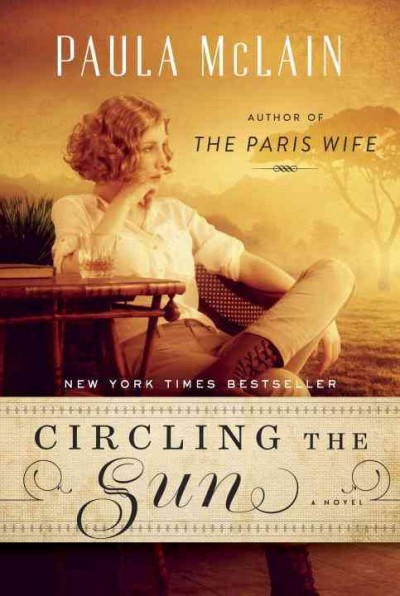
It has been a week now since we met to discuss Circling the Sun by Paula McLain. The delay in no way reflects the quality of our discussion, which was particularly full and detailed given our one-hour time limit and a group of nineteen! The novel is a fictionalized account of the early life of Beryl Markham, a record-breaking aviator and horse trainer who was a young contemporary of Isak Denisen, the author of Out of Africa.

Our first responders noted the writing even more than the story itself, perhaps particularly in comparison with last month’s 414-page selection, The Yiddish Policemen’s Union. Paula McLain’s story is “direct and straightforward,” “lyrical,” “easy to read.”  One of our toughest critics, a fan of author Ken Follett, said that it has been one of the first books we’ve read in a while that he has finished and the description of the horse race nearly brought him to tears. Another member loved the descriptions of the horse training. Yet another had not liked the book to start but had been won over by the end, particularly so when she realized it was based on the life of a real person.

One of us had been so impressed that she had read the author’s previous book, The Paris Wife, a novel about Hemingway’s first wife, as well as Beryl Markham’s own memoir, West with the Night— entirely during this last month.  Inspired by this enthusiasm, I read a selection from Markham’s memoir that described the time she was attacked by a domesticated lion. Markham’s description and perspective is so beautiful that I was even more impressed by McLain’s willingness to describe the same scene.

Even though we still had much to discuss about Beryl Markham’s life and character, and we agreed that she wasn’t always likeable, most of us were impressed. She had been abandoned by her mother and left by her father to be raised by the native tribe. One of us thought about the discussion question asking if Mr. Clutterbuck had been a good father, and we seemed to think he had not. But we discussed the times, the hardships, the roaring twenties, the joke: “Are you married or do you live in Kenya?”(p.129).

We discussed India’s ties to Africa, the title, and what made Denys so attractive, with his bald head and womanizing ways. I was surprised how few of us remembered the film Out of Africa and even more surprised how few of us thought Robert Redford fit the role. We put out a variety of names, and perhaps we just needed more time with that question!

Sometimes, the questions we raise during the meetings do need time to germinate. And sometimes, I know that people in the group may not speak up.   I was surprised recently when our movie club discussed La La Land.  The most outspoken members didn’t like the movie (including me).  I specifically mentioned that many people like this movie, it has won many awards, and I want to hear the other side. I mentioned this several times and little was said.  But afterward, in one-on-one discussions, people spoke up.

I believe many in our book club group have been together long enough to speak up, but if, on reflection, you have more to say, speak up now. Here. In this blog. Or to me at the library. It makes a difference!

Other works discussed:

  • Vanity Fair by W.M. Thackeray
  • See member recommendations for titles discussed during the Book Circle portion of the meeting