Last October, our group considered whether we thought the ethnicity of the writer mattered if the writing was well done. A visitor from Whitney’s Social Justice Book Club was adamant – she wants to see herself reflected in books and subtle understandings of culture and place make a difference in making this connection. She called out Octavia Butler’s novel Kindred, published in 1979 but recently adapted as a miniseries streaming on Hulu. Kindred is a powerful story using time travel as a device to explore how someone from our modern era would cope as a slave. At the October meeting, we also discussed how authors from marginalized groups often feel pigeon-holed, published only when writing about race, struggles, and stereotypical expectations.
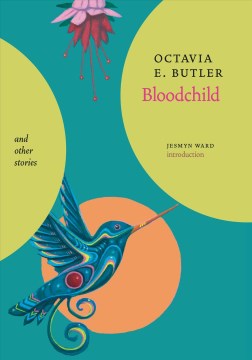
“In 1995, renowned author Octavia E. Butler became the first science-fiction writer, and one of the first Black women, to receive a MacArthur ‘Genius’ Fellowship grant.”[i] I wanted us to read some of her science-fiction stories, but I also know that most of our members are not science-fiction fans. Octavia Butler’s short story collection, Bloodchild & Other Stories (1995) contains a variety of stories, as well as two essays on writing. The title story, “Bloodchild,” was winner of several Best Novelette awards, including the 1984 Nebula Award, the 1985 Hugo Award, the 1985 Locus Award, and the 1985 Science Fiction Chronicle Award.[ii] Since the library had to order copies for us to be able to read these stories and we did not have Large Print copies available, I asked that members read at least two: “Bloodchild” and “The Book of Martha.”
Only eight of us came to the discussion and everyone agreed that the stories were well written and engaging, but most of us found them too dark, even horrifying. One of us, though, is now reading more of Octavia Butler’s work; and an email responder mentioned that she appreciated reading something different for a change. Our first responder explained that she considered the stories well written because they captivated her, she wasn’t bored, and the descriptions made her “see” the worlds being created; but she only found “Next of Kin” and “The Evening, the Morning, and the Night” to be even a little hopeful. She needs some hope and a happy ending. Another of us said she went home after our last meeting and read the first story – only to have nightmares! She appreciated the subtle twists in the stories and kernels of hope.
The stories were definitely thought-provoking. Dystopian. One member said, “the war happened and we lost.” Octavia Butler is famous now for being prescient[iii] and we reflected that these stories show humanity realistically, how we can and will persist. One of us called this a “tough assignment.” He reads a lot, but he never picks up science fiction. He liked the story “Next of Kin,” even though it was about incest, just because it was a recognizable world. No one mentioned the stories “Speech Sounds” and “Crossover.”[iv]
But what about the two stories we were challenged to read? “Bloodchild” was creepy! The author mentions in her afterword that the story is not about slavery, but we were not convinced. Humans are kept on a preserve, used for breeding, fed drugs, not allowed to keep guns, and kind handlers keep away the bad for this particular family. I wish I had asked, “What if the author had been White?” Would we have questioned if this was slavery or accepted it as our fate for landing on a strange planet? Why wasn’t it enough that she wrote it to deal with her fear of botflies and her desire to write a male pregnancy story?
“The Book of Martha” was more relatable. I asked if we considered it sacrilegious. One of us had to get past this version of God that is not her belief; but she could do it, just as she can suspend her disbelief in other stories. We discussed the challenge to making a change for the better that would outweigh negative consequences. And the benefits of negative consequences. We appreciated that God made suggestions but did not tell Martha what to do, which is addressing free will. Another member reads alternative histories and finds it fascinating to think that with just small changes, we would be living a different life. One of us mentioned the Doomsday Clock[v] and how scary things are out there.
I was reading science fiction and fantasy in the 1970s and 1980s. I loved Isaac Asimov, Anne McCaffrey, Ray Bradbury. I never heard of Octavia Butler until I began working at the library. I have now read this collection three times and I still marvel at the stories’ complex simplicity! I definitely recommend Kindred and hope to read more of Butler’s novels. So many books, so little time, is real.
We had some trouble keeping the stories straight and discussed how short stories seem to be more easily forgotten than novels. I asked if anyone could remember any of the stories from December 2023’s collection, The Angel of Rome, and only one of us grasped some details of the title story. So why do we read and discuss, especially things that are outside of our interests and inclinations? We actually didn’t discuss this. We mentioned power, fear of consequences, dinosaurs, cats, male pregnancy, kosher pickles, making the world a better place. Even when I re-read these journals, I often don’t remember the books. I remember how I feel – about books, stories, and the people with whom I share this connection. Until next time . . .
Word discussed: PERSIST
- OTHER WORKS DISCUSSED:
- The Good Place (2016) Television sitcom starring Ted Danson
- Alien (1979) Film
[i] National Women’s Hall of Fame. (n.d.). Octavia E. Butler. Women of the Hall. https://www.womenofthehall.org/inductee/octavia-e-butler-2/. Web accessed: 2-13-2025.
[ii] https://en.wikipedia.org/wiki/Bloodchild_and_Other_Stories
[iii] Just google her name – the interest in her and her humility and persistence are astounding. Here is one: “The Power and Prescience of Octavia Butler’s Parable of the Sower,” NPR recording posted October 8, 2024. https://www.npr.org/2024/10/08/1210938285/1a-10-08-2024
[iv] “Speech Sounds” won a Hugo for Best Short Story in 1984 (https://en.wikipedia.org/wiki/Bloodchild_and_Other_Stories) and “Crossover” was her first publication in 1971 (https://en.wikipedia.org/wiki/Octavia_E._Butler).
[v] “The Doomsday Clock is a design that warns the public about how close we are to destroying our world with dangerous technologies of our own making. It is a metaphor, a reminder of the perils we must address if we are to survive on the planet.” https://thebulletin.org/doomsday-clock/faq/



 WhitneyBookBistro