The Rosie Project Discussion Journal

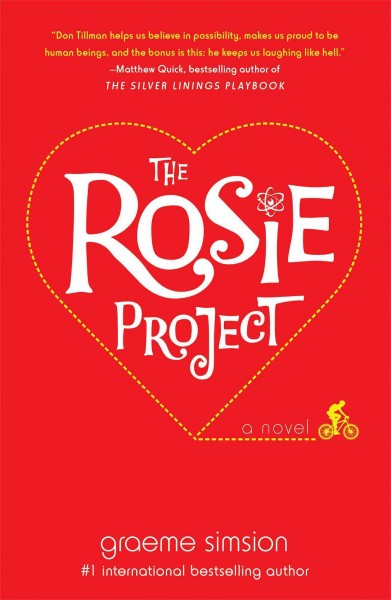
I’m pretty sure everyone liked The Rosie Project by Graeme Simsion. Some of us really liked the book. I suppose there is a spectrum of likeability. I hear and remember RosieProjectCovercomments. With fifteen smiling and reflective faces around the table, I make a judgment call and record it here. We didn’t take a survey.
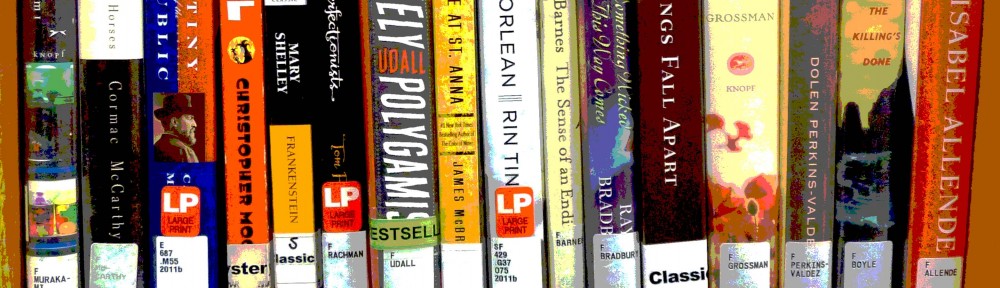
Perhaps our discussion seemed quieter because we were on the stage. Sounds were muted and the air had a foggy quality—diffused light from high ceilings and shadows behind thick dark curtains. When I mentioned we were meeting in the theater, one member had worried that our group had gotten so big we needed an auditorium!

When I asked for someone to offer the first response, quiet chatter reigned. Finally, one member drew our attention and our discussion began. She found the book to be utterly believable and lifelike. Another had never before heard of Asperger Syndrome. Yet another described his experience with an obviously much-loved brother.

We spent much of the hour discussing spectrum disorders. Not just autism, though mainly so. The autistic stage is universal. Autism was not identified until 1944. Do all people with Aspergers have a good memory? Most also have SID (Sensory Input Disorder). Early training and socialization make a difference. Why are so many more boys diagnosed with Autism? Some previously diagnosed schizophrenics are now found to have autism. And in the future it may be schizophrenia again. How do we really know? Is psychology a science?

Bill Gates. Vladamir Putin. Steve Jobs. Our family members, friends, maybe that obnoxious man or woman we try to avoid. And my favorite – Mr. Darcy.

Loveable to some of us, obnoxious to others, Don Tillman described communication issues that made us laugh out loud. One member said the book had been written as a play and polished over eight years. Even though the main characters were from Australia, it seemed very American. Those who listened to the audio book said that the reader sounded American.

We discussed a lot of other books and movies, although none of the same ones Don Tillman mentions. Several of us mentioned The Big Bang Theory television show and the ever-more culturally recognizable Sheldon. Now our group has Don Tillman. And we are part of an even larger group. As of today, Amazon had 6,873 reviews of The Rosie Project—4072 five-stars ratings and 2034 four-star ratings.

Working in a library, I’ve had people ask about the value of fiction. Is it just entertainment, escape, relaxation? Aren’t we any different now that we have read this book, alone and as a group? Do we view the world any differently? Are we less biased or more accepting? The Rosie project was an engaging, easy to read story. Although it’s main character is Gregory Peck-handsome and perhaps not truly as awkward and obnoxious as many people we encounter, the issues raised are pertinent and brought us together. We didn’t always agree, but we listened and shared, exercised our brains and our hearts.

  • Other works discussed:
  •  Big Bang Theory (television show)
  • Curious Incident of the Dog in the Nighttime by Mark Haddon
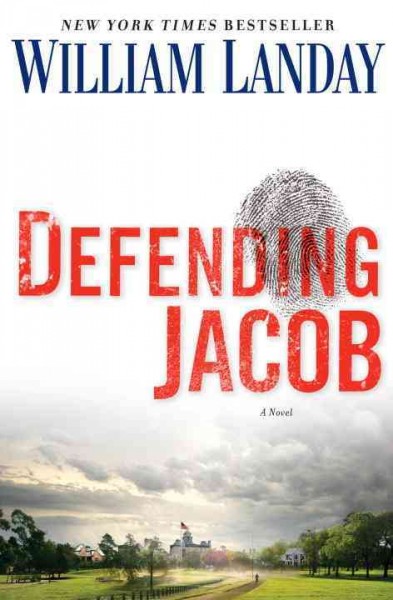
  • Defending Jacob by William Landay
  • House Rules by Jodi Piccoult
  • Pride and Prejudice by Jane Austen
  • Some very interesting read-a-likes — just ask at your local library!
Frankenstein Discussion Journal

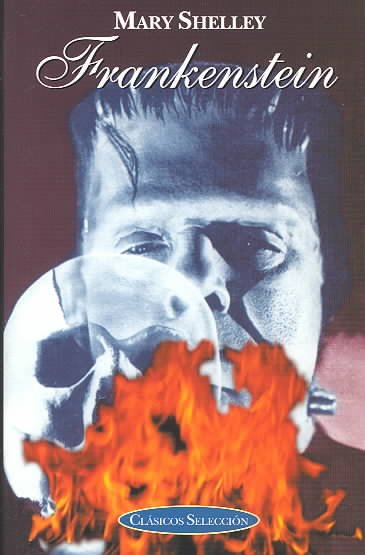
Frankenstein is what I consider a shared cultural icon. If we saw a squared head with boltsFrankensteinSpanish on the side, many of us, around the world, would think of Frankenstein. And many of us might even know pertinent details, having seen only snippets of the story in print, film, or costume. But would we know Frankenstein? And does it even matter?

Frankenstein by Mary Wollstonecraft Shelley was written and published nearly 200 years ago. Considered by many to be the first science fiction novel, the book is short, readable, often requested by students for reading assignments – and yet only five people out of the 20 at our discussion had read the story before it was selected for our book club. And were we surprised! Most of us agreed that the story was not at all what we had expected. Sad–yes–but so much more than horror, murder, and mayhem!

One member had read the annotated version, which included pictures of some of the handwritten pages and detailed information about the historical setting, style, and more. FrankensteinBookCoverSince the original story was published anonymously with an introduction by Shelley’s husband, many people had assumed the poet was the author – and he did contribute to the prose. Handwriting differences indicate his poetic influence on word choices and meanings. This member highly recommended the annotated version and was able to give us authoritative information to some of our questions.

We all agreed that Frankenstein is philosophical, filled with literary references, science, politics and religion. I had been particularly captivated by Shelley’s references to the discovery of the Americas and by such beautiful language as “inspirited by the wind of promise.” Another member wondered about Shelley’s knowledge of Judaism. Discussions of God figure prominently in the work. We wondered about the ornate language and the use of the epistolary form. Was Mary Shelley writing about her own search for parental validation through Frankenstein’s monster? Who has time or energy to philosophize like this any more? She was only 18 when she wrote the story, but for that time she was nearly middle-aged and had already lost a parent and one child. In addition, what was the moral, if Robert Walton only turned back because his crew insisted? Perhaps it has something to do with knowing when to cut your losses.

One of us even wondered whether Victor Frankenstein couldn’t have also been the monster – an intriguing suggestion that might solve some of the problems with the story. Victor Frankenstein wasn’t likable. He abandoned his family, not writing for months during his obsession. He made a big and dangerous monster. He fell into fits for months. He didn’t share his knowledge of the monster to help others. And he abandoned his orphaned brother. We all laughed when one member mentioned how Victor Frankenstein’s ramblings and musings (sigh!) seemed just to go on and on.

And of course, we discussed science. Several times we came back to the question of how Frankenstein could find so ugly something he created. Yet aren’t we still so blinded by possibilities that we don’t recognize the dangers until too late? Mary Shelley was kept indoors during the cold summer of 1816. No television. No video games. No internet. What a different world it might be . . .

Fortunately we do still get together and discuss philosophy and literature and life. Our discussion was full and self-sustaining. As always, not to be missed.

  • Other works discussed:
  • Dracula (1897) by Bram Stoker
  • On the Origin of Species (1859) Charles Darwin
  • “Yes, Frankenstein really was written by Mary Shelley. It’s obvious – because the book is so bad.” article by Germaine Greer (The Guardian. April 12, 2007)

Twenty Miles From A Match Discussion Journal

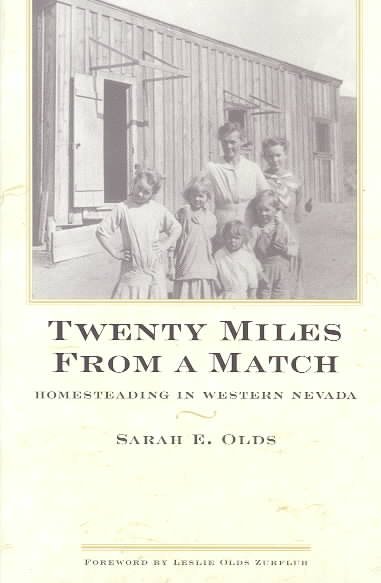
Creating shared experiences through books is my primary objective for our book club. Reading can be pleasurable, educational, and more! But in a large community, especially TwentyMilesFromAMatchone populated from around the world, it can bring us all a little bit closer, give us a reason to get together, help us understand each other, make us all insiders — privy to a history and legacy that is much more than the “Sin City” outsiders see. Participating in this year’s Nevada Reads: First All State Community Group Read is exactly the kind of experience I feel privileged to share.

We had over 20 library patrons and eight staff members read Twenty Miles From a Match by Sarah E. Olds. Staff members shared (and continue to share!) their thoughts — often with a smile or laugh. One staff member was particularly taken by Sarah Olds’ “great determination.” She was impressed by how “a positive attitude goes a long way in making our lives happier and contented.” Another was more unbelieving that the tall tales were actually true!

At our meeting, we had the same mix of awe and incredulity: Pollyanna, Eyeopener, Superwoman! Several members commented that they like their “city life” and couldn’t imagine choosing to head out into the desert wilderness. This was pioneering, not just homesteading! One felt that the book was “like a window into another world.” Another loved the silence in the story. Our world today — with television and internet — is always demanding our attention. He said that the book “hit me and gave me a sense of loss.”

We discussed our own experiences.  One member grew up in rural Hawaii, laughingly sharing with us how the word macadamized seemed made for the macadamia nut shells they used to cover roads. We all seemed to be struck by the sense of community. Thirty-five miles from Reno and twenty miles from a match, Sarah Olds’ family seemed more a part of a community than we are with neighbors ten feet away. Another member had taken her children in the 1970s to rural North Dakota to escape city life — a fabulous experience but hard. Bad things can happen anywhere.

Which brought us back to the importance of that positive attitude. That horse that never died! A one room school — basically in your own house! Can you imagine dancing all night long? We thought longingly over these possibilities. I asked about the feminism in the book and many seemed to think women had it easier in the West.  Sarah Olds was accepting of the prostitutes as a business, even if she didn’t want associate with them. A few of us wondered about A.J. He seemed certainly a crotchety old man, who just kept living despite being seriously ill! But he made sure everything was in her name before he died. One member felt that songs and hymns seemed to keep Sarah’s spirits up throughout. She was the quintessential supermom. One staff member shared the quote: “Mama, you can think the queerest things are fun! My back aches, my eyes are full of dirt, and my fingers are sore. I intend to stay with this job till it’s finished, but it isn’t a bit of fun!”

We spent a lot of time discussing fiction versus nonfiction. How can we know what is true or not?! How true is any memory? Any memoir? We agreed that the story was easy to read. Sarah Olds had a great voice. She was a natural storyteller. There were no literary pretensions. We decided that she was writing oral history. We discussed the differenceI was surprised to learn than none of the members present had read Laura Ingalls Wilder’s books. I was a huge fan and even though her books are marketed as fiction, the people, places and stories are seemingly as real to me as those of Sarah Olds — if not more so because she has a museum with pictures and artifacts.

I cannot emphasize enough how important sharing our history can be. In a scrapbook, in a journal, in short written anecdotes. At one of my first book club meetings a member TwentyMilesMtgDec2014mentioned that she didn’t think her grandchildren would care about her stories. Maybe not now, but in twenty years. . . Whose stories will we be reading in another fifty years?

We never reviewed any of the book discussion guide questions. Time flies — and in my memory, it was wonderful. I still haven’t covered everything. As always, the discussion can continue here, or wherever we meet someone who shared this experience. It matters!

  • Other works discussed:
  • Works by Willa Cather
  • David Copperfield by Charles Dickens (book and dvd)
  • Death Valley Junction : the story of the Amargosa Opera House by Marta Becket.
  • Gold Camp Drifter, 1906 – 1910 by Emmet L. Arnold
  • Friendly Fallout 1953 by Ann Ronald.
  • Lazy B : growing up on a cattle ranch in the American Southwest by Sandra Day O’Connor
  • Little House books by Laura Ingalls Wilder
  • Little house in the Ozarks : the rediscovered writings by Laura Ingalls Wilder ; edited by Stephen W. Hines.
  • Martha and the Doctor : a frontier family in central Nevada by Marvin Lewis ; edited by B. Betty Lewis.
  • “Portraits of an Antique West” by William J. Shepperson. Nevada Historical Society Quarterly Fall 1980. web accessed 12-4-2014 nsla.nevadaculture.org

The Language of Flowers Discussion Journal

I chose The Language of Flowers by Vanessa Diffenbaugh because it covered a serious topic, aging out of foster care, and included an engaging subtopic, the language of flowers. In addition, over 3,000 Amazon reviewers had given the book 4.5 stars out of 5. Potentially, something for everyone.LanguageOfFlowersCover

The first responders could not identify with the main character. The overwhelming majority seemed to be unable to sympathize with Victoria’s abandonment of her baby, of her refusing assistance. The story was romanticized and unrealistic. And yet, didn’t that make it readable? Some members shared personal experiences. Others wondered how a professional midwife could not have known that Victoria needed more assistance and helped her with the constant nursing. One new member wanted to know more about Meredith, the social worker. Another felt that Meredith had set Victoria up for failure as she warned each family how difficult she was. We discussed mental illness and drug addiction. Even though the author has experience with foster children, we didn’t feel the book gave us a good picture of the foster system. So what was the point? We didn’t really get there.

One of the discussion questions asked us to define what makes a family. Catherine and Elizabeth were related, but were they family? As I listened and watched the discussion, about families now including all manner of support systems, not just blood relations, I couldn’t help but think about communities as families. Work families, library families, book club families. All needing support in different ways. All communicating in different ways. It makes me think of a story in Robert Fulghum’s All I need to know I learned in Kindergarten about a kid who plays hide-‘n-seek too well — “Get found kid!”

The room seemed filled to the brim with familiar and new faces, attentive and engaged. Although I know that everyone did not speak, the discussion moved between members and no one seemed to dominate. A large group has both the potential to bring in a lot of viewpoints and to make it more difficult for some to speak out. After the meeting, one member shared that she really liked the book. Another commented on learning about the Camellia Network, co-founded by Vanessa Diffenbaugh, “a support net(work) for youth aging out of foster care” (https://camellianetwork.org/). I wonder now, looking back, if we shouldn’t have broken into smaller groups. It’s a work in progress!

  • Other works discussed:
  • Call the Midwife by Jennifer Worth
  • White Oleander by Janet Fitch


The No. 1 Ladies’ Detective Agency Discussion Journal

I chose The No. 1 Ladies’ Detective Agency for July because I knew that the series is No1LadiesDetectiveAgencyCoverincredibly popular, funny yet substantive, and I hoped its ease would make good summer/vacation reading. The ready availability of many books, including sound recordings, is also a big plus for our book club!

Since I heard Alexander McCall Smith speak at the American Library Association conference here in Las Vegas, I was ready to show some YouTube clips of his comedic routines, a YouTube sample of Botswana pumpkin cooking, and the sweeping shots of Botwana shown at the start of the HBO television series adapted from the book. We had cookies and bush tea (red rooibos from South Africa).

Then we had some technical difficulties. W-fi, plugs, connections, laptop, i-pad, dvd, television. In hindsight it is rather funny to think of taking a seemingly simple story, people who have chosen to take time reading and coming out to discuss a book, and then throwing in technical media! It all worked out in the end, but not necessarily as planned!

I had anticipated enthusiastic, devoted readers and some skeptical newcomers. What we had was a rather quiet group. Those who had re-read the book found it appealing again. Others seemed to like it as well. Since none of us have been to Africa, we couldn’t truly judge its reality.

Before the meeting, one member commented that he found the narrator to be unreliable, since he knew that it was a white male writing about a black female detective. In general, since the author was raised in Africa, we accepted his narration. We discussed the accuracy of the dialogue. I was enamored of the author’s language and read several sentences that I had highlighted throughout. I also mentioned his use of many archaic words I appreciated. We discussed HIV and how it is not spoken of directly. About how positive a view this is of Botswana. We noted that the book is more like a collection of short stories than a novel, and how the author himself says he is afflicted with “serial novelism.”

Every member spoke and brought out interesting aspects prompted by the discussion questions and on their own. As we wondered about Mma Ramotswe’s youthful acceptance of her abusive husband, one member mentioned reading Of Human Bondage. Another compared the opening lines of Isak Dinesen’s Out of Africa with the opening lines “Mma Ramotswe had a detective agency in Africa, at the foot of Kgale Hill.” I marvel at the common association we all now share.

As always, if there is something I have missed or something you’ve thought of that you would like to add or share, make a comment!

  • Other works discussed:
  • Of Human Bondage by Somerset Maugham
  • Out of Africa by Isak Dinesen

Wicked: the life and times of the wicked witch of the West Discussion Journal

Wicked was published in 1995 and over the years several people have told me I just “had” to read it. The musical has a great soundtrack and a happy ending, so the book seemed like a good pick for our group. And it was. Although not in the way I had anticipated!WickedBookCover

I struggled reading it, at least for the first half. Little seemed familiar to me—the descriptions were coarse and sexual, and the gnarly baby teeth gave me serious nightmares. I could tell that it was heavy with symbolism, religious and political innuendo, and much that seemed to pass directly over my head. I struggled to keep names and locations straight, and nearly panicked at the thought of my book club members’ responses!

Of course, I shouldn’t have worried. Although I wasn’t alone in my struggles, most members had tried to finish it. Some had read it before, liked it, and wondered why it was more difficult this time. Another still considered it one of her favorite books and had found even more to savor at this reading. Reading it for the first time, one member was ready to start on the second book in the series, although he had been disappointed in the ending.

Most of us were not surprised that the Witch was not as evil as she was portrayed in the Wizard of Oz. We discussed whether any fairy tales are intended only for children and what could be found with deeper analysis. Our last two books dealt with the nature of evil and I can’t help but wonder how much of our understanding and tolerance is because we are a well-read group. Does this transfer to our understanding in real life? How could it not?

On several occasions the room was quiet with thought. Several members agreed that the use of Animals vs. animals as a theme was not just a statement for animal rights, but for the rights of all societal outsiders – and Elphaba is the ultimate outsider. We disagreed whether Elphaba would ever really add wings to monkeys. The author was working with popular source material and he stays true to things not assumed, although more is inferred than we might otherwise imagine! The opening prologue served not just to set the stage, letting us know that the story would eventually lead to a known world, but showed us how people use gossip to help them understand their world, explaining things that don’t make sense.

We were surprised that Frank L. Baum’s classic was first published in 1900 as America’s first original fairy tale. We did not discuss the nature of science fiction and fantasy and how it serves to point out moral truths, creating a recognizable world that is still separate enough to keep our defenses down and penetrable. I am glad I read Wicked, and like others in the group, I would like to know how the story is continued. One member who has read more of Gregory Maguire’s books said that this was his heaviest. Perhaps one day . . . .

  • Other works discussed:
  • Defending Jacob by William Landay
  • Round House by Louise Erdrich
  • The Wonderful Wizard of Oz by Frank L. Baum
  • The Wizard of Oz (DVD)
  • Oz the Great and Powerful (DVD)
  • Mary Poppins by P.L. Travers
  • Saving Mr. Banks (DVD)
  • Fairy Tales and Nursery Rhymes
  • Other Gregory Maguire books


Round House Discussion Journal

RoundHouseCoverRound House by Louise Erdrich was easy to read.  That was the last question I asked, and the consensus seemed to be positive, even if not everyone liked the book. One member was incredulous that thirteen year olds could be so mature.  We started the meeting discussing the age of the narrator, drinking, driving, and sex. We wondered if this was something distinctive to Native Americans, but some of us remembered our own early teen years while another wondered if this freedom isn’t common in white families with two parents working.  Our own experiences growing up—rural, urban, protected, wealthy, poor, free—have a profound impact on our reading and acceptance of a story, and this was clearly evident in a thoughtful discussion in which members referred to each other’s comments with respect and consideration.

One member felt that the tragedy of alcoholism and hopelessness on reservations was treated too lightly in the book. He referenced a recent article in the Review Journal about increases in suicides among Native Americans. Everyone understood that the author’s main concern in writing the book had been Indian law and jurisdictional issues – especially concerning violence against Native American women. We spent a good amount of time discussing respect and violence – how Americans seem to admire rudeness and be obsessed with crime, about the impact of violent video games and the value of positive role models.

Growing up, seeing our parents suddenly as old and flawed, facing Wiindigoos, spirituality and belonging: so many themes and characters that some of us found the book a bit hard to keep straight. One of us said that reading about the camaraderie made her wish she had been a boy growing up! We all agreed that Cappy was a true friend and felt the sorrow of his loss. We could have kept discussing. In many ways, we only touched the surface.

As I read Round House, I could not help but see connections to many other books I have read, in and out of the Book Bistro. The impact of reading on my understanding of the world around me and the variety of people I meet and serve in the library is profound and one of the most valuable, even when I read strictly for pleasure and when a book seems forgotten as soon as put down. I handed out a list of the many books long-time members may have read over the last several years and I encourage all readers to take an opportunity to stop and think about what they have read—as an exercise for the brain as well as because what we read has become a part of us, good and bad, and this shared community experience brings us all closer together.

  • Other Works Discussed:
  • The Absolutely True Diary of a Part-time Indian by Sherman Alexie
  • Jeremiah Johnson (DVD)1972; Robert Redford; Sydney Pollack (Director)
  • Stand and Deliver (DVD) 1988; Edward James Olmos
  • Stand by Me (DVD) 1986; River Phoenix (based on the short story “The Body” by Stephen King)
  • This Is How You Lose Her by Junot Diaz
  • To Kill a Mockingbird by Harper Lee

Defending Jacob Discussion Journal

As we gathered to discuss Defending Jacob, the room was filled with chattering and DefendingJacobCoverenergy.  Several members noted that the book had been easy to read and kept them engaged. One new member said she was glad she read the book, but she couldn’t say she liked it.  Another was impressed by the realistic picture of our justice system. Yet another felt the book was full of holes and too much foreshadowing. One new member was disappointed by the ending, even angry. Perhaps, like the parents in the story, she had wanted the twist to be exoneration.

Does a murder gene exist? Which plays a larger roll in determining behavior, genetics or environment? We were mixed in our opinions. We asked: What does the author intended for us to get from his novel? Why does it matter? This is fiction, a novel, something to be read for pleasure. True. But many of us want more and our book club challenges us like a lateral thinking puzzle.

We discussed the reliability of the narrator, especially a character who had the “murder gene.” One member suggested that the Grand Jury interview sections were imagined rather than real. Another wondered about the mother—we only heard her side of the story through the narrator. Some felt that the mother’s actions in the end were admirable; others considered her insane. We had several conversations going on at once and the enthusiasm was palpable.

The biggest surprise, though, was when one member mentioned that our discussion had actually made her dislike the book! Quite the opposite of the usual response! Books, like people, are full of surprises.  Our book club keeps us guessing!  Our next book, Round House by Louise Erdrich, is a National Book Award winner.  Give it, and us, a try and join the discussion!

  • Other works discussed:
  • The Sociopath Next Door by Martha Stout
  • The Sopranos (Television Series)

Pride and Prejudice Discussion Journal

Pride and Prejudice Discussion Journal

I was surprisingly nervous going in to our discussion about Pride and Prejudice by Jane PrideAndPrejudiceFlyer2014Austen.  Her books have been so widely read – loved and hated!  Made in to movies. Adapted. Imagine Pride and Prejudice and Zombies by Seth Grahame-Smith. She was the favorite author of my English Novel professor in college.  Sir Walter Scott’s quotes make him seem smitten. Twainquotes.com shares many negative comments, ending in this excerpt from a letter written by Mark Twain in 1898, “Everytime I read ‘Pride and Prejudice’ I want to dig her up and beat her over the skull with her own shin-bone.” I just can’t get past, “Everytime I read . . .”!

Fortunately, several members had either never before read Jane Austen, or had read Pride and Prejudice in school and no long remembered it – perhaps even forgot it because it was required reading! Many of us asked, why is this considered great literature? Or, it was laborious to read, how in the world do high school students get through it?

I am not sure that Jane Austen’s works are considered great literature. One of the library’s Great Courses DVD sets, Classic Novels: Meeting the Challenge of Great Literature, does not include any of her books. We discussed the importance of considering the time the book was written, a period of great social change. The American Revolution. The French Revolution. Not a political book, but definitely a social one. A book of manners, behaviors, and opinions about the time during which it was written.  It is not an historical novel, but it gives us a glimpse of history. One member pointed out that we cannot be sure that the words pride and prejudice even had the same meaning to the author as they have to us!

We discussed whether or not technology, such as washing machines, has decreased the need for men to find a wife. How men can now stay home and care for the household. About arranged marriages and the role of Internet dating. About the time spent walking. And walking. And walking. To town. Through gardens and around the estate grounds. About the quiet – compared to teenagers walking in malls or meeting for coffee (and a donut!). About lust versus love. How great a role did the wealth of Mr. Darcy really play in Elizabeth’s sudden change of heart? Jane Austen was only 21 when she first wrote this story, how did that influence her characterizations? Why is Pride and Prejudice the most popular of Jane Austen’s novels?

One member asked about the name Jane.  Why did Jane Austen use it in her novel? Did she identify with that character? Although I imagine this question has been asked and researched somewhere, we were stumped. I think the consensus was that it must have been a common name. Yet, I have come back to that question again and again. Although I had always assumed that Jane Austen identified with the spunky character of Elizabeth Bennet, the one character who showed the least pride and prejudice was Jane Bennet. Names are always important. As are the questions. Thanks for joining the discussion.

  • Other Works Discussed:
  • Sense and Sensibility by Jane Austen
  • Emma by Jane Austen
  • Northanger Abbey by Jane Austen
  • Great Expectations by Charles Dickens
  • Wuthering Heights by Charlotte Bronte
  • Classic Novels: Meeting the Challenge of Great Literature (Great Courses DVD) by Arnold L. Weinstein
  • Pride and Prejudice (DVD BBC mini-series) Colin Firth
  • Multiple other film versions of Jane Austen’s works

Destiny of the Republic Discussion Journal

From George Washington to Barrack Obama, forty-four men have served as president of the United States. Some names we recognize as founding fathers, others because DestinyOfTheRepublicCoverwe associate them with wars, the Great Depression, our hometowns, current events. None of us at the meeting knew much about President Garfield before reading Candice Millard’s book, Destiny of the Republic: a Tale of Madness, Medicine, and the Murder of a President. I barely remembered that he had been assassinated, let alone that he served less than six months before being shot and then lived for nearly three months before succumbing to an infection. We liked the book, found it easy to read and were impressed by President Garfield’s character and constitution. Although I found the depiction of President Garfield almost too saintly, we accepted the book’s accuracy because it has been well-reviewed and includes copious notes.

We started the discussion with an absent member’s suggestion that medicine hasn’t really changed much – hospital workers still often don’t wash their hands enough and many don’t get flu shots. Although some of us felt that we are so much more advanced now that we couldn’t agree, we also couldn’t help but think of the recent re-used needle scandal that convicted Dr. Dipak Desai; and of the mother and newborns that died of undiagnosed tuberculosis this last month. Our incredulity that Doctor Bliss’ authority could go unchallenged was tempered by our discussion – not only is truth stranger than fiction, but it is always easier to see the truth in hindsight. I was reminded of the member who told us about penicillin toothpaste.

We briefly discussed the changes in the approachability of the president, the politics of patronage, the change in Chester Arthur, the love story between Garfield and his wife, and the insanity of his assassin. We did not actually use the entire hour for the discussion. The book had little that was controversial but much that was new to us, and the discussion was thoughtful and considered, as is the written review another absent member gave me to share, and I will post it as a comment below. Destiny of the Republic is a book about President James Garfield, but also about the country, moving from war toward a new millennium. I was particularly moved by individual contributions – Julia Sand, who wrote to vice president Arthur and inspired him to rise to the challenge of the presidency, and all the individuals who lined the tracks of Garfield’s train as he traveled to the sea, finally pushing the train up the last hill to his cottage. Individual contributions and shared community experiences make a difference!

  • Other works discussed:
  • Devil in the White City by Erik Larson
  • Jerry Silverman’s Folk Song Encyclopedia v. 1 (includes a song about Charles Guiteau)
  • American President (PBS Series – DVD)